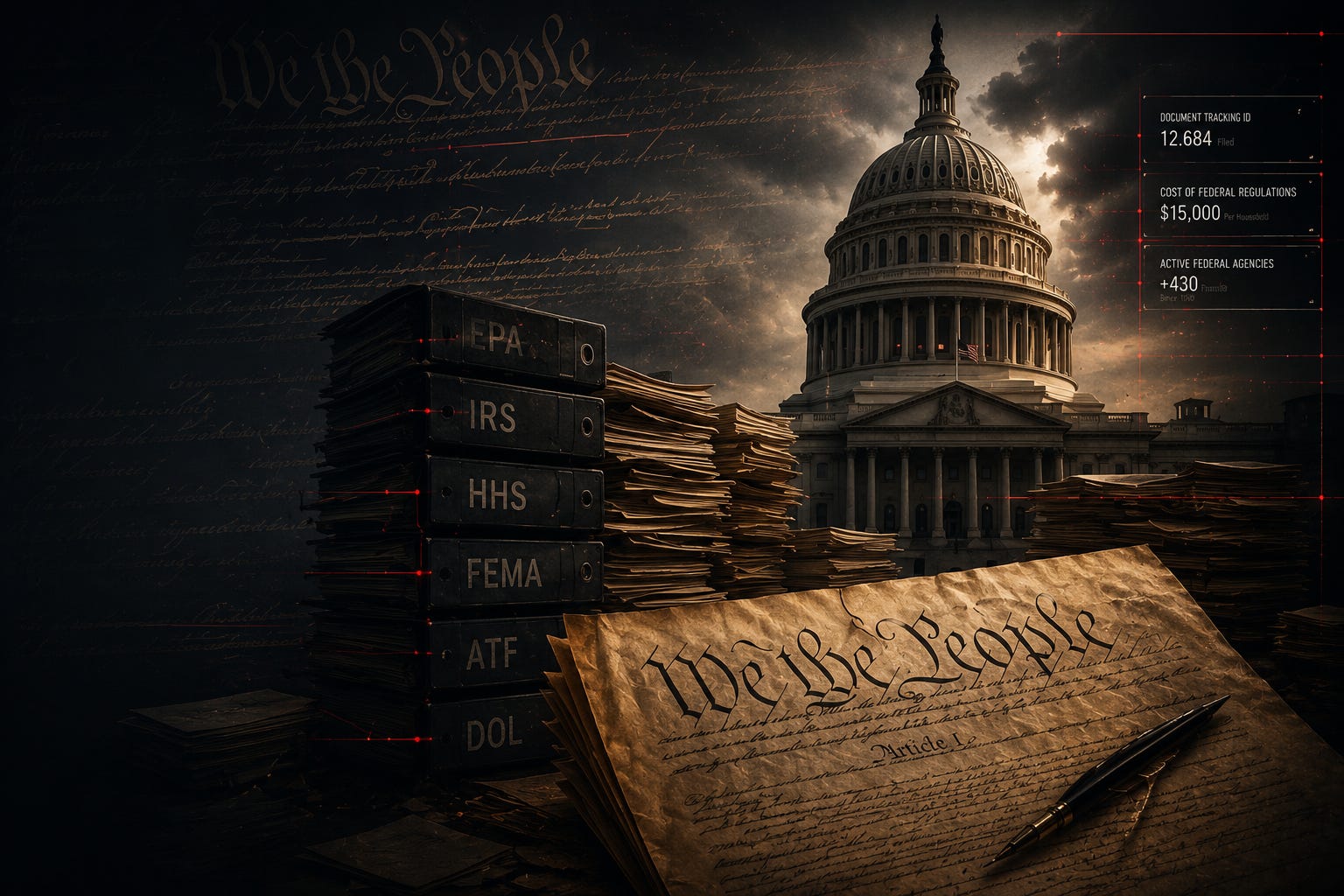


Does the government work for us, or do we work for the government? We pay its taxes, obey its laws and regulations, finance its wars and submit to its surveillance. We are told that all of this is necessary for personal safety, collective prosperity and national security. Yet the government has become totalitarian while individuals have become powerless.
The very institution established to protect our natural rights has become our greatest threat.
This did not happen through a coup. There was no single moment when the republic was suspended. It happened through accumulation: statutes layered on statutes, agencies stacked on agencies, emergencies declared and never rescinded. Each expansion arrived with a justification, a threat, a promise of temporary necessity. The temporary became permanent. The exception became the operating system. Strip away the narratives, the procedural noise, the manufactured fog, and what remains is a simple arrangement. The government takes. The citizen complies. The Constitution sits in a display case while the machinery runs on something else entirely.
Surveillance Without Suspicion
The Fourth Amendment protects the right to privacy by prohibiting unreasonable searches and seizures and requiring judicial warrants supported by probable cause. Yet the National Security Agency has developed a surveillance apparatus capable of intercepting and examining all electronic communications traveling through the fiber-optic cables that carry the world’s internet traffic.
The NSA literally captures every keystroke and telephonic conversation of every person in America. It subjects Americans who are suspected of absolutely nothing to continuous surveillance. The distinction between collecting information first and examining it later offers little comfort to someone whose private life has become government property. A warehouse does not need to be opened to be a violation. The seizure happens at the point of collection. Everything after that is inventory management.
Understand what this reverses. The Fourth Amendment was written by men who had lived under general warrants, documents that authorized agents of the crown to search anyone, anywhere, on nothing more than official discretion. The amendment exists specifically to forbid that arrangement. Suspicion must come first. A judge must review it. The warrant must name the place and the thing. Bulk collection inverts every step of that sequence. Everyone is collected. Suspicion, if it ever arrives, arrives afterward, applied retroactively to data already seized. The protection becomes a formality performed on material the government already owns.
Privacy is not a privilege granted by government. It is a natural right protected by the Constitution. The burden belongs to government to establish probable cause before invading the privacy of an individual, not to its victims to demonstrate afterward why they deserved privacy before the government stole it. When officials say “if you have nothing to hide, you have nothing to fear,” they are confessing the inversion. They are telling you that innocence is now something you prove to them, using records they took without asking.
And the loss of privacy produces fear. People who believe their conversations, correspondence, internet searches, medical, legal and banking records, and political associations are being monitored become less willing to be candid. They hesitate before criticizing or challenging government officials, or associating with controversial organizations. They begin self-censorship.
This is how surveillance destroys freedom without ever having to prosecute anyone. No trial is required. No martyr is created. No headline announces the loss. The journalist softens the sentence before writing it. The organizer skips the meeting. The citizen types the question into the search bar, pauses, and deletes it. Multiply that pause across three hundred million people and you have a governed population that polices itself at no cost to the state. It is the most efficient censorship machine ever built, because the censor lives inside the censored.
Speech Under Threat
Freedom of speech is the linchpin of all other freedoms. Without it, there can be no meaningful political opposition, no effective accountability, no public exposure of corruption and no peaceful means of challenging government abuses. Every other right depends on the ability to say, publicly and without penalty, that the right has been violated. Remove speech and the remaining rights become decorations. You cannot defend what you are forbidden to discuss.
George Washington warned that if men were prevented from expressing their opinions, reason would become useless and, “dumb and silent, we may be led, like sheep, to the slaughter.” Yet the government deports lawful U.S. residents and threatens American college students because it hates and fears their speech.
Note the mechanism. The government rarely says it is punishing speech. It says it is enforcing immigration status, reviewing visa conditions, investigating material support, assessing campus compliance. The label changes; the target does not. A resident who wrote the wrong op-ed discovers a paperwork problem. A student who attended the wrong protest discovers a security review. The punishment arrives dressed as administration. This is deliberate. Prosecuting speech openly would force a constitutional fight the government might lose. Processing people through discretionary bureaucratic channels achieves the same silence while keeping the First Amendment out of the courtroom.
The message is not aimed at the individual being processed. It is aimed at everyone watching. One visa revoked, one residency questioned, one student investigated broadcasts a price list to millions. The calculation happens quietly in every head that receives it: is this opinion worth my status, my enrollment, my career? That is the intended output. Not one silenced dissident, but a nation of people who have priced their own candor and found it too expensive.
Criminal Law as a Weapon
Congress has enacted over 5,000 criminal laws and its agencies have produced over 300,000 regulations. No person can reasonably claim to understand all of them. Not you. Not your lawyer. Not the members of Congress who voted for them. Federal criminal laws are often written so broadly that ordinary Americans can violate provisions without realizing that they have committed a federal crime. Don’t dare write a check for less than a dollar, clean fish in a national park or toss caught fish back into the sea.
Sit with the scale of that.
Five thousand criminal statutes.
Three hundred thousand regulatory commands carrying enforcement teeth.
This is not a legal code a citizen can know. It is a legal environment a citizen can only survive by luck or by staying invisible. And many of these offenses dispense with the requirement that you knew you were doing anything wrong. The old principle that a guilty mind is part of a crime has been quietly stripped from vast sections of federal law. You can intend nothing, know nothing, suspect nothing, and still be a felon by Tuesday.
The Constitution was never intended to create a federal government with unlimited criminal jurisdiction. It establishes a government of limited and enumerated powers. It authorizes only one federal crime: treason. It does not grant Congress a general police power to criminalize whatever conduct it finds objectionable. The entire architecture of enumerated powers exists to prevent exactly what has been built. A general authority to define crimes is a general authority over life itself, and the Founders withheld it on purpose.
The proliferation of federal crimes is a signpost of government corruption. When almost every aspect of human activity can potentially be brought within some criminal prohibition, selective prosecution becomes an instrument of political power. The old observation attributed to Joseph Stalin captures the danger: “Show me the man and I will find you the crime.” A government with too many criminal laws can find a legal pretext to punish almost anyone it wishes.
This is the part that should unsettle you. Universal criminality means prosecution is no longer about guilt. Guilt is universal and therefore useless as a selection criterion. What replaces it is discretion. The prosecutor chooses. The agency chooses. And what guides the choice is not the severity of the offense but the identity of the offender: his politics, his associations, his usefulness, his enemies. The law stops being a rule and becomes a targeting system. Everyone is guilty. Only the disfavored are charged.
Debt Without Consent
Meanwhile, the government has demonstrated criminal irresponsibility with the people’s money. The government’s debt has now surpassed $40 trillion and grows by $2 trillion or more annually.
These are not abstractions. Every dollar borrowed is a claim on future labor, yours and your children’s, contracted without your signature. The debt is taxation deferred and disguised, moved past the horizon of the current election so that no living politician has to answer for it. Congress spends. The Treasury borrows. The Federal Reserve manages the consequences. The bill is addressed to people who cannot yet vote, some of whom have not been born.
Consent of the governed does not survive this arrangement. You cannot consent to obligations you are not permitted to see clearly, imposed by budgets no member reads in full, serviced by monetary operations explained in language designed to exclude you. The fog is not incidental. Complexity is the product. A fiscal system that ordinary citizens cannot audit is a fiscal system that ordinary citizens cannot refuse.
War Without End
Perpetual war compounds the damage. For generations, administrations of both political parties have treated military intervention as an ordinary instrument of American foreign policy. Wars are launched, expanded and continued without the serious constitutional deliberation the Founders intended.
Congress has increasingly surrendered its responsibility to declare war, while presidents have claimed authority to commit American lives and resources to conflicts with no clearly defined objectives or endings. The last formal declaration of war came in 1942. Everything since has been executed through authorizations stretched decades past their subject, through emergency claims, through legal memos drafted inside the executive branch to authorize the executive branch. The declaration power was placed in Congress precisely because starting a war was supposed to be difficult, deliberative, and traceable to the people’s representatives. That difficulty was the safety mechanism. It has been removed.
War is the health of the state and the enemy of liberty. It produces death, taxation, borrowing, secrecy, executive power, censorship, surveillance and the diversion of productive resources into destruction. It creates permanent bureaucracies whose institutional survival depends upon permanent threats. The national security state becomes an unaccountable government within the government in the name of emergencies that never seem to end.
Watch the ratchet. Every wartime power survives the war that justified it. Surveillance authorities enacted against foreign enemies get pointed inward. Emergency spending becomes baseline spending. Temporary agencies acquire buildings, budgets, constituencies and lawyers. Nothing expires. Nothing is returned. The emergency is not a condition the state endures. It is a condition the state maintains, because a frightened population asks fewer questions and signs fewer objections.
Both Parties Built This
What makes this tragedy particularly infuriating is that neither political party can claim innocence. Republicans and Democrats have alternated control of the White House and Congress while expanding surveillance, increasing federal spending, accumulating debt, multiplying criminal statutes and perpetuating foreign military interventions.
The pattern holds regardless of who holds the office. The party out of power discovers civil liberties; the party in power discovers national security. Then they trade places and trade arguments, and the apparatus grows another floor either way. Campaigns offer you a choice of managers. Neither offers you a choice of direction. The surveillance expands, the debt compounds, the wars continue, and the only thing that reliably alternates is the branding.
The problem is not which politicians are in charge. The problem is the concentration of power itself. Any structure this large, this opaque, this armed will be used by whoever occupies it. Replacing the occupant does not disarm the structure. It hands it over.
The Constitution as Inconvenience
Our “elected” officials increasingly behave as though the Constitution they have sworn to uphold is an inconvenient and avoidable historical artifact rather than the supreme law of the land. The First Amendment says, “Congress shall make no law … abridging the freedom of speech.” If no law doesn’t really mean no law, what does it mean? It means whatever any five justices of the Supreme Court say it means, and that makes them, not the Constitution, the supreme law of the land.
A constitution whose meaning is decided by the government it constrains is not a constraint. It is a permission slip with better calligraphy. The document was written in plain language precisely so that citizens could hold power to it without needing priestly interpreters. When “no law” becomes a balancing test administered by five lawyers in robes, the citizen loses the ability to point at the text and say: it means what it says. And a right you cannot enforce by reading it is a right you do not have.
The Declaration of Independence tells us that governments derive their just powers from the consent of the governed. Consent is meaningless if people are afraid to speak, cannot understand the laws governing them, are watched without suspicion and are forced to finance debts and wars they never authorized. Run the ledger honestly. Speech carries a price. Law exceeds comprehension. Surveillance precedes suspicion. Debt and war proceed without authorization. At what point in that arrangement did anyone consent to anything?
We were not born as subjects of Washington. We were born free, with natural human rights that no legislation or executive command has the moral authority to extinguish. Rights that exist before government do not require government’s renewal. They can be violated. They cannot be repealed. That distinction is the entire foundation, and it is the one thing the machinery works hardest to make you forget.
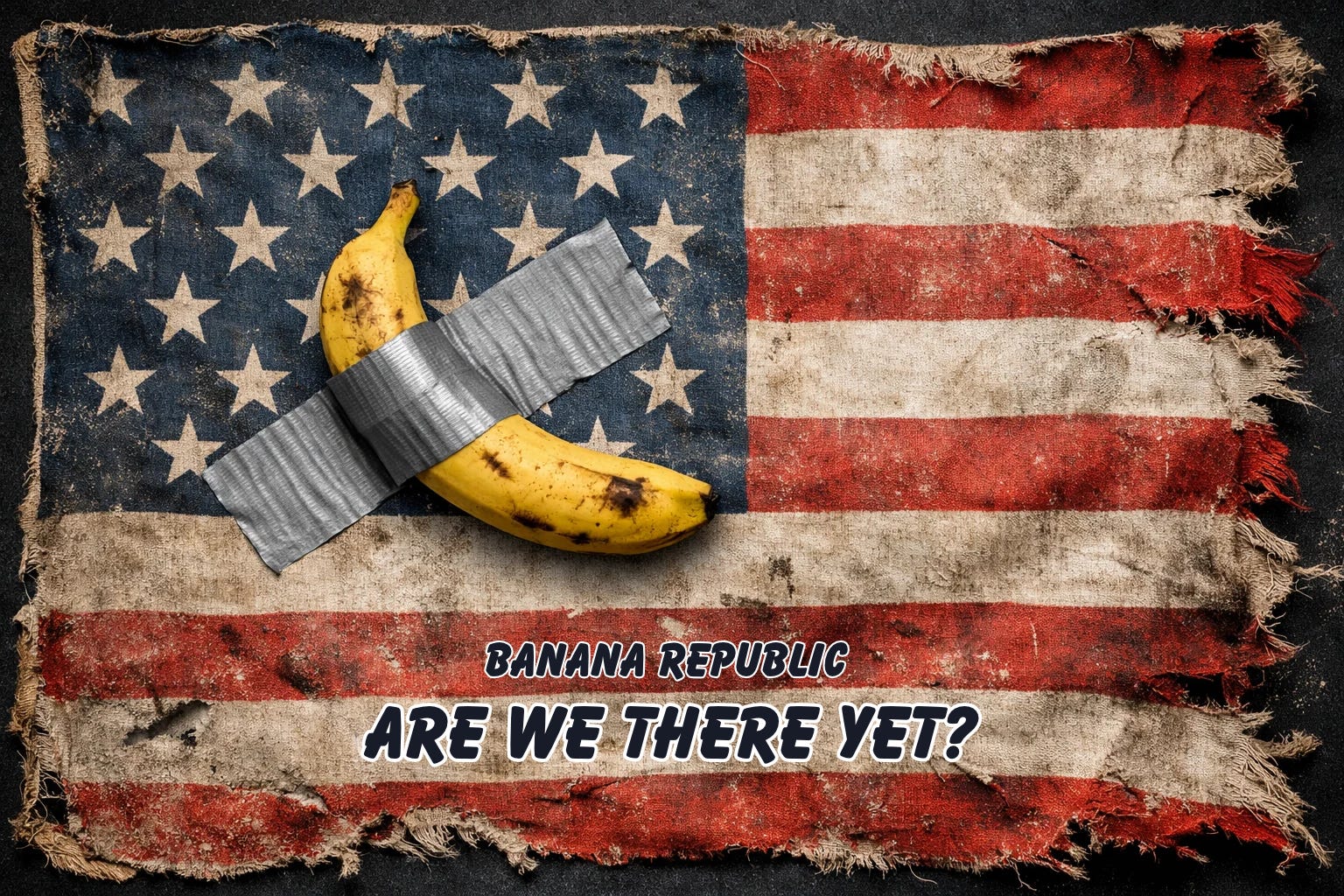
Today, the government doesn’t work for us. We work for it. We have lost the republic. It has become a fading bankrupt empire. It’s time for massive resistance to reclaim personal freedom, to alter or abolish the government that has failed to preserve our liberties and instead assaults them.
The Constitution is not a relic to be managed. It is a standard to be enforced. The government was built to answer to us. It answers to no one now. That arrangement ends only when the people it was built to serve stop treating it as legitimate and start treating it as what the evidence shows it to be: a power that broke its contract, kept the money, and expects obedience anyway.
Margin of the Law publishes constitutional analysis, civic research, and legal education for people who want to understand the system they actually live in. Read the Full Constitutional Analysis Library at marginofthelaw.com.
© 2026 – MK3 Law Group
For republication or citation, please credit this article with link attribution to marginofthelaw.com.