


“Whoever would overthrow the liberty of a nation must begin by subduing the freeness of speech”
Benjamin Franklin
At its core, a banana republic is not just about fruit or exports. It’s a political and economic operating system built on:
foreign corporate control,
domestic elite collaboration,
and systematic dependence on one commodity or income stream.
The term was coined by O. Henry back in 1901 after living in Honduras — where the United Fruit Company (today’s Chiquita Brands) had bought up half the country and owned most of its rails, ports, and politicians.
The early “banana republics” — Honduras, Guatemala, Costa Rica, Nicaragua — were essentially company states masquerading as nations. Local rulers wore military uniforms, foreign executives wore white suits, and the real seat of power was wherever the balance sheets were tallied.
The Operating Mechanics
From cross-referenced independent works — Didi, Diawara & Acevedo (2025); Sahin (2024); Britannica (2025) — three defining features stand out:
Commodity Monoculture
The economy depends almost entirely on a single export (bananas, sugar, copper, oil).
All infrastructure — rail, ports, even telegraph lines — exists to serve that export.
When the crop fails or global prices crash, the entire state collapses.
External Corporate Dominion
The so-called government answers to foreign investors and lenders, not the public.
United Fruit (UFCo) owned over 40% of Honduran land at one point and directly ordered coups.
In 1954, the CIA’s Operation PBSUCCESS ousted Guatemala’s elected president Jacobo Árbenz to protect UFCo’s land from reform.
Political Captivity
Elections exist on paper. Real power resides in deals between domestic oligarchs and corporate boardrooms.
State security is used to crush labor movements, not protect citizens.
The military acts as a private security wing for exporters.
That’s the “banana republic architecture” — a system designed to prevent economic sovereignty.
The Evolution: From Plantations to Supply Chains
According to Didi et al. (2025), the literal bananas have faded, but the structure survived. Modern successors exist under new names:
Debt servitude through the IMF and World Bank.
Mineral and tech extraction in Africa and Asia by Western or Chinese syndicates.
Offshore labor dependency through maquiladoras or factory zones.
Corporate–state collusion that privatizes gains and socializes risk.
It’s the same logic: external profit first, self‐determination never.
Dependency Theory — developed by scholars like Andre Gunder Frank and Immanuel Wallerstein — nailed the mechanism decades ago:
Peripheral nations remain underdeveloped because the global core extracts value without allowing capital formation at the periphery.
The fruit changed — the system didn’t.
The Modern Parallels
Today’s versions don’t always look tropical. They appear as:
Resource states run by dynastic elites — think Equatorial Guinea or parts of the Gulf.
Tourism economies selling paradise under foreign brand management.
“Captured states” — nations whose institutions have been hollowed out so elites and corporations rule behind civilian façades.
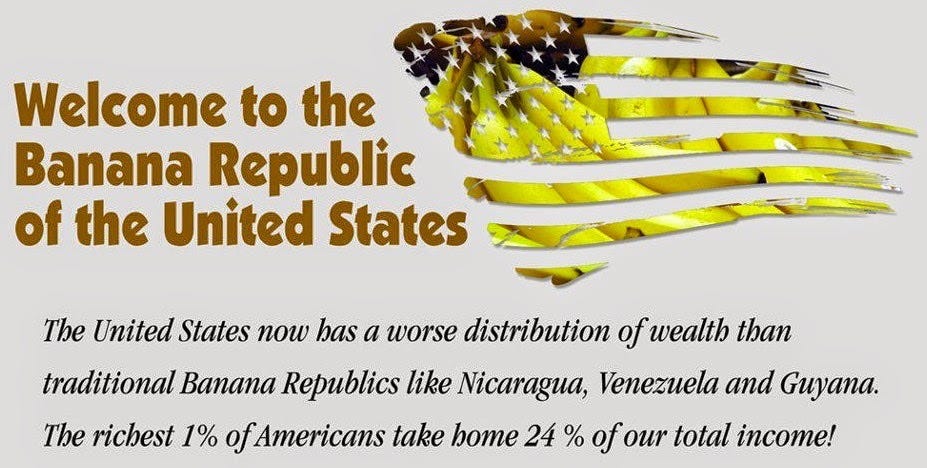
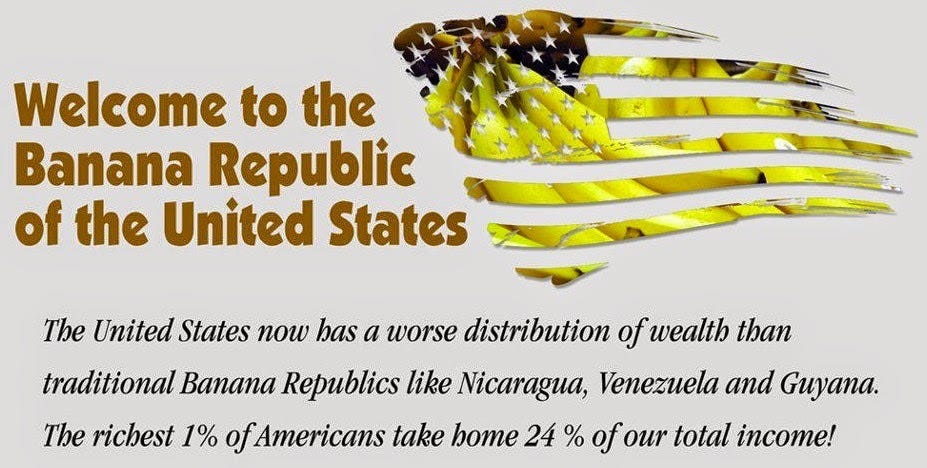
Even the recent Just Security analysis (2025) warned that the United States itself shows symptoms of “state capture”— a term scholars now use instead of “banana republic.” When financial, legal, and enforcement arms serve private or political interests instead of the constitution, you’ve entered the same pathology — just with higher GDP and better PR.
The Moral and Structural Core
A banana republic is not a place — it’s a relationship:
Foreign capital + local corruption − public accountability = systemic dependency.
It thrives wherever transparency is replaced by manipulation and economic control replaces civic consent.
Good governance — as outlined by Asefa & Huang — requires accountability, transparency, participation, and rule of law. Banana republics fail precisely because those are inverted: secrecy, impunity, exclusion, and rule by decree.
The Real Lesson
The “banana republic” isn’t a museum piece from Central America’s past. It’s a warning label for any country letting private interests own its policy. The flags can change, the fruits can change, but the core conditions remain:
Debt-ridden dependency on foreign capital
Politicized judiciary
Weaponized bureaucracy
A captured press narrating compliance as progress
When you see that combination, you’re not looking at a democracy — you’re looking at a commodity zone with an anthem.
It’sBottom Line
A banana republic is:
a nation where sovereignty is cosmetic, democracy is theatrical, and profit is policy.
Whether governed by generals or suited technocrats, the result is the same — foreign extraction, domestic stagnation, and citizens reduced to labor units.
Call it what you will — neo‑colonialism, state capture, global supply management — the mechanics haven’t changed in a century.
What’s changed is only the marketing.