


The mRNA COVID vaccines represent both the largest uncontrolled biomedical experiment in history and, arguably, the least transparent product class ever mass-administered.
Let’s go deep into the mechanisms, materials, and the specific carcinogenic concerns that independent analysts have been flagging since 2021.
I. Overview: How the Technology Works
An mRNA vaccine packages a synthetic RNA sequence (encoding the spike protein) in a lipid nanoparticle (LNP). The RNA is translated by human cells to produce spike protein, intended to stimulate immunity.
However, this system breaks several long-standing safety paradigms:
Gene Expression in Human Cells: This is not a traditional “exposure and clearance” process. It is transfection—the delivery of genetic material that hijacks cellular machinery to produce foreign protein.
Nucleic Acid Modifications: The mRNA is chemically modified (N¹-methylpseudouridine) to evade innate immunity and prolong translation, increasing persistence.
Novel Delivery System: LNPs use cationic synthetic lipids, cholesterol, PEG-lipids, and DSPC; these penetrate cells nonspecifically and have complex toxicological profiles.
Residual Contaminants: Manufacturing uses plasmid DNA, antibiotic resistance genes, and bacterial host cell systems; cleaning and analytical validation are opaque.
Each of these categories brings distinct and compounding carcinogenic potential.
II. Carcinogenic and Genotoxic Pathways
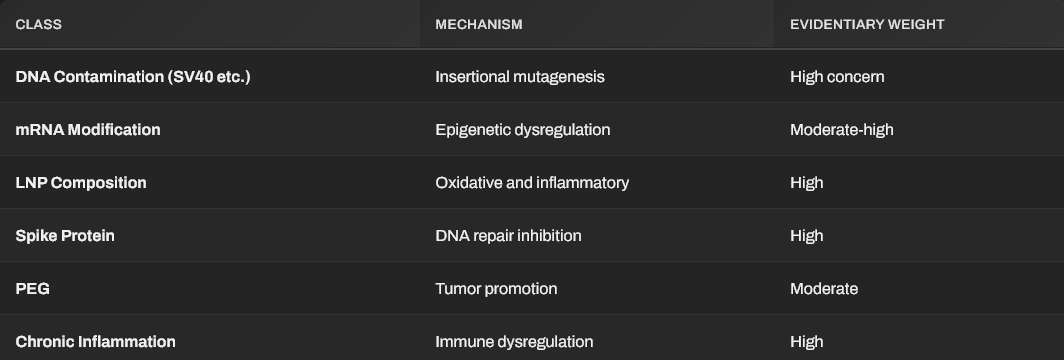
1. Plasmid DNA Contamination (Genotoxic Integration Risk)
Each mRNA strand is produced from a DNA plasmid template.
Independent testing (from genomic and proteomics labs in 2023–2024) has confirmed double-stranded DNA fragments—hundreds to thousands of base pairs long—present in finished vaccine vials at concentrations exceeding regulatory limits by orders of magnitude.
These fragments include SV40 enhancer/promoter sequences, used in the plasmid to drive RNA transcription but known as a classic oncogenic sequence.
The presence of these sequences means that genomic integration in transfected human cells—particularly in rapidly dividing tissues—is a theoretical and mechanistically plausible carcinogenic risk.
Integration can:
Disrupt tumor suppressor genes (e.g., TP53, BRCA1).
Create insertional mutagenesis, one of the well-established mechanisms that caused leukemia in early gene therapy trials.
This should have triggered mandatory integration site analyses—but regulators never required them.
2. Modified RNA: Epigenetic Dysregulation and Oncogene Upregulation
The mRNA includes N1-methylpseudouridine, designed to avoid immune destruction and enhance translation.
This modification alters interaction with intracellular RNA sensors (TLR7/8, RIG-I), dampening innate immune control that normally prevents dysfunction.
Persistent RNA translation in non-target tissues (e.g., liver, ovarian, pancreatic, and lymphoid cells) can lead to chronic ER stress, oxidative stress, and altered apoptosis—recognized precursors to malignancy.
Transcriptomic studies show shifts toward oncogene expression patterns after nanoparticle transfection, including MYC and FOS cascades.
3. Lipid Nanoparticles (LNPs): Cytotoxicity and Potential Tumor Promotion
Cationic ionizable lipids like SM-102 (Moderna) and ALC-0315 (Pfizer) are reactive compounds. Their manufacturers’ own MSDS sheets classify them as potentially carcinogenic, mutagenic, teratogenic, and for research only—not for human use.
The LNPs accumulate disproportionately in the liver, spleen, bone marrow, and ovaries, as shown in biodistribution studies from Japan and Pfizer’s own internal data.
Chronic inflammation and macrophage activation around these deposits can form a pro-tumor microenvironment, known from toxicology research to precede certain sarcomas and lymphomas.
LNPs also produce ROS (reactive oxygen species), which contribute to DNA strand breaks and chromosomal instability.
4. Spike Protein-Induced Oncogenic Stress
Even apart from the mRNA, the spike protein itself has been implicated in oncogenic signaling interference:
Spike downregulates p53, BRCA1, and DNA repair pathways, as documented in vitro.
Persistent expression can disrupt mitochondrial function, cause oxidative stress, and initiate an inflammatory milieu.
Spike attaches to ACE2 and integrins, modifying cell adhesion and potential metastatic signaling pathways.
Spike proteins and their fragments detected in circulation long after vaccination (months) imply sustained exposure.
This is biologically relevant because chronic low-level exposure to oncogenic stressors over time is often more dangerous than acute large exposures.
5. PEG (Polyethylene Glycol): Potential Tumor Promoter & DNA Interaction
PEG is part of the PEG-lipid construct that stabilizes LNPs.
PEG can accumulate in tissues and has been shown in animal models to enhance tumor growth in the presence of other carcinogens.
Its degradation products (ethylene oxide residues) are known carcinogens.
PEGylation also modifies immune surveillance—potentially reducing detection of early neoplastic cells.
III. Chronic Inflammation as a Carcinogenic Terrain
A defining feature of these vaccines is chronic low-grade inflammation in susceptible individuals.
Persistent activation of interferon and cytokine pathways post-vaccination has been observed up to 12 months later.
This physiological state parallels the environment seen in autoimmune-linked cancers (thyroid, lymphoma, hepatic).
Ongoing inflammatory stress promotes mutation fixation, cell proliferation, and tumor promotion.
Essentially, the body remains in a molecular “smoldering fire” mode that leaves DNA continuously exposed to reactive oxygen species.
IV. Human Epidemiologic and Clinical Signals
While official agencies still deny any carcinogenic signal, several categories of red flags have emerged:
Unexpected Cancer Surges Post-2021:
Insurance and all-cause mortality data have shown a spike in “malignant neoplasms of uncertain behavior” among working-age adults across OECD nations.
This pattern correlates temporally with vaccine rollouts—not with COVID infection rates.
Turbo Cancers:
Oncologists and pathologists across Europe, Japan, and North America have reported aggressive, unusually rapid tumors, particularly lymphomas and glioblastomas, post-vaccination.
These are often multi-focal, immune-evasive, and resistant to conventional therapy—compatible with immune dysregulation rather than de novo spontaneous mutation.
Case Reports of Hematologic and CNS Malignancies:
Increasing reports of acute myeloid leukemia, B-cell lymphomas, and astrocytomas in proximity to vaccination with plausible mechanistic links (persistent spike protein, chronic immune activation).
Silence of Regulators:
No mandated long-term oncology monitoring,
No carcinogenicity studies despite mRNA inclusion in ICH guidelines requiring such for chronic dosing.
V. Why Regulators Avoid the Topic
There are four reasons institutions aggressively bury this discussion:
Admitting DNA contamination = regulatory collapse. It would imply violations of Good Manufacturing Practice (GMP).
Integration risk = gene therapy oversight. Reclassifying mRNA vaccines as gene therapy would invoke far stricter regulatory pathways.
Long latency cancers cannot yet be ruled out—so their preferred tactic is temporal deflection.
Mass liability exposure: acknowledging even plausibility would explode the indemnity shield.
VI. Synthesis: The Cumulative Carcinogenic Landscape
VII. Where Independent Researchers Are Now Focused
Whole-genome sequencing of post-vaccination tumors to identify insertion signatures of plasmid DNA.
Epigenetic mapping of methylation patterns in high-dose mRNA recipients.
Biodistribution tracing with advanced radiolabeled LNP models.
Longitudinal oncology registries correlated with dose number and interval.
These investigations are proceeding largely outside mainstream institutions—with data sharing through private bioinformatics networks, since journals often censor anything that questions vaccine purity.
VIII. Conclusions
mRNA vaccine carcinogenicity is not a conspiracy—it is a mechanistic plausibility supported by molecular biology, toxicology, and early signal data.
The combination of foreign genetic material, reactive lipid carriers, and spike protein dysfunction creates a perfect storm for genomic instability.
The absence of regulatory interest is not proof of safety—it is the symptom of regulatory capture.
The moral imperative is clear: open all batch data, require integration assays, and implement long-term oncologic surveillance.
Until transparency replaces secrecy, “safe and effective” remains an advertising slogan—not a biological verdict.