

Origin and Historical Use
The phrase “useful idiot” means something specific. It describes a naive or credulous person who gets used to advance a cause without realizing it. The person believes they are acting on principle. The people using them know better.
Most people assume the term was born in Soviet Russia. That assumption is wrong.
The earliest documented use appeared in an 1864 edition of The Saturday Review, a British publication. The piece described a French elector as “one of those useful idiots who are furnished in the nick of time by every constituency in every country.” No ideology. No espionage. Just a fool being used for political purposes. That usage predates the Bolshevik Revolution by more than fifty years and proves the concept existed long before communist strategy made it famous.
What changed in the 20th century was the scale. Totalitarian movements needed populations to comply, institutions to look away, and sympathizers in foreign countries to vouch for them. The useful idiot became a structural feature of modern propaganda, not just an insult.
The Lenin attribution deserves direct treatment. Popular history insists Lenin coined the term. He did not. Extensive searches of Lenin’s published works and archived papers have found no instance of the phrase “useful idiot” or its Russian equivalent “poleznyye idioty.” The U.S. Library of Congress conducted one such search at the request of journalist William Safire in 1987 and came up empty. The attribution is a myth that Western anti-communists built into Cold War rhetoric. By tying the phrase to Lenin, they gave it authority it did not need and obscured its actual documented history.
Lenin did, however, express the underlying idea. He described certain nominal socialists as “simpletons” who served the czarist cause without intending to. He called some opponents “servile accomplices” of the Whiteguards. He reportedly predicted that Western capitalists would sell the Soviets the rope to hang them with, so blind would they be to their own long-term interests. These statements capture the spirit of the useful idiot without using the words. The concept was present. The phrase was not his.
Soviet Strategy and Cold War Application
After World War II, the concept moved from theory into operational practice. Communist parties across Europe formed coalitions with democratic and liberal allies who had no idea they were being managed. These partners were valuable precisely because they were genuine. Their credibility shielded the communists from scrutiny. Their presence made the movement look pluralist. Once power was secured, they were no longer needed.
Yugoslavia offers a documented example. Marshal Tito’s communists used the term “korisne budale,” meaning “useful innocents,” for the democratic politicians who agreed to collaborate. These were not secret agents. They were people who believed in coalition politics and got outmaneuvered by a movement that had no intention of sharing power. Yugoslav dissident Bogdan Raditsa wrote about it in 1946, warning his fellow democrats directly: “do not be Koristne Budale. Do not be useful innocents.” He had seen the mechanism from the inside.
The phrase entered the Cold War’s English-language political vocabulary by 1948. Italy’s parliamentary elections that year were a flashpoint. The Communist Party was strong, and the left-wing Socialist Party had aligned itself with communist electoral interests. Italy’s Interior Minister Mario Scelba publicly called the Socialist leader the “No. 1 useful idiot assisting Communist aspirations to control Italy.” That quote circulated widely in the press. It is currently the earliest documented use of the exact phrase “useful idiot” in a Cold War political context.
The same year, an American newspaper editorial explained the term to its readers with unusual clarity. It noted that wherever communists gained power, they “persecuted or killed the useful idiots” once those allies had served their purpose. The useful idiot was expendable by design. The relationship was parasitic from the start. The host just didn’t know it.
This became one of the defining warnings of Cold War political thought: the people most at risk from a totalitarian takeover are not always the enemies of the movement. Sometimes they are the naive allies who helped it get there.
Western Intellectuals and the Making of a Classic Example
The Cold War produced no shortage of candidates for the label. Western intellectuals, writers, and journalists who visited the Soviet Union and returned with glowing accounts became the most cited examples.
George Bernard Shaw is one of the most documented cases. Shaw visited the USSR in 1931, met with Stalin, and came back praising the Soviet experiment. He dismissed reports of famine and political terror as Western propaganda. He kept a portrait of Stalin on his mantelpiece until his death in 1950. Historians who have reviewed his public statements and private correspondence describe a man who was not stupid but who needed the Soviet project to succeed in a way that made disconfirming evidence psychologically intolerable. He turned a blind eye to mass death and called it progress.
Jean-Paul Sartre followed a similar pattern over a longer timeline. Sartre rationalized the Soviet show trials, defended Stalinist purges as historically necessary, and embraced Maoism. When Khrushchev’s 1956 speech confirmed the scale of Stalinist crimes, Sartre was shocked. He had spent years in service to a narrative that the Soviet government itself eventually had to acknowledge was built on atrocity. His philosophical sophistication did not protect him. It may have made him more vulnerable, because he had intellectual tools to construct rationalizations that less educated people would not have bothered with.
Sidney and Beatrice Webb, the Fabian socialist intellectuals, wrote a lengthy and admiring study of Soviet governance in 1935. Walter Duranty of The New York Times filed dispatches from Moscow that denied or minimized the Ukrainian famine while it was killing millions. These were not marginal figures. They were credentialed, respected, and published by major institutions. Their accounts gave the Soviet project legitimacy in Western public opinion at a time when that legitimacy had real political consequences.
The pattern across all these cases is consistent. The useful idiot was typically someone with a prior ideological commitment that required the Soviet experiment to be real. The communists understood this. They structured their information access accordingly, giving sympathetic visitors curated tours, stage-managed encounters, and carefully selected data. The visitors’ genuine enthusiasm was the product. It got exported back home.
Modern Applications
The Soviet Union collapsed in 1991. The term did not retire with it.
The most persistent modern application is in the context of Russia under Vladimir Putin. Since roughly 2014, commentators have used “Putin’s useful idiots” to describe Western politicians, media figures, and public intellectuals who amplify Kremlin talking points, express admiration for Russian governance, or oppose Western policy responses in ways that align with Moscow’s interests. This charge has been applied across the political spectrum. It has appeared in mainstream publications including The Atlantic and The Washington Post, typically aimed at figures who echo Russian narratives on NATO expansion, election interference, or the conflicts in Ukraine and Syria.
The accusation carries the same structure as its Cold War version. The person being accused is not necessarily a paid agent. They may genuinely believe what they are saying. The problem, from the accusers’ perspective, is that what they sincerely believe happens to serve an adversary’s strategic interests, and they either cannot see the connection or refuse to.
The terrorism context produced similar usage during the post-September 11 period. Analysts at institutions like the Manhattan Institute drew explicit parallels between Cold War fellow travelers and Western voices who defended or contextualized militant groups. The argument was the same: principled disagreement is one thing, but when your position consistently produces cover for organizations committed to mass violence, something has gone wrong in your analysis, and someone is benefiting from that error.
The misinformation context has added a new layer. Researchers examining Russian influence operations found that the Kremlin’s social media strategy relied heavily on amplification by ordinary Western users who had no idea they were participating in a coordinated campaign. These users shared content, added commentary, and spread narratives organically. They were not paid. They were not recruited. They were useful precisely because they were unaware.
A 2021 study in the Colorado Technology Law Journal used the phrase explicitly to describe this mechanism: the unwitting bystander who perpetuates a disinformation campaign while believing they are sharing the truth. The study noted that these participants often see themselves as truth-tellers pushing back against official narratives. The adversary’s operation works by designing content that appeals to that self-image.
Environmental activism provided another documented example. European officials and intelligence analysts have reported that Russian state-linked entities covertly funded anti-fracking campaigns in Western Europe. The strategic logic was direct: keeping Europe dependent on Russian natural gas was a priority for Moscow. Environmental groups opposing the development of domestic European energy sources were advancing that priority regardless of their intentions. Analysts who reported this were not accusing the activists of being Russian agents. They were pointing out that the activists’ campaigns served Russian interests, and that some of that effort was deliberately seeded and funded from Moscow.
The activists who received no Russian money were in the same analytical category as the ones who did: useful idiots in the operational sense, even if the label felt unfair to people acting on genuine environmental concern.
Intelligence and Psychological Operations
The Soviet KGB had a formal structure for influence operations. Declassified files and accounts from defectors describe a department, Service A, specifically dedicated to disinformation. Its methods included seeding false stories in foreign media, cultivating unwitting sources, and using front organizations to give Kremlin narratives the appearance of independent grassroots support.
Defector Stanislav Levchenko described how Service A worked in practice. KGB officers would develop a false or misleading story and then identify Western journalists, academics, or activists who could be nudged toward picking it up. The nudge didn’t require direct contact. It could be as simple as ensuring the story appeared in sources the target found credible. Once a respected Western voice repeated the narrative, it gained legitimacy that Soviet state media could never generate on its own.
After the 1986 Chernobyl disaster, the KGB used this mechanism to manage Western coverage. According to historian Calder Walton, the KGB flooded Western channels with messaging emphasizing that nuclear accidents could happen anywhere, that Western nuclear programs were equally dangerous, and that the real lesson was universal nuclear risk rather than Soviet institutional failure. Anti-nuclear activist groups in the West, most of them acting in complete good faith, amplified that framing. The Campaign for Nuclear Disarmament and similar organizations became, in Walton’s analysis, unwitting distributors of Soviet damage control.
The KGB’s own internal terminology for these unwitting assets was consistent with “useful idiots,” though the exact translation varied. What mattered operationally was that these people didn’t need to be paid or controlled. They needed only to be positioned. Their existing beliefs and commitments would do the rest.
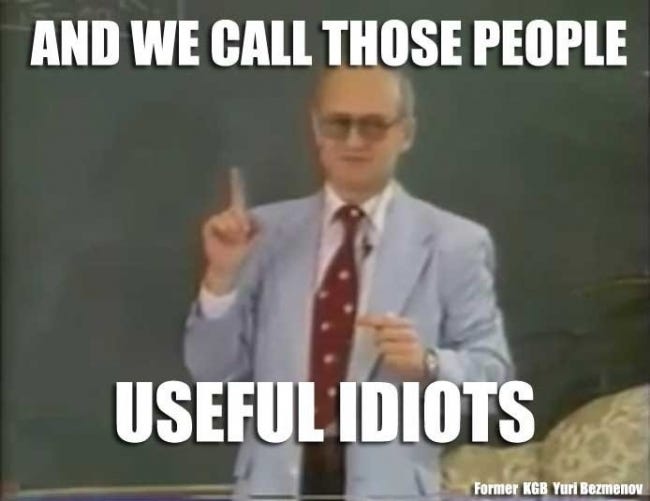
Yuri Bezmenov, who defected from the KGB in 1970 and spent years afterward explaining Soviet influence operations to Western audiences, was explicit about this. He described a four-stage process of “ideological subversion” that Soviet intelligence used against Western societies: demoralization, destabilization, crisis, and normalization. The useful idiot was most relevant in the first stage. Journalists, academics, clergymen, and activists were targeted not to recruit them as agents but to gradually shift the cultural and intellectual environment in ways favorable to Soviet goals.
Bezmenov also made a point that Bogdan Raditsa had made decades earlier in the Yugoslav context: once the process succeeds, the useful idiots become liabilities. They know too much. They have expectations. They believed the ideology. A communist government that takes power has no room for people who actually expect the promised outcomes. History confirmed this repeatedly. The early sympathizers in Russia, China, and Cuba who survived the revolutionary period often spent the next phase of their lives in prison or exile.
Former CIA Director Robert Gates captured the systemic version of this problem in 1985 congressional testimony. He argued that the most effective disinformation against Western societies was not imported from Moscow but generated internally by “true believers willing to amplify falsehoods.” The external adversary plants seeds. Domestic useful idiots grow the crop.
Cultural Presence
The phrase has moved well beyond political analysis. It now functions as a cultural shorthand, a signal that the speaker understands propaganda mechanics and wants to invoke them without lengthy explanation.
Matt Taibbi and Katie Halper named their political podcast “Useful Idiots” when they launched it in 2019. The title was deliberate. It positioned the hosts as self-aware commentators willing to question the narratives of their own media environment, including those that would benefit them professionally. Whether the show delivered on that promise is a separate question. The choice of title itself demonstrated how loaded and recognizable the phrase had become. It could be reclaimed, played with, and used to signal a certain kind of adversarial media stance.
In 2025, a Hollywood film of the same title went into production, starring Meryl Streep and Sigourney Weaver. The premise involves a journalist investigating a powerful oligarch protected by a network of enablers who don’t fully understand what they are facilitating. The title choice tells you everything about how familiar the concept has become. You don’t name your film “Useful Idiots” if you have to explain the reference. The production is betting audiences already know what it means and feel something about it.
Mona Charen’s 2003 book used the term directly in its subtitle, applying it to liberals she argued had been consistently wrong about the Soviet threat and had refused to update their assessments. The book was a product of its moment in post-Cold War conservative commentary, but it demonstrated how naturally the phrase had migrated from Soviet context to domestic political argument. You no longer needed a communist in the room. Any situation involving perceived ideological blindness that served someone else’s interests could invoke the term.
Jan Mark’s young adult novel, also titled “Useful Idiots” and published in 2004, applied the concept to a dystopian fiction setting, using it as a metaphor for manipulated youth in a future Britain. When the phrase shows up in young adult fiction, the cultural absorption is essentially complete.
The Academic Question
Academic literature generally avoids the phrase because it is an insult, and scholarly analysis prefers neutral framing. But the underlying phenomenon has been extensively studied.
Paul Hollander’s “Political Pilgrims,” published in 1981, examined why Western intellectuals traveled to Stalin’s Russia, Mao’s China, and Castro’s Cuba and returned with favorable accounts despite conditions that should have been obvious. Hollander documented the psychological needs these visits served: the desire for a functioning alternative to capitalism, the social rewards of ideological solidarity, the investment of reputation that made changing one’s mind expensive. He did not use “useful idiot,” but he described its mechanics in precise detail.
Research on cognitive dissonance explains part of it. Once you have publicly committed to a position, evidence against that position triggers discomfort that most people resolve by discounting the evidence rather than changing the position. The more public and repeated the commitment, the stronger the effect. A journalist who has filed a dozen favorable dispatches from Moscow has a very high psychological cost for filing an unfavorable one. A philosopher who has defended Stalin’s purges in print faces enormous internal resistance to admitting he was wrong.
Research on confirmation bias explains the filtering. People in an ideologically charged environment notice and remember information that confirms their existing beliefs more readily than information that challenges them. Soviet handlers who managed visits by Western sympathizers understood this intuitively. You show the visitor the school, not the labor camp. The visitor’s own mental architecture does the rest.
Modern misinformation research extends this into the social media environment. Echo chambers, algorithmic reinforcement, and social identity dynamics all make ordinary people more susceptible to believing and sharing false information that aligns with their group’s worldview. The useful idiot of 2025 does not need a handler. The information environment provides the function automatically.
The one academic reappraisal worth noting is the shift from pure scorn to partial sympathy. Several contemporary analysts have pointed out that the useful idiot is also a victim. The propaganda operations that produce them are sophisticated, patient, and designed by professionals. The targets are ordinary people, or in some cases very smart people whose intelligence has been turned against them. The grim observation often attributed to Joseph Goebbels captures it: “Propaganda works best when those who are being manipulated are confident they are acting on their own free will.”
That does not remove responsibility. But it does explain why the problem persists. You cannot fix it by simply telling people not to be stupid. The mechanism does not depend on stupidity. It depends on normal human psychology operating in a designed information environment.
Where the Term Stands
The phrase “useful idiot” has outlasted the Cold War because the dynamic it describes has outlasted it. Foreign governments still run influence operations targeting Western populations. Domestic actors still design information campaigns that rely on unwitting amplifiers. Institutions still produce credentialed voices whose analysis consistently benefits powerful interests they claim to scrutinize.
The warning embedded in the term is direct: know whose agenda your position advances. Not just who you think you are helping, but who is actually helped by the outcome. Those are not always the same answer.
The concept is not partisan. It does not belong to anti-communists, or conservatives, or progressives. Any movement, government, or institution can cultivate useful idiots. Any person, regardless of education or political position, can become one.
The protection is not cynicism. Cynicism without analysis is just another posture. The protection is genuine critical thinking about who benefits from what you believe, who funds what you read, and what assumptions are built into the information you receive before you decide you’ve formed an independent opinion.
The useful idiot always believes they are acting freely. That belief is the product. It is also the warning.
Margin of the Law publishes constitutional analysis, civic research, and legal education for people who want to understand the system they actually live in. Read the Full Constitutional Analysis Library at marginofthelaw.com.
© 2026 – MK3 Law Group
For republication or citation, please credit this article with link attribution to marginofthelaw.com.