

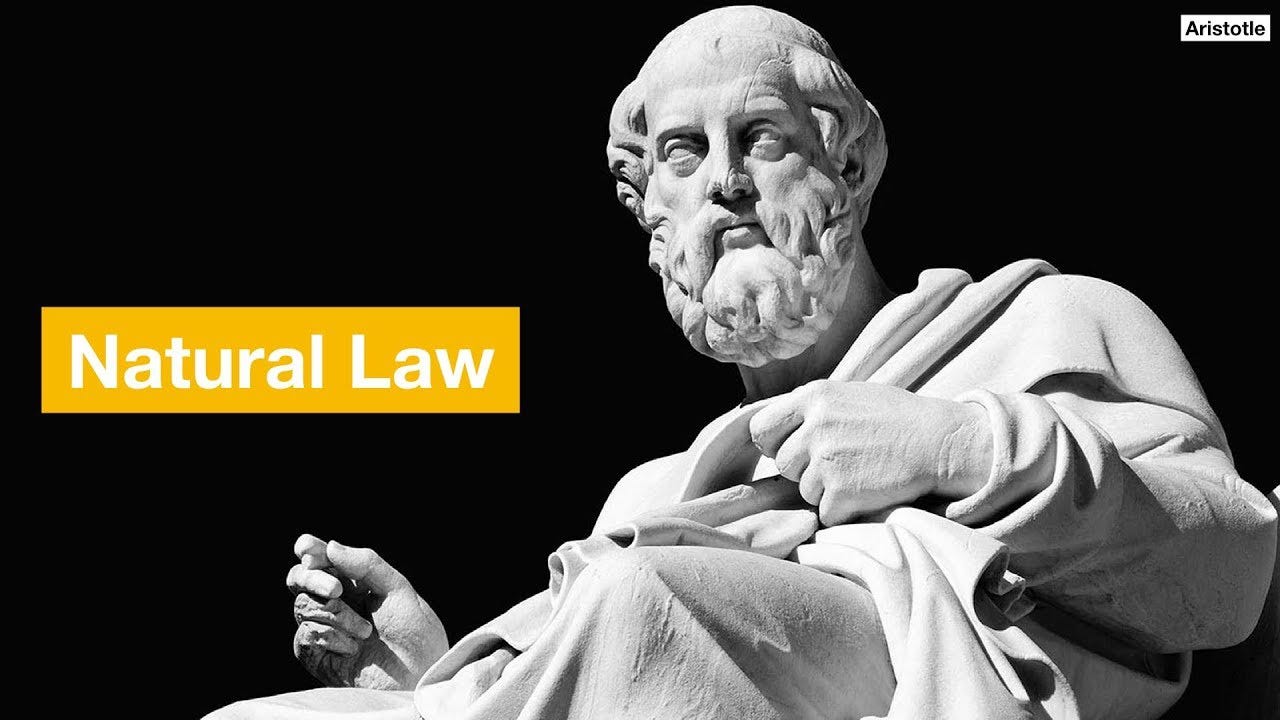
Certain moral principles exist independently of what governments write into law books. You can discover these principles through reason alone—they’re built into human nature itself. This idea forms the backbone of natural law theory, and it has shaped how we think about international law for centuries.
The theory makes a bold claim: laws must align with universal human rights to be legitimate. If a government passes laws that violate these natural principles, those laws lack moral authority. This creates tension between what is legal and what is right.
Historical Development
Ancient Greek philosophers started this conversation. Plato and Aristotle believed moral principles could be discovered through careful thinking, not just cultural tradition. These weren’t arbitrary rules—they were universal truths that applied everywhere.
Medieval thinkers changed the game entirely. Thomas Aquinas merged Aristotelian philosophy with Christian theology in the 13th century. He argued that natural law reflects divine will, making it both rational and sacred. This synthesis dominated European legal thought for centuries.
The Enlightenment brought another shift. John Locke emphasized individual rights over divine command. He claimed people possessed natural rights to life, liberty, and property before any government existed. These rights didn’t come from kings or parliaments—they came from being human.
Hugo Grotius took natural law international. Writing during the devastating Thirty Years’ War, he argued that certain laws governed relations between nations regardless of local customs. Wars needed just causes. Treaties required good faith. Some principles transcended borders.
Core Framework
Natural law theory rests on several key assumptions about human nature and moral reasoning.
Universal accessibility through reason. Anyone can discover moral principles by thinking clearly about human nature and social life. You don’t need special training, divine revelation, or cultural initiation. Reason alone suffices.
Inherent rights. Humans possess certain rights simply by existing. These aren’t gifts from government or society—they’re part of what makes us human. Life, liberty, and basic dignity top most lists.
Moral evaluation of positive law. Written laws can be morally wrong. Natural law provides the standard for judging whether human-made laws deserve respect or resistance. Unjust laws lack true legal authority.
Cross-cultural validity. Natural law principles apply universally, not just within particular societies. What’s morally required in one culture is morally required everywhere, even if local laws disagree.
These assumptions create a framework for critiquing existing legal systems and building better ones.
Key Thinkers and Their Contributions
Thomas Aquinas developed the most systematic account of natural law in medieval Europe. He distinguished between eternal law (God’s providence), natural law (the rational creature’s participation in eternal law), human law (specific applications of natural law), and divine law (biblical revelation).
For Aquinas, natural law aimed at human flourishing. People naturally seek good and avoid evil, but reason must guide these inclinations. The basic precept—do good and avoid evil—generates more specific principles about preserving life, living in society, seeking truth, and worshipping God.
Aquinas made natural law both theological and rational. It depended on God’s existence but could be discovered through human reason without special revelation. This balanced approach influenced centuries of legal and political thought.
John Locke secularized natural law theory for the modern era. He argued that people in the state of nature possessed natural rights before forming governments. These rights came from God but could be known through reason alone.
Locke’s natural rights were negative rights—they required others to refrain from interference rather than provide positive assistance. The right to life meant others couldn’t kill you. The right to liberty meant others couldn’t enslave you. The right to property meant others couldn’t steal from you.
Government existed solely to protect these natural rights. When governments failed in this task or actively violated natural rights, people could legitimately resist or replace them. This theory justified the English Revolution of 1688 and later inspired American revolutionaries.
Hugo Grotius applied natural law to international relations. His 1625 work “On the Law of War and Peace” established principles for when wars were justified and how they should be conducted.
Grotius argued that natural law would exist even if God didn’t exist—a shocking claim for his time. This made international law independent of religious differences between Christian and non-Christian nations. Natural law applied to everyone regardless of their theological beliefs.
He developed detailed rules for just war, treaty obligations, and diplomatic immunity. These principles became foundations of modern international law, even as their natural law origins faded from view.
Natural Law in International Legal Systems
Natural law theory has profoundly influenced international law development, though often indirectly.
The Universal Declaration of Human Rights reflects natural law thinking without explicitly acknowledging it. The declaration proclaims certain rights as inherent in human dignity rather than granted by governments. This assumption—that rights exist independently of positive law—comes straight from natural law tradition.
Humanitarian intervention debates often invoke natural law reasoning. When should the international community intervene to stop genocide, ethnic cleansing, or massive human rights violations? Natural law theorists argue that some moral principles transcend national sovereignty. Governments that violate fundamental human rights forfeit their claim to non-interference.
International criminal law prosecutes individuals for crimes against humanity, war crimes, and genocide. These prosecutions assume that certain acts are wrong regardless of local laws or cultural practices. Natural law provides the theoretical foundation for universal criminal jurisdiction.
Treaty interpretation sometimes relies on natural law principles. When treaty language is ambiguous, international courts may invoke fundamental principles of justice, good faith, and human dignity. These principles function like natural law even when not explicitly labeled as such.
Contemporary Applications
Modern human rights movements draw heavily on natural law reasoning, whether consciously or not. Civil rights activists argue that segregation laws violated natural equality principles. Anti-apartheid campaigners claimed that racial classification systems contradicted human dignity. Democracy advocates assert that people have natural rights to political participation.
Constitutional interpretation often involves natural law reasoning. When judges interpret broad constitutional phrases like “due process” or “equal protection,” they may invoke principles of natural justice that transcend the written text. This judicial approach remains controversial but persistent.
Bioethics frequently employs natural law arguments. Debates over abortion, euthanasia, genetic engineering, and human enhancement often reference natural human purposes and inherent human dignity. These concepts derive from natural law tradition even when participants don’t recognize their philosophical heritage.
Environmental law increasingly incorporates natural law thinking. Some theorists argue that humans have natural duties to preserve the environment for future generations. Others claim that nature itself possesses inherent rights that human law should protect.
Critical Challenges
Natural law theory faces several persistent criticisms that limit its influence in contemporary legal systems.
Cultural relativism challenges the universality claims. Anthropological research reveals dramatic moral disagreements between cultures on fundamental questions. What natural law theorists claim as universal principles may reflect merely Western cultural biases disguised as rational truths.
Secular skepticism questions whether moral principles can be discovered through reason alone. If natural law requires theological foundations, it becomes irrelevant in pluralistic societies with religious disagreement. If it doesn’t require theological foundations, critics wonder why its conclusions should be considered objectively true rather than subjective preferences.
Legal interpretation problems arise when judges invoke natural law principles. How do courts determine which principles count as natural law? How do they resolve conflicts between competing natural law claims? The interpretive process appears to give judges excessive discretion to impose their personal moral views.
Democratic objections focus on political legitimacy. In democratic societies, elected representatives should determine legal content through majoritarian processes. When judges overturn democratically enacted laws by appealing to natural law principles, they undermine democratic self-governance.
Practical enforcement creates additional difficulties. Even if natural law principles exist and can be known, how should legal systems enforce them? What institutions have authority to declare positive laws invalid based on natural law violations? How can international legal systems enforce natural law principles against sovereign nations?
Natural Law versus Legal Positivism
The debate between natural law theory and legal positivism represents one of jurisprudence’s central controversies.
Legal positivism argues that law’s validity depends entirely on its sources—whether it was properly enacted by authorized institutions following correct procedures. The moral content of law is irrelevant to its legal validity. Unjust laws are still laws; they’re just unjust laws.
Natural law theory insists that moral content affects legal validity. Sufficiently unjust laws aren’t really laws at all—they’re corruptions of law. Legal systems derive their authority from their connection to moral principles, not just from procedural correctness.
This disagreement has practical consequences. Legal positivists argue that separating law from morality promotes clarity, predictability, and democratic governance. Citizens know what the law requires by consulting authoritative legal sources rather than engaging in moral reasoning.
Natural law theorists respond that legal positivism enables tyranny by giving moral legitimacy to any law that follows proper procedures. They point to Nazi Germany, where legally valid laws authorized genocide and other atrocities.
Modern legal systems typically blend both approaches. Courts generally defer to properly enacted laws but sometimes invoke broader principles of justice to interpret ambiguous provisions or strike down extreme violations of fundamental rights.
Justice and Natural Law
Natural law theory provides a distinctive account of justice that emphasizes objective moral standards rather than social conventions or power relations.
Distributive justice concerns how benefits and burdens should be allocated within society. Natural law theorists typically argue that distributions should reflect human dignity, merit, need, or contribution rather than arbitrary factors like race, class, or political connections.
Corrective justice addresses how to respond to wrongdoing. Natural law emphasizes restoration and proportionality rather than pure deterrence or retribution. Punishments should fit crimes and aim at restoring moral balance disrupted by wrongful acts.
Procedural justice requires fair processes for determining legal disputes. Natural law theorists insist that procedural fairness serves substantive moral purposes rather than merely promoting efficiency or legitimacy. Due process protects human dignity by treating people as rational agents capable of defending themselves.
Future Prospects
Natural law theory faces an uncertain future in international legal systems. Several trends may affect its influence.
Globalization creates pressure for universal legal principles that can coordinate behavior across different legal systems. Natural law provides one theoretical framework for developing such principles, though competing approaches also exist.
Human rights expansion continues the natural law tradition of discovering new rights claims based on human dignity and flourishing. Rights to development, environment, peace, and democratic governance extend beyond traditional civil and political rights.
Technological challenges raise questions that natural law theorists must address. How do traditional principles apply to artificial intelligence, genetic engineering, space exploration, or digital privacy? Natural law’s emphasis on human nature and flourishing may provide guidance, but applications require careful reasoning.
Religious pluralism complicates natural law’s traditional theological foundations. Contemporary natural law theorists increasingly emphasize secular philosophical arguments rather than religious doctrine. This may broaden appeal but weakens the theory’s historical foundations.
Democratic governance remains in tension with natural law approaches that limit majoritarian decision-making. Future natural law theories must better explain how objective moral principles can coexist with democratic legitimacy.
Conclusion
Natural law theory continues shaping international legal discourse despite facing significant theoretical and practical challenges. Its core insight—that moral principles constrain legitimate law—remains relevant for contemporary legal systems grappling with questions about human rights, international intervention, and the limits of governmental authority.
The theory’s emphasis on universal moral principles provides resources for critiquing unjust laws and building better legal institutions. Whether through explicit natural law reasoning or implicit appeals to human dignity and fundamental rights, these ideas continue influencing how lawyers, judges, and citizens think about law’s proper role in human society.
Natural law theory will likely persist as long as people believe that some moral principles transcend particular legal systems and cultural practices. Its future influence will depend on whether contemporary theorists can address traditional criticisms while developing applications relevant to emerging global challenges.
The tension between universal moral principles and diverse cultural practices, between objective standards and democratic self-governance, between theoretical ideals and practical constraints—these fundamental issues ensure that natural law theory will remain part of international legal conversations for the foreseeable future.