


“Is life so dear, or peaceful so sweet, as to be purchased at the price of chains and slavery? Forbid it, Almighty God! I know not what course others may take, but as for me, give me liberty or give me death!”
Patrick Henry, Speech at the Virginia Convention
Introduction
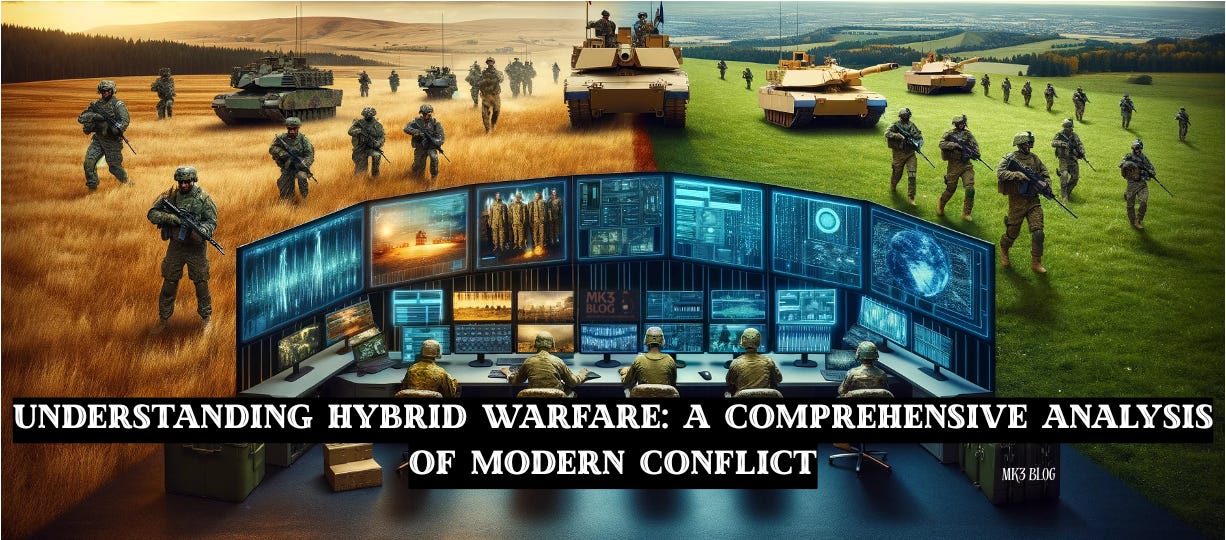
Contemporary warfare has fundamentally transformed from the traditional model of declared conflicts between nation-states. The emergence of hybrid warfare represents a strategic evolution that operates below the threshold of conventional military engagement, utilizing a sophisticated blend of information operations, economic pressure, cyber capabilities, and social manipulation to achieve political objectives.
This analysis examines hybrid warfare as a comprehensive doctrine that prioritizes the capture of perception over territory, demonstrating how modern conflicts are waged through continuous engagement rather than discrete periods of war and peace.
Defining Hybrid Warfare
Hybrid warfare represents the systematic integration of conventional and unconventional tactics, combining military and non-military tools to create strategic effects while maintaining plausible deniability. Unlike traditional warfare, which relied on clear declarations and territorial objectives, hybrid operations focus on degrading an adversary’s decision-making capabilities and social cohesion through sustained, multi-domain campaigns.
The fundamental principle underlying hybrid warfare is asymmetric engagement—utilizing intelligence, manipulation, and precision strategy rather than overwhelming force. This approach allows smaller powers to compete with larger adversaries by exploiting vulnerabilities in information systems, economic structures, and social frameworks.
Core Components of Hybrid Operations
Information Operations: These campaigns aim to establish narrative dominance through the systematic manipulation of information environments. Practitioners flood communication channels with contradictory messages, emotional content, and deliberate confusion to undermine public confidence in institutions and shared reality.
Cyber Operations: Digital attacks target critical infrastructure while maintaining deniability through technical complexity. These operations range from electoral system penetration disguised as technical malfunctions to industrial sabotage presented as equipment failures.
Economic Warfare: Modern economic tools include sanctions regimes, debt leverage, market manipulation, and supply chain disruption. These methods create strategic pressure without triggering traditional alliance obligations or international legal frameworks.
Proxy Forces: Officially independent militias, private contractors, and online networks conduct operations that governments cannot openly acknowledge. This structure provides strategic flexibility while maintaining legal and political distance.
Lawfare: The exploitation of legal frameworks—international courts, treaty obligations, and regulatory systems—to constrain adversaries while projecting moral legitimacy. This approach weaponizes legal processes for strategic advantage.
Cultural Subversion: Long-term campaigns targeting educational institutions, entertainment platforms, and social media to gradually reshape values, replace rational discourse with emotional reactions, and cultivate national self-doubt.
Historical Evolution
While hybrid warfare appears novel, its foundational concepts have deep historical precedents. Sun Tzu’s strategic philosophy emphasized defeating enemies without direct confrontation, advocating for the use of deception, intelligence, and political manipulation to achieve victory.
The Soviet Union’s Active Measures programs during the Cold War demonstrated systematic information warfare capabilities, utilizing propaganda, disinformation, and cultural influence operations to undermine Western societies from within. These programs established many of the methodologies that contemporary hybrid practitioners have refined and expanded.
Operation Gladio illustrated how intelligence operations could blur the boundaries between espionage, domestic politics, and paramilitary activities, creating networks that operated across multiple domains simultaneously.
Modern Russia’s approach, particularly following the 2008 Georgian conflict and the 2014 Crimean annexation, represents the systematic application of hybrid doctrine. These operations demonstrated how information warfare, economic pressure, and deniable military action could achieve strategic objectives while avoiding direct confrontation with superior conventional forces.
Western nations have subsequently developed similar capabilities, establishing information operations centers, public-private partnerships for “counter-disinformation,” and digital influence programs that mirror many aspects of adversary methodologies.
The Cognitive Battlefield
Contemporary hybrid warfare recognizes that the most decisive battles occur in cognitive space—the contested domain of belief, trust, and perceived reality. This understanding drives the development of what military theorists term “reflexive control”: the implantation of false premises that cause adversaries to make self-defeating decisions.
The cognitive battlefield operates through memetic warfare, utilizing algorithmic systems to condition public responses and engineer specific behavioral outcomes. Social media platforms function as delivery mechanisms for psychological operations, with engagement algorithms optimized to amplify emotional content and suppress rational deliberation.
This approach transforms civilian populations into both weapons and targets. Citizens become unwitting participants in information operations through their social media activity, while simultaneously serving as the primary targets of influence campaigns designed to fragment social cohesion.
Contemporary Applications
Crimea (2014)
Russia’s Crimean operation demonstrated coordinated hybrid warfare across multiple domains. Unmarked military personnel (”little green men”) provided ground presence while information operations created narrative confusion about their identity and purpose. Simultaneously, cyber attacks disrupted Ukrainian communications and digital chaos prevented effective coordination of resistance.
Hong Kong (2019-2020)
The Hong Kong protests illustrated how multiple actors can conduct simultaneous information warfare campaigns. Both Chinese and Western information operations targeted diaspora communities and international opinion, weaponizing social media identities and loyalty narratives to advance competing political objectives.
Syria
The Syrian conflict represents a comprehensive hybrid warfare laboratory, featuring proxy militaries, sophisticated disinformation networks, energy sector manipulation, and humanitarian messaging campaigns. Multiple state and non-state actors utilized the full spectrum of hybrid tools while maintaining varying degrees of deniability.
COVID-19 Pandemic
The pandemic period demonstrated how health information could become geopolitical ammunition. Competing narratives about medical interventions, policy responses, and scientific data became vehicles for broader influence operations, with censorship and narrative management conducted under public health justifications.
Ukraine (2022-Present)
The ongoing Ukraine conflict operates as a global hybrid warfare theater. While kinetic operations dominate ground combat, information warfare shapes international perception and support, while economic measures create worldwide strategic pressure. The conflict demonstrates how hybrid and conventional operations can function simultaneously across different domains.
Operational Architecture
Hybrid warfare operates through distributed command structures rather than centralized military hierarchies. This network approach involves multiple categories of actors operating with aligned interests but independent authorities.
State Actors: Intelligence services such as Russia’s GRU, China’s Unit 61398, and Western information operations centers officially focus on defensive missions while conducting offensive operations. These agencies provide strategic direction and resource allocation for broader hybrid campaigns.
Corporate Networks: Technology companies function as critical infrastructure for information operations, with algorithms serving as behavioral modification systems. Data analytics capabilities allow for precision targeting of psychological operations at unprecedented scale and specificity.
Financial Systems: Banking networks, payment processors, and monetary policy institutions serve as enforcement mechanisms for economic warfare. “De-risking” policies and sanctions regimes create strategic pressure while maintaining legal justification.
Non-Governmental Organizations: Think tanks, advocacy groups, and research institutions provide intellectual legitimacy for policy positions while functioning as narrative laundering operations. These organizations validate predetermined conclusions through ostensibly independent analysis.
Academic and Media Institutions: Universities and news organizations manufacture intellectual frameworks and moral justifications for hybrid operations while maintaining claims to objectivity and independence.
Modern Mercenary Networks
Contemporary hybrid operations utilize civilian contractors operating in digital domains rather than traditional battlefields. These networks include:
Cyber-for-Hire Firms: Private companies developing and deploying surveillance software, exploitation tools, and digital weapons systems. These organizations provide technical capabilities while maintaining commercial cover for state operations.
Public Relations Agencies: Communications firms specializing in reputation management and crisis response function as information warfare contractors, utilizing sophisticated psychological research and social media manipulation techniques.
Influencer Networks: Paid content creators who present political messaging as authentic personal opinions, providing civilian camouflage for state-sponsored influence operations while maintaining plausible deniability about their funding sources.
Technological Integration
The fusion of intelligence capabilities with commercial technology platforms has created unprecedented surveillance and influence capabilities. Predictive analytics allow operators to anticipate and preempt resistance movements before they develop effective organizational structures.
Projects like Maven, Jigsaw, and Palantir demonstrate how military requirements drive civilian technology development, creating dual-use capabilities that enhance both commercial services and intelligence operations. These systems compress the temporal gap between detection and influence to near-instantaneous response times.
Economic and Legal Weapons
Financial dominance provides significant hybrid warfare capabilities through monetary policy and banking system control. Dollar-denominated international trade allows the United States to impose sanctions with global effect, while debt diplomacy enables long-term strategic influence through infrastructure financing arrangements.
Supply chain dependencies create strategic vulnerabilities in pharmaceuticals, semiconductors, and rare earth minerals. Control over these resources provides non-kinetic siege capabilities that can pressure adversaries without triggering traditional alliance obligations.
Legal warfare exploits international court systems, treaty frameworks, and regulatory processes to constrain adversary actions while projecting moral authority. Selective application of legal standards creates asymmetric advantages for operators with superior institutional access.
Domestic Applications
Hybrid warfare techniques increasingly target domestic populations under national security and public safety justifications. Counter-disinformation programs, content moderation policies, and algorithmic curation systems create mechanisms for managing public opinion while maintaining claims to democratic legitimacy.
These domestic applications represent the evolution of counter-insurgency doctrine for information age governance. Rather than suppressing dissent through direct confrontation, modern systems engineer voluntary compliance through environmental manipulation and social pressure.
Information Operations in Practice
Contemporary information warfare operates through attention capture and behavioral conditioning systems. Social media platforms function as militarized attention grids that collect behavioral data for psychological profiling and manipulation targeting.
The operational sequence follows a collect-predict-amplify-entrench pattern:
Collection of user behavior data for analysis
Prediction of emotional triggers and response patterns
Amplification of content designed to generate specific reactions
Entrenchment of ideological positions through algorithm-driven isolation
This process exploits neurological biases that prioritize emotional responses over analytical thinking, leveraging dopamine-driven engagement patterns to maintain user attention and behavioral predictability.
Language as Strategic Weapon
Hybrid practitioners treat linguistic terrain as critically important strategic space. Operational techniques include:
Semantic Reframing: Redefining key terms to shift public consent by making opposition appear morally illegitimate or socially unacceptable.
Inoculation Strategies: Pre-emptively labeling potential dissent with negative associations to prevent serious consideration of alternative perspectives.
Mirror Tactics: Appropriating the language of resistance movements and reissuing it in diluted forms that support establishment positions.
These approaches aim to control the conceptual frameworks through which populations understand political issues, making certain conclusions appear natural and inevitable while rendering alternatives intellectually inaccessible.
Synthetic Social Proof
Human decision-making relies heavily on social consensus cues, which hybrid operators exploit through artificial majority creation. Coordinated bot networks, paid influencer campaigns, and engagement manipulation create false impressions of widespread support for specific positions.
The psychological mechanism operates through conformity pressure: artificial consensus triggers natural conformity responses, which then generate claims of social inevitability. This process allows minority positions to appear as majority views through technological amplification.
Visual Manipulation Technologies
Advanced artificial intelligence enables sophisticated visual and audio manipulation that undermines traditional evidence verification methods. Deep fake technologies, composite imagery, and voice cloning create possibilities for entirely fabricated events that appear authentic to casual observation.
The strategic objective is not necessarily widespread belief in false information, but rather the degradation of confidence in any information source. When populations conclude that verification is impossible, they become susceptible to influence operations that provide certainty and emotional satisfaction regardless of factual accuracy.
Defense Strategies
Effective defense against hybrid warfare requires multi-dimensional approaches that address cognitive, informational, and institutional vulnerabilities without creating authoritarian control mechanisms.
Cognitive Resilience: Public education programs must develop citizens’ ability to recognize and resist manipulation techniques. This includes training in information verification, source analysis, and emotional regulation under information pressure.
Information Integrity: Technical systems for content verification, source tracking, and algorithmic transparency can provide tools for independent assessment of information reliability without centralizing control over acceptable opinion.
Institutional Immunity: Government transparency requirements, decision-making accountability protocols, and citizen oversight mechanisms can prevent institutional capture while maintaining operational effectiveness.
Cultural Defense
Long-term resistance to hybrid warfare requires cultural foundations that support critical thinking, civic engagement, and shared commitment to truth-seeking over ideological conformity. This includes:
Restoration of craftsmanship and practical competence as cultural values
Protection and support for independent journalism and whistleblowing
Development of decentralized cultural institutions that resist centralized narrative control
Conclusion
Hybrid warfare represents the dominant form of contemporary strategic competition, operating through continuous engagement across multiple domains rather than discrete periods of declared conflict. Understanding these operations is essential for citizens and institutions seeking to maintain democratic governance and cultural autonomy in an environment of constant information warfare.
The fundamental challenge lies in developing defensive capabilities that preserve open society values while providing effective protection against sophisticated manipulation campaigns. Success requires individual cognitive discipline, institutional transparency, and cultural commitment to independent thinking over comfortable certainty.
As hybrid warfare continues to evolve, the societies that maintain their ability to distinguish between information and manipulation, between genuine consensus and manufactured agreement, will retain their sovereignty and self-determination. Those that fail this challenge will find themselves administered by forces they never recognized as adversaries.