


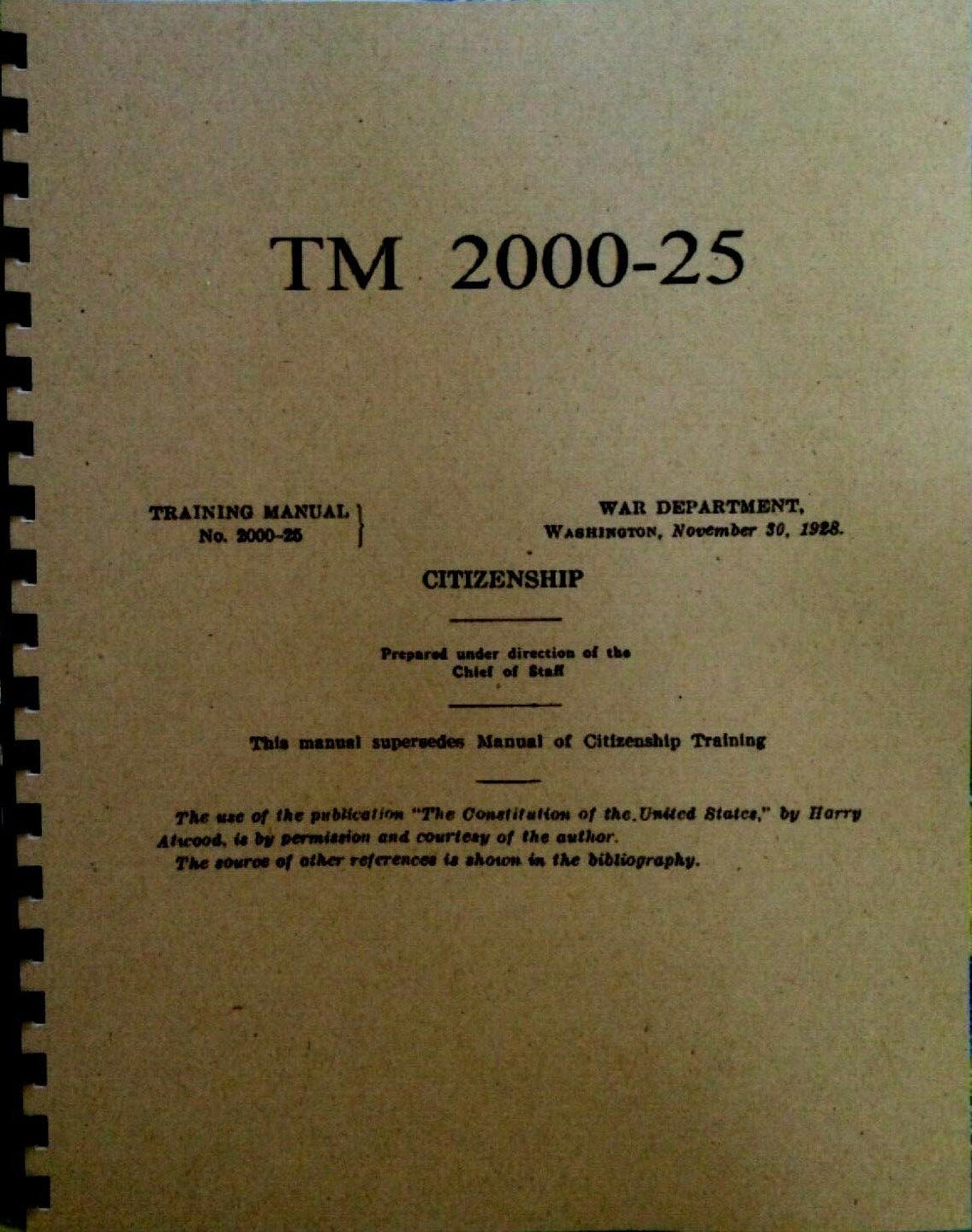
In 1928, the United States War Department published Training Manual No. 2000-25: Citizenship—a document that outlined the fundamental requirements for sustaining the American Republic. This manual, distributed to young men entering military service, addressed a question that modern political discourse carefully avoids: What kind of citizen must exist for republican government to survive?
The manual’s approach was direct and uncompromising. It treated citizenship not as an identity or cultural expression, but as a set of concrete responsibilities and moral obligations. Unlike contemporary civic education, which focuses primarily on rights and entitlements, this document emphasized the duties and character requirements necessary for self-government to function.
The Core Premise: Liberty Requires Active Maintenance
The manual’s authors understood that freedom is not self-sustaining. They explicitly rejected the modern assumption that liberty, once established, continues automatically. Instead, they argued that national defense begins with citizenship training—because a republic defended by military force but undermined by civic ignorance will collapse from internal weakness.
According to the manual, liberty depends on five essential foundations:
Educational competence among the general population
Moral character demonstrated through individual behavior
Individual initiative rather than dependency on collective solutions
Respect for law as the framework for ordered freedom
Loyalty to constitutional principles above all other allegiances
The manual warned that removing any of these elements weakens the republican structure, while eliminating several guarantees its collapse. This analysis directly contradicts current approaches that treat civic education as optional and assume institutional mechanisms can substitute for individual virtue.
Individual Initiative: The Political Foundation Under Attack
The manual places extraordinary emphasis on individual initiative, tracing this principle through Anglo-Saxon legal traditions, English common law, and American colonial experience. This emphasis reflects a crucial understanding: individual initiative operates as both an economic and political force.
The authors argued that citizens incapable of self-governance inevitably demand external governance. American republicanism succeeded because early Americans followed a specific sequence: they worked before demanding, governed locally before appealing to distant authority, and solved problems personally before outsourcing them to institutions.
This sequence created citizens capable of republican participation. The manual explicitly contrasts this approach with collectivist ideologies that reverse the equation—teaching dependency first, grievance second, entitlement third, and personal responsibility never.
The authors identified the tension between individualism and collectivism as the defining political struggle of the future. Their analysis proves remarkably prescient given contemporary debates about the role of government, individual responsibility, and collective welfare.
Citizenship Education and Social Cohesion
One of the manual’s most controversial aspects involves its treatment of assimilation and social cohesion. The authors argue that self-government requires shared civic understanding and cannot survive indefinite cultural fragmentation. They distinguish between tolerance and surrender, claiming that republican institutions depend on common civic knowledge and loyalty.
The manual acknowledges that mass immigration from societies without self-governing traditions presents genuine challenges to republican government unless deliberate citizenship education occurs. This analysis reflects political realism rather than cultural prejudice—self-government represents a learned skill set, not an intuitive human capacity.
Without proper civic education, the manual argues, republican traditions give way to hierarchical authority, factional conflict, or authoritarian control. The proposed solution emphasizes education, assimilation to civic principles, and loyalty to constitutional frameworks above competing allegiances.
The Question of Divided Allegiance
The manual states plainly: “There can be no divided allegiance here.” This principle, considered obvious in 1928, would generate significant controversy today. The authors argue that citizenship, by definition, requires exclusive political loyalty—not cultural conformity or personal assimilation, but political allegiance.
The reasoning follows from the nature of sovereignty: citizens cannot serve competing political authorities, obey contradictory constitutional systems, or claim protection from governments they refuse to defend. The manual connects voting rights, office-holding, and full civic participation directly to demonstrated loyalty and constitutional attachment.
This framework treats voting not as personal expression but as duty owed to the political community. The manual asks whether citizens still understand suffrage as obligation rather than entitlement—a question that challenges contemporary assumptions about democratic participation.
Economic Literacy and Civic Responsibility
The manual’s economic sections emphasize practical knowledge over ideological positions. It rejects assumptions that prosperity occurs automatically or that government can guarantee economic outcomes. Instead, it emphasizes:
Thrift as individual financial responsibility
Skill development through education and training
Capital formation through investment and saving
Productive cooperation between labor and management
Economic literacy among the general population
The authors warn against class conflict, material envy, and economic ignorance, arguing that these forces destroy both productivity and social trust. They understand that specialized modern economies require cooperation between different groups and functions.
The manual makes a crucial observation: economic warfare within a republic remains warfare, regardless of the justifications offered. When citizens view other economic groups as enemies rather than partners in a common enterprise, the social foundation for self-government erodes.
Character as National Foundation
The manual identifies character as “the greatest asset of America”—more important than gross domestic product, military spending, or technological advancement. This priority reflects the understanding that institutions, wealth, and infrastructure represent products rather than sources. Character provides the source from which all other national assets emerge.
The authors trace American character development to specific institutional sources:
Religious discipline providing moral framework and self-control
Family structure teaching responsibility and social cooperation
Local self-government developing practical civic skills
Educational systems transmitting knowledge and cultural wisdom
Moral restraint enabling freedom without chaos
The manual explicitly rejects the concept of collective morality, arguing instead that social morality represents the sum of individual moral quality. This principle directly contradicts modern political theories that assume systemic solutions can replace personal virtue.
The authors understood that corrupt populations inevitably produce corrupt systems. No institutional design can permanently overcome the moral quality of the citizens who operate within it.
Historical Preparation for Self-Government
The manual emphasizes that American self-government resulted from extensive preparation rather than spontaneous enlightenment. The Founders experienced repeated failures, governed at local levels, learned from mistakes, studied historical precedents, and developed practical skills over generations.
This preparation required approximately 150 years before independence became viable. The manual contrasts this careful development with contemporary demands for instant results, zero tradeoffs, and continuous revolutionary change.
The authors warn that freedom without adequate preparation produces chaos, and chaos inevitably generates demands for authoritarian control. This cycle explains why many liberation movements eventually produce tyrannical governments—they lack the civic foundation necessary for sustained self-government.
Practical Patriotism
The manual defines patriotism through specific behaviors rather than emotional expressions or symbolic displays. True patriotism manifests through:
Law-abiding behavior that maintains social order
Tax payment that funds legitimate government functions
Responsible voting based on civic knowledge rather than personal interest
Service when required for national defense or civic needs
Placing national welfare above personal convenience
The manual concludes that declaring “I am an American” represents not a boast but a challenge—a commitment to meet standards that require continuous effort and sacrifice.
Why This Manual Matters Today
Training Manual No. 2000-25 threatens contemporary political assumptions because it exposes dependency relationships that modern systems prefer to obscure. The manual assumes citizens are capable of discipline, that liberty has conditions, that ignorance undermines self-government, and that loyalty matters for political survival.
Most importantly, it assumes the Republic can fail if citizenship education continues treating civic participation as entitlement rather than responsibility.
The Contemporary Challenge
The manual’s authors had witnessed World War I, rapid industrialization, mass immigration, and rising political extremism abroad. They understood institutional fragility and recognized that constitutions cannot enforce themselves.
Their warning remains relevant: no constitution survives without citizens capable of sustaining it. The question today is not whether these principles still apply, but whether enough citizens remain willing to accept the responsibilities that republican government requires.
The manual serves as a reminder that citizenship represents an active choice requiring knowledge, discipline, and commitment. Without these qualities, the institutions designed to protect liberty cannot function, regardless of their theoretical perfection.