


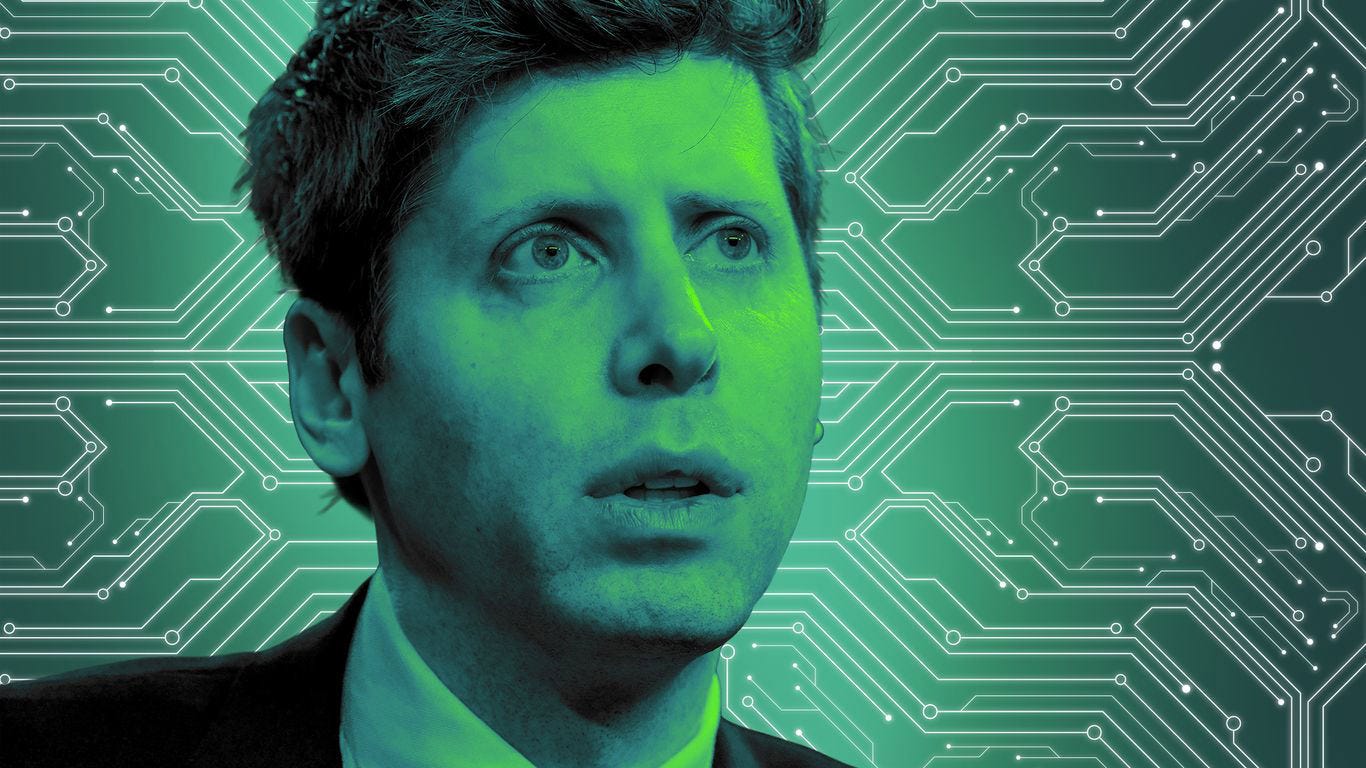
At BlackRock’s U.S. Infrastructure Summit this week, Sam Altman, CEO of OpenAI, made a statement that deserves more scrutiny than it received. “We see a future where intelligence is a utility, like electricity or water,” he told investors.
This wasn’t casual speculation. It was a declaration of intent. Intelligence itself, not the machine producing it, not the interface delivering it, but intelligence as a concept, will become something you purchase. A metered commodity. And the company that promised to democratize artificial intelligence now wants to become its landlord.
The Original Promise
When OpenAI launched in 2015, it positioned itself as a nonprofit research organization. The founding charter stated an explicit goal: to “advance digital intelligence in a way that is most likely to benefit humanity as a whole, unconstrained by a need to generate financial return.”
The founders included Elon Musk, Sam Altman, Greg Brockman, and several AI researchers concerned about concentration of power. Their stated fear was that a single corporation, Google in particular, might develop artificial general intelligence and control it exclusively. OpenAI presented itself as the antidote: open source, nonprofit, accountable only to humanity’s interests.
No shareholders. No proprietary models. No paywalls on knowledge.
A decade later, every one of those principles has been abandoned.
The Structural Transformation
The evolution from nonprofit to trillion-dollar corporation followed a predictable pattern:
2015: Nonprofit Launch
OpenAI established itself with a clear mission statement emphasizing public benefit. Early models were open source. Funding came from philanthropic donations. The commitment to transparency appeared genuine.
2019: Microsoft Investment
Microsoft invested $1 billion in exchange for exclusive cloud computing rights and first access to commercial applications. This marked the first major deviation from the nonprofit model. OpenAI created a “capped-profit” subsidiary, claiming this hybrid structure would allow necessary fundraising while limiting returns to investors.
2020–2023: Source Code Closure
Despite the name OpenAI, the organization stopped releasing model architectures and training details. GPT-3, and later GPT-4, became black boxes. The code, the weights, the training data became proprietary assets. The “Open” in OpenAI became purely historical.
2023: For-Profit Conversion
The capped-profit model proved too restrictive for the scale of capital OpenAI wanted to attract. The company restructured again, this time removing profit limitations entirely. Board governance shifted to prioritize investor returns.
2024–2026: Massive Capital Raises
By February 2026, OpenAI closed a $110 billion funding round from Amazon, NVIDIA,and Soft Bank. The pre−money valuation reached between $110 billion funding round from Amazon, NVIDIA, and Soft Bank. The pre−money valuation reached between $730 billion and $840 billion. These aren’t numbers associated with humanitarian projects. They’re numbers that demand monopolistic returns.
The Data Question Nobody Answers
OpenAI trained its models on virtually the entire accessible internet. Books, articles, code repositories, artwork, forum posts, social media conversations. Billions of hours of human creative and intellectual output, produced by millions of people who never consented to its use in this way.
When artists, writers, and programmers sued over this unauthorized use, OpenAI’s legal defense rested on a claim of “fair use” because the material was publicly accessible online.
This argument treats the internet as a data mine rather than what it actually is: a commons of human expression. People didn’t publish their work so that corporations could build trillion-dollar businesses by automating them out of relevance. They published to share knowledge, build community, advance their fields, or simply express themselves.
The scale of this extraction is unprecedented. OpenAI didn’t license content. It didn’t compensate creators. It simply took, at industrial scale, and now charges access fees to interact with systems built on that taken material.
The Utility Model Explained
When Altman describes intelligence as a utility, he’s invoking a specific economic model with profound implications.
Electric utilities became regulated monopolies because of natural economics. Building parallel power grids is inefficient. One provider can serve a region more cost-effectively than competing networks. In exchange for this monopoly position, utilities accept government regulation of prices and service standards.
But utilities also receive guaranteed returns, captive customer bases, and often public subsidies for infrastructure expansion. The comparison Altman is making isn’t just descriptive. It’s prescriptive.
He wants OpenAI to occupy the same structural position for intelligence that power companies occupy for electricity. A necessary service, unavoidable for participation in modern life, with pricing power and regulatory protection.
Altman has already proposed that the federal government provide loan guarantees for AI data center construction. This would make taxpayers the backstop for OpenAI’s infrastructure investments while the company retains all upside from monetization.
The “too cheap to meter” phrase comes from 1950s promises about nuclear power. That promise never materialized. Instead, nuclear became one of the most expensive forms of electricity. The phrase now functions as shorthand for technological optimism that ignores economic and political reality.
If intelligence requires a meter at all, someone owns the spigot. And if OpenAI controls that spigot, every thought assisted by AI becomes a transaction.
The Stargate Project
Behind the utility rhetoric sits tangible infrastructure expansion. The Stargate project represents OpenAI’s commitment to build data centers at unprecedented scale. Current estimates put total investment at up to $500 billion over the next several years.
Each facility will consume electricity comparable to a small city. The cognitive processing capacity inside these centers could exceed total human cognitive capacity by 2028, according to internal projections Altman shared with investors.
This isn’t speculative. Construction has already begun. Financing is in place. The grid integration studies are underway.
OpenAI is building the physical infrastructure to make intelligence-as-a-service not just possible, but unavoidable. If you want access to AI capabilities that match or exceed human-level performance across domains, you’ll need to connect to this infrastructure. And someone will bill you for that connection.
The Safety Apparatus Dissolves
OpenAI once maintained a team specifically focused on AI alignment and safety. Their job was ensuring that as systems became more capable, they remained beneficial and controllable.
That team has been dissolved. The word “safely” was removed from OpenAI’s mission statement in 2024.
This wasn’t an oversight. It reflects a strategic pivot. Safety concerns create constraints on development speed and monetization timelines. They require transparency that conflicts with proprietary competitive advantages. They raise questions about whether deployment should proceed at all in certain cases.
The dissolution of safety infrastructure while pursuing trillion-dollar valuations reveals the actual priority hierarchy. Growth and market dominance outweigh precautionary principles.
Altman now frames AI advancement as inevitable and necessary for competitive advantage. The framing has shifted from “How do we ensure this technology benefits humanity?” to “How do we ensure America leads in this technology?”
National security arguments now justify speed over safety. The logic is simple: if we slow down for safety considerations, competitors won’t, so we’ll lose strategic advantage. This transforms caution into liability.
What Gets Lost
The shift from open research to proprietary service fundamentally changes what AI development optimizes for.
Open research optimizes for understanding, reproducibility, and distributed innovation. Anyone can examine methods, challenge conclusions, build on findings, or develop alternatives.
Proprietary services optimize for user retention, pricing power, and competitive moats. The goal becomes locking users into ecosystems where switching costs are high and alternatives are limited.
These aren’t compatible optimization targets. A company cannot simultaneously maximize shareholder returns and freely distribute the source of those returns.
When OpenAI was a nonprofit, its incentive was producing beneficial AI. Now that it’s a for-profit corporation valued near a trillion dollars, its incentive is producing profitable AI. Those might overlap, but where they conflict, profit wins. Corporate structure guarantees this.
The Broader Pattern
OpenAI’s trajectory isn’t unique. It follows a well-established pattern in technology sectors:
Identify a domain that operates as a commons or public good
Enter that domain claiming to protect or democratize it
Achieve scale by leveraging open resources and network effects
Close the platform once dominance is established
Extract rent from the newly privatized resource
We’ve seen this with social media platforms that built user bases by promising open connection, then monetized attention through algorithmic curation and advertising.
We’ve seen it with ride-sharing services that promised to disrupt taxi monopolies, then became new monopolies with surge pricing.
We’ve seen it with cloud services that commoditized computing resources, then locked users into proprietary ecosystems.
The pattern is consistent because it works. By the time users recognize the bait-and-switch, switching costs are prohibitive and alternatives have been starved of the oxygen needed to compete.
The Policy Vacuum
This transformation happens in the absence of regulatory frameworks designed for it. Existing law doesn’t clearly address whether training AI on copyrighted material constitutes infringement. Antitrust frameworks struggle to identify monopolistic behavior in markets that didn’t exist five years ago.
By the time policy catches up, market structure will be entrenched. Once OpenAI and a handful of competitors control the infrastructure, the compute, the models, and the distribution channels, regulation becomes vastly more difficult.
Incumbents can afford compliance costs that crush potential competitors. They can shape regulatory frameworks through lobbying and expertise asymmetries. They can argue that breaking them up would harm national competitiveness.
The window for structural intervention closes quickly. We’re watching it close in real time.
Two Possible Futures
The utility comparison clarifies what’s at stake. If intelligence genuinely becomes infrastructure, two paths are available:
Path One: Public Infrastructure
Intelligence infrastructure is treated like roads, water systems, or the early internet. Public investment, open standards, common-carrier obligations, and regulated access ensure broad benefit. Training data is transparently sourced and appropriately compensated. Models are open for inspection and improvement. Competition remains possible because the foundational layers are accessible.
Path Two: Private Infrastructure
A small number of corporations own the models, the compute, the training data, and the access points. They set prices, determine availability, and shape what intelligence capabilities exist. Public subsidy underwrites their expansion while private shareholders capture returns. Alternatives can’t compete because the capital requirements and data advantages are insurmountable.
Without deliberate policy choices, the second path is the default. Market dynamics favor consolidation. First-mover advantages compound. Network effects create winner-take-all outcomes.
What This Means Practically
If the utility model succeeds, several concrete changes follow:
You will subscribe to intelligence services the way you subscribe to internet access or phone service. Free tiers will exist but with meaningful limitations. Competitive pricing will give way to price increases as alternatives disappear.
Your cognitive work will generate data that improves the systems you pay to access. Every query trains the model. Every interaction refines the product you’re purchasing. You’re simultaneously customer and unpaid contributor.
The boundary between augmented thinking and dependent thinking will blur. If AI assistance becomes standard for professional work, education, creative production, and daily decision-making, the absence of that assistance becomes a competitive disadvantage. Subscription becomes necessary, not optional.
Control over training data and model behavior gives platforms power over acceptable discourse. If a company mediates access to intelligence, it can shape what intelligence produces. Content policies, safety filters, and alignment techniques all embed values and priorities that users inherit.
The Enclosure of the Commons
Economic historians describe “enclosure” as the process by which common land in England was privatized. Fields that communities shared for grazing, farming, and gathering became private property through legal and political mechanisms that benefited landowners at the expense of commoners.
What’s happening with AI is structural enclosure of the cognitive commons. The internet functioned as a shared space where human knowledge, creativity, and communication accumulated. That accumulation was largely non-rival, information could be copied and shared without depleting the source, and non-excludable, blocking access was difficult and generally not attempted.
AI companies are making this commons both rival and excludable. The training data is privatized. The models are closed. The outputs are monetized. Access requires payment. What was open becomes gated.
And because the training data came from the commons, this represents a transfer. Value created collectively becomes owned privately. The people whose work built the training corpus now pay for access to systems that wouldn’t exist without that work.
Where This Ends
Sam Altman believes he’s building the infrastructure for an “intelligence age” where cognitive abundance solves problems that human thinking alone cannot. That framing treats AI as purely additive, more intelligence is simply better.
But intelligence shaped by profit motives and deployed through proprietary platforms isn’t neutral abundance. It’s intelligence optimized for specific ends by entities with specific interests.
If your access to augmented cognition depends on a subscription, someone else decides the price of your participation in that augmented world. If the models that assist your thinking are trained on principles you don’t control, your thinking inherits those principles whether you agree with them or not.
The future where intelligence is a utility controlled by private corporations isn’t one where humanity gains a tool. It’s one where a tool gains leverage over humanity.
And the man who built that tool is telling you clearly what he intends. The question is whether anyone is listening closely enough to object before the infrastructure is too entrenched to change.
In 1776, people revolted over a tax on tea.
In 2026, they might need to revolt over a tax on thought.