

“Where an excess of power prevails, property of no sort is duly respected. No man is safe in his opinions, his person, his faculties, or his possessions.”
– James Madison
Christmas came and went. The old jokes about Santa watching, lists being made, kids behaving because someone was “always watching.” What used to be harmless folklore reads differently now. Not as a joke. Not as nostalgia. As a warning we ignored.
The song faded. The lights came down. The surveillance stayed.
That playful holiday threat turned out to be a near-perfect metaphor for modern governance. Someone is making lists. Someone is checking them twice. Unlike Santa, these lists don’t disappear with the decorations. They follow you for life.
This isn’t paranoia. It’s infrastructure. And it’s time you understood exactly what you’re facing.
Santa watched for a season. The state watches forever. Santa judged behavior. The state predicts it. Santa delivered coal. The state delivers consequences that ruin lives quietly and efficiently—frozen accounts, grounded flights, permanent flags on records no citizen can access or challenge.
Americans allowed this. We permitted the construction of a surveillance apparatus so expansive, so invasive, and so unaccountable that it would embarrass the secret police of the 20th century. Not through conquest. Through consent, convenience, and apathy.
That ends now. Or it ends us.
Know What You’re Fighting
Your phone tracked your location long after the holidays ended. Not just GPS coordinates. Tower pings. WiFi connections. Bluetooth handshakes. A mesh of signals painting your life in real-time resolution. Carriers sold this data. Brokers packaged it. Agencies bought it. No warrant required when the private sector does the collecting.
Your car logged every mile. Modern vehicles contain dozens of computers, recording speed, location, acceleration, braking patterns, seatbelt usage. This data flows to manufacturers, insurers, and anyone willing to pay. Law enforcement bypasses the Fourth Amendment by purchasing what they can’t seize.
License plate readers stitch together your movements. Mounted on police cars, traffic lights, parking garages, tow trucks. Each scan timestamped and mapped. Drive through a protest? Logged. Visit a mosque? Recorded. Park near a political meeting? Cataloged forever.
Smart devices listen patiently. Alexa hears your arguments. Ring watches your neighbors. Your TV tracks your viewing. Your thermostat learns your schedule. Each device a node in a surveillance network you paid to install. Corporate terms of service replaced constitutional protection.
Stop pretending this is abstract. This is your daily life.
Fusion centers merged local and federal data streams. Information sharing agreements dissolved jurisdictional boundaries. Local police access federal databases. Federal agencies tap local cameras. The distinction between levels of government vanished in the data flow.
Travel data became an enforcement pipeline. The TSA’s mission expanded far beyond airports. Bus companies share passenger lists. Train tickets trigger database checks. People with no criminal record get detained, questioned, or flagged simply for being present. Wrong name. Wrong origin. Wrong destination. Wrong timing.
The presumption of innocence inverted. Prove you’re not a threat. Explain your innocence. Justify your movement. In a free country.
This is what you’re up against. Now decide what you’re going to do about it.
Understand the Logic That Enslaves
“Patterns of life,” they call it. A bloodless phrase for mapping human existence.
The concept came from military intelligence. Tracking insurgents in war zones. But wars end. The technology came home. Combat techniques became law enforcement tools. You became a pattern to analyze.
Where you go. Who you meet. What you believe. What you might do next.
Algorithms assign meaning to movement. Visiting certain locations raises flags. Meeting certain people triggers alerts. Patterns deemed abnormal generate reports. Code decides who deserves scrutiny. Not judges. Not juries. Code.
Predictive policing completed the turn. Algorithms trained on biased data assign risk scores to human beings. Not for crimes committed, but for probabilities calculated. Routes deemed suspicious. Associations deemed risky. Entire lives reduced to models no one can inspect or challenge.
You aren’t judged by actions anymore. You’re judged by proximity, prediction, and profile.
Live in the wrong neighborhood? Higher risk score. Know the wrong people? Flagged for monitoring. Travel the wrong routes? Suspicious pattern detected. The presumption of innocence dies in algorithms. Everyone becomes potentially guilty of crimes not yet committed.
Companies claim trade secrets. Agencies cite national security. Courts defer to both. The systems that judge you became black boxes. No transparency. No accountability. No appeal that means anything.
Computer says guilty. Case closed.
This is the logic you must reject. Completely. Loudly. Relentlessly.
Recognize the Expansion That Never Stops
Every surveillance tool follows the same pattern. Introduced for extreme cases. Expanded to routine use. Normalized across populations. The extraordinary becomes ordinary. The targeted becomes universal.
What was built for “them” never stayed with them.
Driver databases, utility records, financial data, facial recognition networks—all feeding a system with one lesson learned. If it works on one population, it can work on any population.
History always runs that script. Social Security numbers that would “never be used for identification.” Census data that located Japanese Americans for internment. Communist blacklists. Civil rights surveillance. Every tool of tracking found new purposes. Every database discovered new uses. Every promise of limitation broke under necessity, convenience, or fear.
Watchlists metastasized. The no-fly list grew from dozens to thousands to tens of thousands. Names added through association, algorithm, or accident. Senator Ted Kennedy found himself flagged. If senators face that wall, ordinary citizens face a fortress.
Gang databases swallow children. Kids added for wearing certain colors. For living on certain blocks. For knowing certain people. Once listed, always suspect. Job applications denied. Housing rejected. Lives constrained by designations made in childhood.
Suspicious Activity Reports harden prejudice into permanent records. Photography becomes suspicious. Note-taking raises flags. Asking questions triggers reports. The criteria stay secret. The evidence stays classified. The appeals stay meaningless.
Even dissent gets cataloged. Journalists criticized. Protesters flagged. Critics labeled. The First Amendment still exists on paper. Exercise it, and expect surveillance. Protest peacefully, and join a database. Question authority, and accept the scrutiny.
Public “naughty lists” were floated, tested, and walked back—not because they were wrong, but because the timing wasn’t right. The infrastructure remains. Waiting for the right crisis. The right fear. The right moment.
Stop waiting for that moment to arrive. Start acting before it does.
See What Authoritarianism Looks Like Now
This is modern authoritarianism. Not boots, but databases. Not gulags, but algorithms. Not censorship by force, but prediction by proxy.
No mass arrests. Just mass surveillance. No official censorship. Just algorithmic suppression. No declared enemies. Just risk scores and watch lists. Soft totalitarianism. Wrapped in safety. Delivered by convenience.
The Founders understood this because they lived under surveillance. Writs of assistance. General warrants. Soldiers quartered in homes. They knew how power coupled with visibility leads inevitably to control.
That’s why they demanded warrants, probable cause, and due process. They knew a government that sees everything eventually controls everything.
The Fourth Amendment wasn’t written for criminals. It was written for citizens. For the space between public and private. For conversations, associations, and activities that free people conduct without oversight. Privacy isn’t about having something to hide. It’s about having space to be human without performing for authority.
We forgot that. Step by step. Crisis by crisis. Convenience by convenience.
We traded foundational rights for false safety. We accepted surveillance to catch them, not us. We believed promises of limitation that evaporated at the first test.
The ratchet only turns one direction. Powers granted are never returned. Emergencies end but authorities remain. Threats evolve but surveillance only grows.
A watched society doesn’t stay free. It becomes compliant. Not through force but through exhaustion. The energy required to maintain privacy becomes overwhelming. Easier to accept. Easier to comply. Easier to pretend the watchers are benign.
Until they aren’t. Until the wrong person takes power. Until the wrong algorithm flags you. Until the system you ignored turns its attention your way.
That day is coming. For everyone. Unless we act.
Reclaim What’s Yours
The surveillance state doesn’t sleep. Processing power never tires. Algorithms never rest. Data centers run constantly. The watching never stops because the infrastructure never stops.
It doesn’t forgive. Every search logged. Every location recorded. Every association mapped. The system remembers what humans forget. It connects dots across decades. It never grants absolution because it never stops judging.
It’s embedded, normalized, and defended by those who benefit from it. Contractors profit from building it. Agencies expand through operating it. Politicians claim safety from supporting it. A surveillance-industrial complex as entrenched as any military equivalent.
But the tools to resist still exist. Law. Encryption. Organization. Constitutional limits.
Courts can still rule. Encryption still works. Citizens can still organize. The Constitution still stands. Technology that enables surveillance can enable privacy. Laws that permit watching can be changed. Power exercised through democratic systems can be checked by democratic action.
What’s missing isn’t technology or precedent. It’s will.
Your will.
Act Like a Free Citizen
Start with your own life. Audit your digital footprint. Encrypt your communications. Use privacy-focused tools. Delete apps that surveil you. Reject devices that listen. Treat convenience as the trap it often is.
Demand warrant requirements be real, not theoretical. Support organizations fighting for digital rights. Fund legal challenges to surveillance overreach. Make privacy a voting issue. Make surveillance a disqualifier for candidates who expand it.
Educate your community. Your neighbors don’t know the scope of what watches them. Tell them. Your family doesn’t understand the permanence of digital records. Explain it. Your friends think they have nothing to hide. Show them why that thinking is the problem.
Organize locally. Oppose surveillance infrastructure in your city. Fight license plate readers at municipal meetings. Challenge police partnerships with surveillance companies. Make your local government answer for every camera, every database, every sharing agreement.
Push for legislation with teeth. Warrant requirements for location data. Prohibitions on facial recognition. Mandatory transparency for algorithmic decision-making. Sunset clauses on surveillance authorities. Real penalties for violations.
Support journalism that exposes the system. The surveillance state survives partly through obscurity. Investigative reporting shreds that cover. Fund it. Share it. Demand more of it.
Run for office if you have to. The people making these decisions often face no opposition. No one asks them hard questions about surveillance because no one runs against them on those issues. Change that.
Raise children who understand privacy as a right, not a relic. The next generation is being taught that surveillance is normal. Counter that programming. Teach them the history of what happens when governments see everything. Give them the tools and the mindset to resist.
Choose Before the Window Closes
We can accept the digital panopticon and call it safety. Or we can reclaim the republic that assumed citizens were innocent, not perpetually suspect.
The choice is still available. But windows close. Infrastructure hardens. Habits form. Each year of acceptance makes resistance harder. Each generation raised under surveillance considers it normal. The extraordinary becomes mundane through repetition.
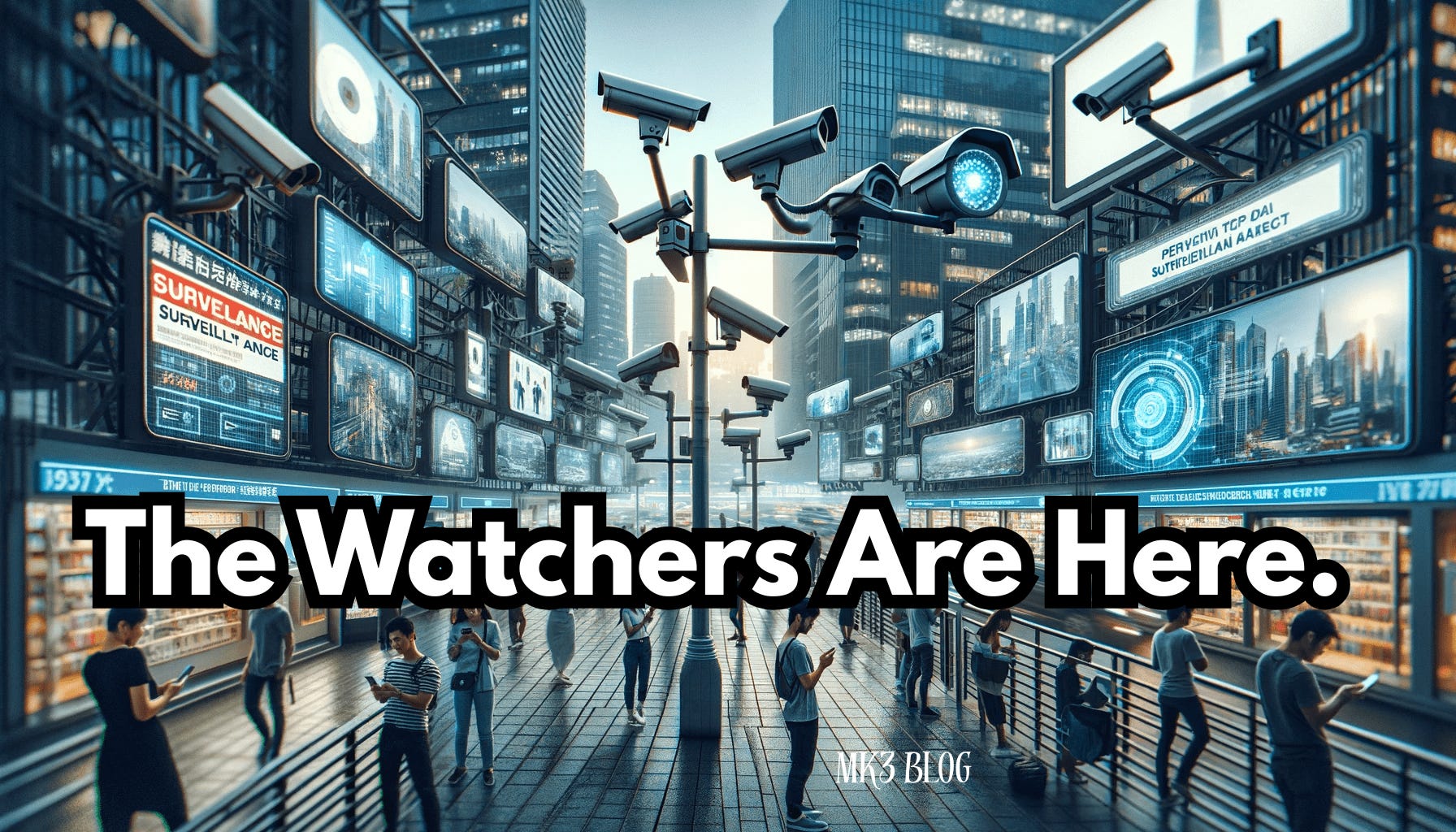
The watchers are already here. In your pocket. On your street. In your car. At your job. They see your purchases, your travels, your associations, your interests. They predict your behavior. They assign your risk. They compile your permanent record.
The surveillance state counts on your exhaustion. On complexity that breeds resignation. On convenience that sedates resistance. On fear that justifies expansion.
Don’t give them what they expect.
The tools exist. The law remains. The choice is yours.
But choosing requires admitting what we’ve built. What we’ve accepted. What we’ve become. A watched people. A cataloged nation. A republic that traded its birthright for the illusion of safety.
That changes when you decide it changes. Not by accident. Not by hoping. Not by waiting for someone else.
By you. Acting like you understand what’s at stake. Acting like you see what’s watching. Acting like you remember what freedom costs.
The surveillance state is here. Permanent. Patient. Growing.
The only question left is what you intend to do about it.
So answer it. Not tomorrow. Not after the next election. Not when it’s convenient.
Now.