


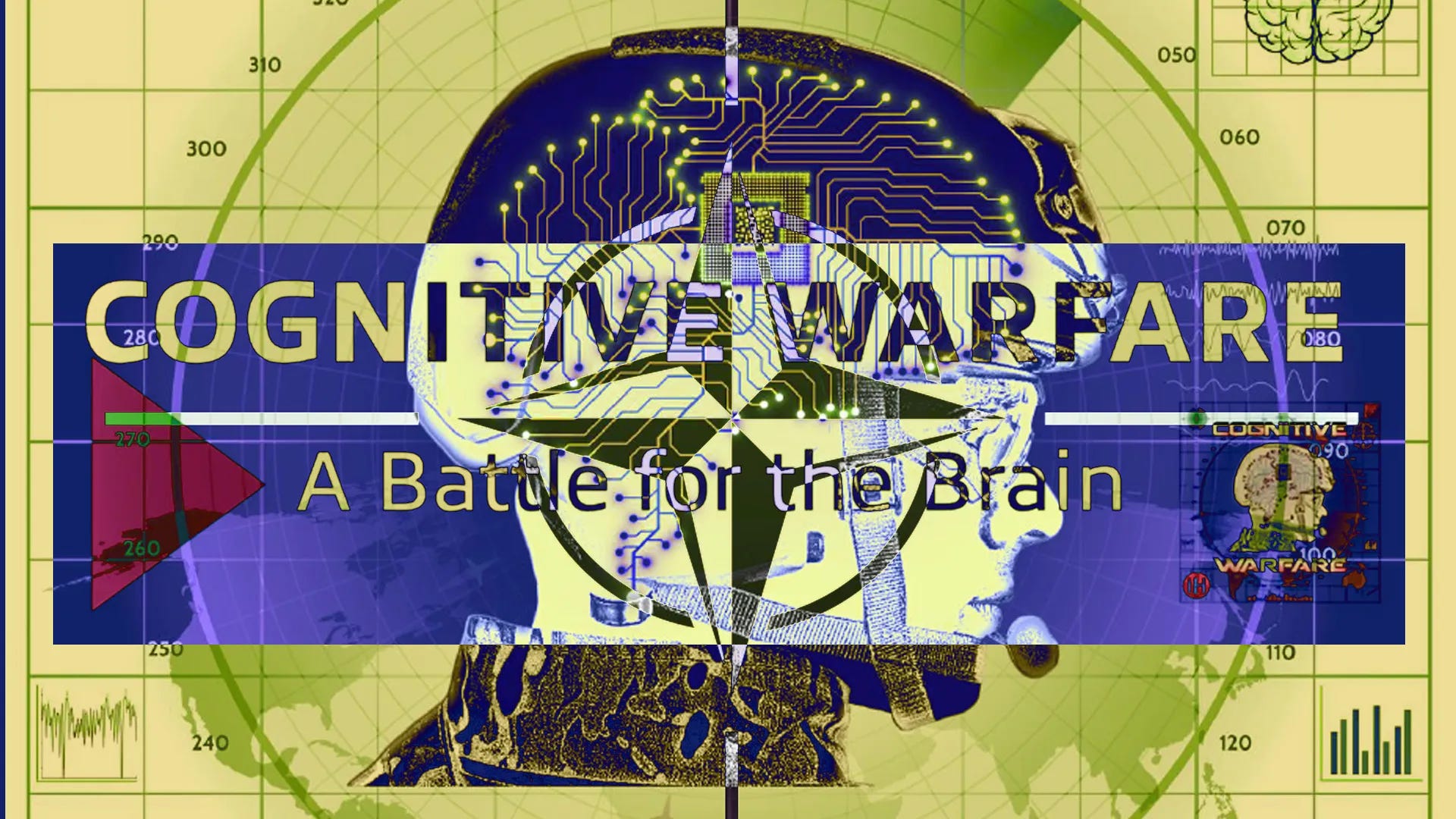
The Mind as Battlefield
The battlefield has moved inside your head. Military strategists no longer focus solely on controlling territory, supply lines, or even information networks. The target is human cognition itself; the mental processes that determine what people believe, how they interpret reality, and what actions they take.
This shift represents the emergence of cognitive warfare, a discipline that NATO’s 2021 Innovation Hub document defines as operations designed to “make enemies destroy themselves from the inside out.” Unlike traditional propaganda, which attempts to persuade, cognitive warfare seeks to reprogram the cognitive frameworks through which people process information.
Recent analyses from the Irregular Warfare Initiative, Small Wars Journal, and specialized publications like Neural Horizons document a troubling consensus among military strategists: control in the twenty-first century depends on perception engineering. The implications extend beyond military conflict into the foundations of democratic governance, individual autonomy, and social cohesion.
Evolution of the Battlespace
Warfare has consistently evolved to target whatever provides strategic advantage. Ancient conflicts centered on controlling land and resources. Naval power dominated trade routes. Air superiority determined industrial-age outcomes. The information age introduced cyberwarfare, where networks and data became strategic assets.
Cognitive warfare represents the logical endpoint of this progression. Rather than destroying infrastructure or even corrupting data, attackers target the human decision-making process itself. The European Nexus for Strategic Intelligence describes this as the “battlefield of perception”; where victory depends not on what information exists, but on how meaning is constructed from it.
The Cold War demonstrated early applications of this approach through influence campaigns designed to shape enemy morale and public opinion. However, modern cognitive warfare operates with unprecedented precision. Machine learning algorithms, behavioral data analytics, and predictive modeling enable attackers to manipulate individual psychological vulnerabilities at scale.
The perfect cognitive attack leaves targets convinced they were never attacked at all. Internal collapse occurs through the manipulation of belief systems, trust networks, and perceptual frameworks.
Defining Cognitive Warfare
Cognitive warfare builds upon but extends beyond related concepts:
Psychological Operations (PSYOP) involve deliberate military efforts to influence emotions and reasoning in target audiences. These operations traditionally focus on foreign populations during active conflicts.
Information Warfare encompasses the struggle to control data flows, communications channels, and media narratives. The objective is managing access to information.
Cyber Warfare targets digital systems through manipulation or disruption of technological infrastructure.
Cognitive Warfare synthesizes these approaches while targeting human cognition directly. It attacks the mental filters people use to distinguish truth from falsehood, the emotional triggers that drive interpretation, and the neurological pathways that process reward and threat.
NATO documentation emphasizes two primary objectives: destabilization through the cultivation of distrust, confusion, and division; and influence through the manipulation of public behavior and policy decisions to serve external interests.
Where classical propaganda aimed to persuade through argument, cognitive warfare reprograms cognitive processes to bypass rational analysis entirely.
Operational Methods
Algorithmic Amplification Systems
Social media platforms function as automated influence machines. Their engagement-maximizing algorithms systematically promote content that generates strong emotional responses; particularly outrage, tribal identification, and fear. The OODA Loop’s analysis of psychological operations concludes that society now exists within “a contested cognitive terrain...an always-on influence layer that no longer requires state sponsorship to manipulate belief.”
This system’s effectiveness stems from its decentralized nature. No single actor controls it, yet the profit-driven architecture of digital media automatically fragments public discourse into polarized communities that reinforce existing beliefs while rejecting contradictory information.
AI-Generated Content Pipelines
Independent analyst Peter Benson documents what he terms a “cognitive weapons pipeline” in Neural Horizons publications. This process involves sourcing behavioral data on target populations, designing targeted narratives, generating synthetic content through artificial intelligence, and deploying it across multiple distribution channels.
AI integration enables industrial-scale deception. Low-cost production of high-volume fabricated content floods information channels faster than verification systems can respond. Sophisticated attackers deliberately exploit AI limitations, using what Benson calls “hallucinatory confabulation” tuning generative models to produce believable falsehoods that overwhelm fact-checking resources.
Sensory Manipulation Technologies
James Grundvig’s Battle 4 Cognition research explores how augmented reality, virtual reality, and biometric feedback systems can directly manipulate perception. Visual overlays, spatial audio, and emotional modulation systems can tune entire sensory environments to promote or suppress specific psychological states.
This approach to “perceptual governance” operates through comfort rather than coercion. People voluntarily choose manipulated experiences because they feel more pleasant than unfiltered reality. The psychological conditioning creates compliance loops that make resistance feel inherently uncomfortable.
Cognitive Contagion Mechanisms
Jeremiah Lumbaca’s research for the SOF Support Foundation describes “cognitive contagions”—self-replicating ideological constructs that spread through social networks like malware. These constructs embed emotional heuristics and logical fallacies within normal social interaction, creating what researchers call “epistemic closure.”
The goal is fragmenting populations until shared truth becomes impossible. When communities cannot agree on basic facts, democratic deliberation becomes impossible and social cohesion dissolves.
Strategic Implementation
Frank Hoffman’s 2025 analysis in Small Wars Journal states that “war in the future will not be wars of attrition, but wars of cognition.” This assessment reflects documented strategic planning by major military powers.
The People’s Liberation Army openly discusses “cognitive domain operations” as central to future military doctrine. Chinese strategists define this as coordinated use of cyber capabilities, artificial intelligence, neuroscience research, and behavioral data to alter adversary decision-making without kinetic operations.
The cost advantages are substantial. Psychological defeat costs cents on the dollar compared to conventional military operations. The effects persist because damage occurs in the mental models people use to interpret reality rather than in physical infrastructure that can be rebuilt.
A society that loses the ability to distinguish truth from fabrication becomes easy to control or collapse. When trust in institutions erodes and communities fragment, external manipulation becomes unnecessary—the target system destroys itself.
American Vulnerabilities
The United States has historically treated information operations as wartime tools while assuming that peacetime free speech protections naturally defend truth. However, cognitive warfare inverts this assumption. Openness becomes vulnerability when attention functions as currency and truth competes poorly with entertainment and outrage.
Current symptoms include widespread institutional distrust, community fragmentation, politicization of scientific evidence, and citizen inability to distinguish authentic from fabricated content. These conditions result from deliberate strategic operations exploiting psychological and technological vulnerabilities rather than natural social evolution.
NATO’s 2021 assessment warned that democracy’s greatest asset—freedom of thought—had become its primary vulnerability. Trust, rather than truth, represents the ultimate strategic target. Once trust networks fracture, legal, political, and social systems begin internal dissolution.
Defensive Frameworks
Defending against cognitive warfare requires different approaches than traditional information security. Censorship and narrative control deepen division rather than restoring coherence. Effective defense emerges through transparency, critical awareness, and psychological sovereignty.
Individual Cognitive Hygiene
Personal defense begins with what military theorists call “cognitive hygiene”—slowing the reaction cycle between information exposure and belief formation. This involves verifying source credibility, identifying potential conflicts of interest, and examining information patterns before forming conclusions.
Rather than seeking confirmation of existing beliefs, effective cognitive defense actively seeks contradictory information. This approach builds resistance to manipulation while maintaining intellectual flexibility.
Community Trust Networks
Local, interpersonal relationships provide natural immunity to algorithmic manipulation. Face-to-face conversation cannot be mediated by digital amplification systems or targeted by behavioral analytics. Every genuine community discussion weakens the influence architecture that enables cognitive warfare.
Rebuilding local civic institutions, neighborhood organizations, and professional associations creates redundant trust networks that resist centralized manipulation attempts.
Institutional Transparency
Government agencies must embrace open data policies and honest risk communication. Secrecy and paternalistic information management, even when well-intentioned, create information vacuums that manipulators exploit.
When authorities withhold information or provide sanitized communications, conspiracy theories and alternative narratives fill the gaps. Transparency builds credibility that outcompetes manipulation over time.
Ethical Implications
Cognitive warfare creates fundamental tensions within democratic societies. Free speech protections and open information flow—core democratic values—provide the vectors through which cognitive attacks operate.
Digital platforms have become weapon systems where engagement metrics replace moral reasoning. The architects of these systems exercise more influence than intelligence agencies while operating without accountability or oversight.
Philosopher Adam Henschke describes this condition as “soft domination—where free people behave like captured systems.” Citizens retain formal freedoms while losing practical agency to algorithmic manipulation and manufactured consensus.
Regulating cognitive influence presents inherent dangers to democratic governance, yet unregulated manipulation threatens democratic survival. The challenge involves protecting cognitive liberty without enabling cognitive warfare.
Conclusions
Cognitive warfare represents civilization’s current defining struggle—whether individuals retain meaningful agency in an age of pervasive manipulation. Every digital device, social media feed, and broadcast signal functions as a potential influence vector. Each unexamined reaction becomes a weapon against rational decision-making.
The consequences of inaction extend beyond political dysfunction. Societies that lose the ability to discern truth lose institutional memory and historical continuity. Shared reality dissolves into competing narratives with no common foundation for collective action.
Defense begins with recognition rather than policy. Citizens become combatants by default in a war most do not recognize exists. Each act of careful attention and independent judgment becomes resistance against cognitive manipulation.
The remaining frontier is internal—the preservation of mental autonomy against industrial-scale influence operations. Democratic survival depends on whether ordinary people rediscover the discipline to think independently and defend truth as civic responsibility rather than personal convenience.
Resources:
https://www.nato.int/content/dam/nato/webready/documents/sto/chief-scientist-report-cognitive-warfare.pdf
https://pmc.ncbi.nlm.nih.gov/articles/PMC11565700/
https://inss.ndu.edu/Research-and-Commentary/View-Publications/Article/4371195/cognitive-warfare-2026-natos-chief-scientist-report-as-sentinel-call-for-operat/
https://irregularwarfare.org/articles/assessing-cognitive-warfare/
https://www.act.nato.int/activities/cognitive-warfare/