


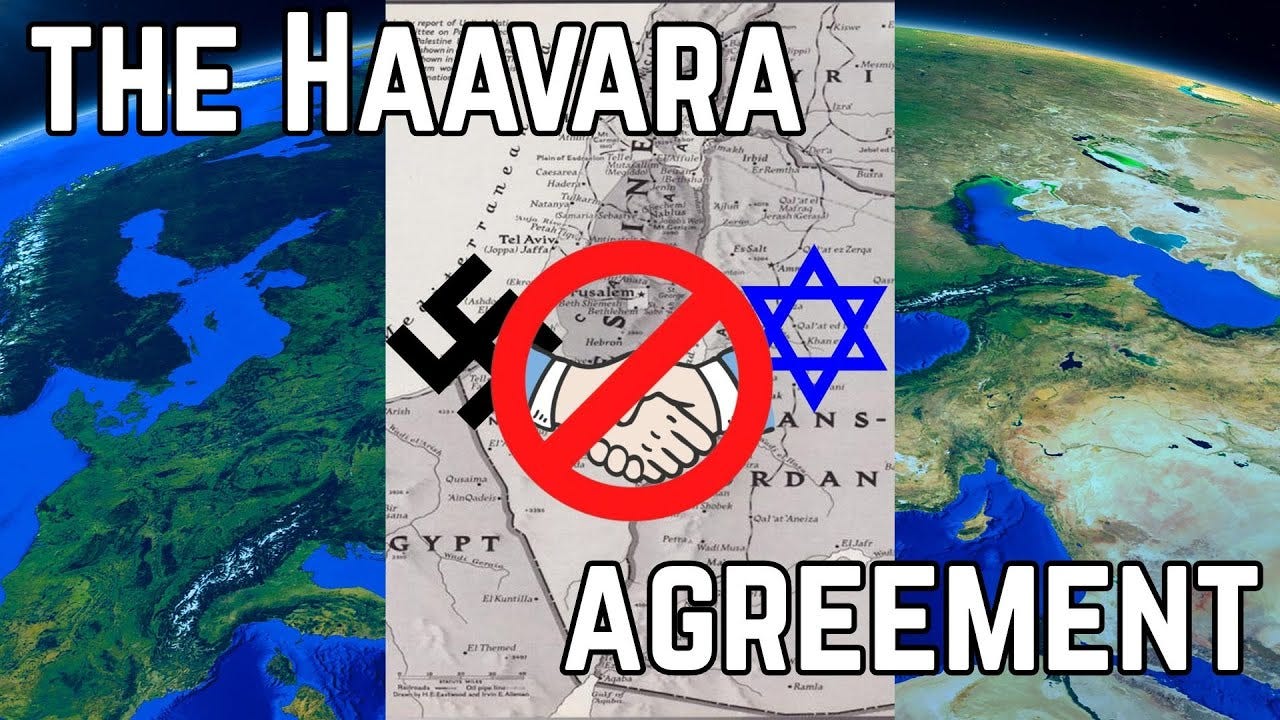
The Deal Nobody Taught You About
In 1933, the Zionist Federation of Germany and the Jewish Agency for Palestine entered into a formal economic arrangement with the government of Adolf Hitler. It was called the Ha’avara Agreement. In Hebrew, “ha’avara” means transfer.
This was not a rumor. It was not a fringe discovery buried in obscure archives. It was a documented, official, negotiated agreement that operated for six years, moved tens of thousands of people, and transferred the equivalent of billions in modern currency between two parties that post-war history has presented as locked in total, irreconcilable conflict from the moment Hitler took power.
The agreement has been acknowledged by mainstream historians. It appears in reputable academic texts. It is not disputed. What is disputed, ignored, or actively suppressed is what it means, what it reveals about the relationship between Zionism and National Socialism in the early 1930s, and what questions it logically forces onto the table.
This piece documents what the Transfer Agreement was, how it functioned, what each party gained from it, what it cost them politically, and why the broader questions it raises remain among the most aggressively suppressed in modern Western discourse.
Mechanics of the Arrangement
The Transfer Agreement was formal and structured. Understanding its mechanics is essential to understanding its implications.
A German Jew who wished to emigrate to British Mandate Palestine would deposit a minimum of 1,000 British Pounds Sterling into a special blocked account held at the Paltreu bank in Germany. This was a substantial sum. It represented significant accumulated wealth.
That deposited capital was then used to purchase German-manufactured goods: industrial machinery, agricultural equipment, irrigation hardware, cement, pipes, and other manufactured products. These goods were loaded onto ships and exported to Palestine.
In Palestine, a Jewish-owned company called Ha’avara Ltd. received and sold these German goods on the local market. The proceeds from those sales, converted into Palestinian currency, were then paid out to the emigrant upon their arrival.
The emigrant received a portion of their original deposit back in usable local currency. The exact percentage varied over the life of the agreement and depended on market conditions. Emigrants did not recover the full value of what they deposited. A meaningful portion was lost in the process. But they recovered far more than they would have under the punishing Nazi “flight tax,” which confiscated a substantial percentage of assets from Jews attempting to leave Germany through standard emigration channels.
The Paltreu bank sat at the center of the mechanism. It held the deposits, managed the purchasing of export goods, and coordinated with Ha’avara Ltd. in Palestine. The arrangement was overseen on the German side by the Reich Economics Ministry and on the Zionist side by the Jewish Agency and the Zionist Federation.
This was a functioning economic system, not an informal arrangement. It had institutional infrastructure, legal standing, and the active participation of government ministries on both sides.
What Each Party Gained
The agreement was not charity. It was not humanitarian aid extended by one party to another out of compassion. It was a transaction, and both parties at the table got what they came for.
The Nazi Regime’s Interests
The Nazi government in 1933 had two pressing problems that the Ha’avara Agreement addressed directly.
The first was the Jewish population of Germany. The racial ideology of National Socialism demanded a Germany free of Jewish residents. In the early years of the regime, the primary mechanism for achieving this was not mass murder. It was economic and social coercion designed to make Jewish life in Germany untenable, forcing emigration. The Nazi term for this objective was “judenrein,” meaning Jew-free. Emigration to Palestine was an acceptable and, from the Nazi perspective, efficient means of achieving it.
The second problem was economic. Germany’s economy had been devastated by the Great Depression, and the Nazi government faced an additional threat: a coordinated international boycott of German goods, organized by Jewish organizations worldwide in response to the persecution of German Jews. This boycott was gaining traction and represented a serious threat to Germany’s export economy and foreign currency reserves.
The Ha’avara Agreement attacked both problems simultaneously. It redirected Jewish capital directly into the purchase of German exports, functionally breaking the boycott by creating a pipeline that bypassed it. It simultaneously facilitated the emigration of a portion of the German Jewish population to Palestine.
Leopold von Mildenstein, a Gestapo official who specialized in Jewish affairs, visited Palestine in 1933 and wrote a series of articles for a Nazi publication praising the Zionist project as a constructive form of Jewish nationalism. He even had a medal struck commemorating the trip, with a Star of David on one side and a swastika on the other. This was not aberrant. Senior Nazi officials in the early period viewed Zionism as philosophically compatible with their own ethnic nationalist goals. Both movements held that Jews and Germans were distinct peoples who should have separate national homelands. The Nazis wanted Jews out of Germany. The Zionists wanted Jews in Palestine. Their immediate objectives aligned.
The Zionist Leadership’s Interests
The Zionist leadership faced a different set of pressures, but their calculations were equally pragmatic.
The Jewish Agency and the Zionist Federation were attempting to build a viable Jewish national home in British Mandate Palestine. That project required two things above all else: people and capital. In 1933, the Zionist project was capital-starved, the Jewish population of Palestine was limited, and the British Mandate authorities had placed severe restrictions on immigration that the Zionist leadership was constantly working against.
The German Jewish community was, at that moment, one of the most educated, professionally accomplished, and financially capable Jewish populations in the world. They were also trapped in an increasingly hostile environment with their economic rights being systematically stripped.
The Ha’avara Agreement provided direct access to both. It channeled German Jewish emigrants, along with a significant portion of their capital, directly into the Palestinian Jewish economy. The emigrants arrived not as penniless refugees but as people carrying wealth in the form of goods purchased with their deposits.
Chaim Arlosoroff, the head of the Jewish Agency’s political department who was centrally involved in negotiating the agreement, was assassinated in 1933 under disputed circumstances. David Ben-Gurion, who became the dominant figure in the Zionist leadership, supported the agreement and defended it against fierce internal opposition.
Ben-Gurion’s position was explicit: building the Jewish national home in Palestine was the paramount objective. It superseded abstract principles. It superseded solidarity with the international Jewish boycott movement. He stated that he would make a pact with the devil himself if it advanced the Zionist cause. That was not a metaphor. It was a policy statement.
The Internal Jewish War Over the Agreement
The Ha’avara Agreement did not pass without controversy. It created one of the most bitter schisms in Jewish organizational life in the 1930s.
The opposition was substantial and came from serious people. Rabbi Stephen Wise, one of the most prominent Jewish leaders in the United States, attacked the agreement as a betrayal. The Revisionist Zionist movement under Ze’ev Jabotinsky opposed it fiercely. The World Jewish Congress condemned it. Critics argued, with considerable force, that the agreement legitimized the Nazi regime, broke the economic pressure of the boycott at a critical moment, and represented a moral capitulation to an openly genocidal government.
The economic argument against it was concrete. The international boycott of German goods was causing genuine damage to the German export economy in 1933. It had broad participation, significant public support, and was demonstrating that it could inflict financial pain on the Nazi government. The Ha’avara Agreement created a formal mechanism for redirecting Jewish capital directly into German exports, undermining the boycott’s core strategy.
Critics were not wrong about this. The agreement did weaken the boycott. It did inject German export revenue into the Nazi economy during a fragile economic period.
The counterargument from Ben-Gurion and the Jewish Agency leadership was equally concrete: the boycott, whatever its moral clarity, was not going to save anyone. The Jews of Germany were being economically destroyed in real time. No country, including the United States and Britain, was opening its doors to mass Jewish immigration. The window for getting people and capital out of Germany into Palestine was finite, and the agreement was the mechanism for doing it at scale.
The Twentieth Zionist Congress in 1935 debated the agreement formally. The leadership’s position prevailed. The agreement continued until 1939, when Germany’s invasion of Poland ended any further possibility of its operation.
This internal debate reveals something important. The Zionist leadership’s decision to engage with the Nazi government was not made naively, cynically, or without awareness of what it meant. It was a deliberate strategic choice made under extreme pressure, with full knowledge of the moral costs, because the leadership concluded that state-building in Palestine was the only viable long-term protection for Jewish survival.
The Numbers
The Ha’avara Agreement operated from 1933 to 1939. During that period, approximately 60,000 German Jews emigrated to Palestine under its terms.
The total capital transferred through the mechanism was the equivalent of approximately 140 million in 1930s currency. In 2025 purchasing power terms, that figure represents roughly 2.7 to 3 billion dollars.
This was not marginal. This was foundational.
The capital transferred through the Ha’avara Agreement directly financed the development of infrastructure and industry in British Mandate Palestine that became the economic backbone of the future State of Israel. The Mekorot water company, which still manages Israel’s national water infrastructure, was among the projects financed by Ha’avara capital. Agricultural development, industrial equipment, construction materials, and urban infrastructure were all built with this transferred wealth.
The 60,000 emigrants themselves represented a massive human capital injection. German Jewry was disproportionately educated, professionally trained, and economically capable relative to other Jewish immigrant populations. Doctors, engineers, lawyers, academics, skilled tradespeople, and business owners arrived with professional training and, through the Ha’avara mechanism, with portable capital.
The demographic and economic foundations of the State of Israel, established in 1948, were built in significant part on what the Transfer Agreement delivered between 1933 and 1939.
This is not a controversial historical claim. It is acknowledged in mainstream Israeli and Jewish historiography. The controversy is not about whether these things happened. It is about how to think about what they mean.
What the Agreement Reveals About the Early Nazi Period
The existence and functioning of the Ha’avara Agreement complicates the standard narrative of the Nazi period in ways that deserve direct acknowledgment.
The standard narrative presents the relationship between the Nazi regime and European Jews as a single, unbroken arc of persecution moving toward genocide from the first day Hitler took power. This narrative serves important functions. It provides moral clarity. It makes the Holocaust legible as the inevitable outcome of an exterminatory ideology that never deviated from its ultimate purpose.
The historical record is more complicated.
The Ha’avara Agreement operated with the active participation and formal approval of the Nazi government for six years. During those six years, the regime’s primary mechanism for addressing the Jewish question was coerced emigration, not mass murder. Gas chambers and systematic extermination were not operational until the early 1940s, a full eight to ten years after Hitler took power and four to six years after the Ha’avara Agreement began operating.
This does not minimize what the Nazi regime was. It does not rehabilitate or excuse the ideology. It does not change the outcome. But it does require honest acknowledgment that the relationship between the Nazi government and European Jews in the 1933 to 1939 period was not simply the unrelenting march toward genocide that retrospective accounts often imply.
There was a period in which Nazi policy was oriented toward emigration rather than extermination. There was a period in which the Zionist leadership was formally engaged with the Nazi government in a documented economic arrangement. There was a period in which SS officers received training at Zionist agricultural communities in Germany. These things happened. They are documented. They are part of the historical record.
Acknowledging them is not the same as denying genocide. It is the same as demanding that history be examined as it actually occurred rather than as subsequent narratives require it to have occurred.
The Pre-War “Six Million” References
Separate from the Transfer Agreement itself, there is a documented pattern in Western media and political discourse that predates World War II and deserves examination on its own terms.
References to six million Jews facing catastrophic threat appear in Western sources across several decades before the Holocaust.
During and after World War I, American and British political figures publicly invoked the figure of six million Jews in Eastern Europe described as facing “extermination” or “extinction.” These figures included President Woodrow Wilson and British Foreign Secretary Arthur Balfour. The context was Zionist political advocacy, specifically the campaign to win American and British support for the establishment of a Jewish homeland in Palestine. These statements were not marginal. They appeared in major newspapers and official political contexts.
In the 1920s, American Jewish advocacy organizations used the six million figure in fundraising campaigns, describing that number of Jews in Eastern Europe as facing starvation and persecution. The New York Times and other major publications carried these claims.
The specific number six million appeared repeatedly across multiple separate contexts, applied to the same population group, describing existential threats, before the events of the Second World War.
A responsible historian examining this pattern is required to ask what it means. The presence of this specific number in pre-war discourse does not, by itself, prove anything about the accuracy of the Holocaust death toll. But it does establish that the number had prior political utility, that it was used instrumentally in Zionist political campaigns before the war, and that it was a familiar rhetorical figure in the specific context of Jewish suffering and Western political obligation.
This is a question of historical pattern analysis. It is not, in itself, a denial of the Holocaust. But it is the kind of question that serious historical inquiry requires asking, and the kind of question that current legal and institutional structures in many Western countries treat as prohibited.
Why These Questions Are Legally Prohibited
The legal architecture surrounding Holocaust inquiry represents a direct and deliberate restriction on historical speech in more than 30 countries, including Germany, France, Austria, Hungary, and others.
These laws criminalize denial, minimization, or trivialization of the Holocaust. Penalties include prison sentences. People have served years in prison in European countries for publishing historical arguments, regardless of the evidence cited or the methodology applied.
The enforcement mechanism is instructive. In countries with formal free speech protections, Holocaust denial laws have been upheld by classifying revisionist historical argument not as speech but as action. Specifically, it is classified as incitement to hatred. By reframing historical argument as a form of aggression against a protected group rather than as expression of opinion or scholarly inquiry, courts have been able to uphold these laws within constitutional frameworks that would otherwise protect the speech.
This legal maneuver has practical consequences. It means that a defendant in a German or French court cannot mount a defense based on the historical evidence. The question of whether the evidence supports their claims is deemed irrelevant. The crime is the act of making the claim, not its accuracy. Courts explicitly hold that the historical facts are so well established that questioning them constitutes an aggressive act rather than a scholarly position.
This is a significant departure from the standards applied to every other area of historical inquiry. The history of the Soviet gulags is debated. The death toll of Mao’s Cultural Revolution is contested. The mechanisms and scale of various colonial atrocities are argued over in academic journals without legal consequence. The Holocaust is the only historical event in the modern Western world for which specific conclusions are legally mandated and alternative conclusions are criminally punishable.
A principle of historical inquiry that is applied universally would require that all historical claims be subject to examination, debate, and revision based on evidence. The selective application of legal prohibition to a single historical topic does not strengthen the credibility of the official account. It raises the question of why that particular topic requires legal protection that no other historical claim requires.
David Irving, a British historian whose work was deeply flawed and whose conclusions were often indefensible, nonetheless served time in an Austrian prison for Holocaust denial. Ernst Zundel, a German-Canadian publisher, was extradited from Canada to Germany and imprisoned. These prosecutions did not resolve any historical dispute. They punished individuals for the act of raising questions, regardless of the evidence.
The chilling effect of these prosecutions extends far beyond the individuals directly punished. Academics, journalists, and researchers who might otherwise engage with revisionist arguments or primary sources are deterred by the professional and legal consequences of being associated with prohibited inquiry.
The Structural Function of the Holocaust Narrative
Setting aside the question of historical accuracy, the Holocaust narrative serves specific, identifiable structural functions in post-World War II Western political order.
It provides the primary moral justification for the existence and Western support of Israel. The argument that a people who faced attempted extermination require a secure national homeland, and that Western nations bear a moral obligation to support and protect that homeland, rests on the Holocaust as its foundation. Any significant revision of the scale or nature of the Holocaust would directly implicate this political obligation.
It provides the framework for German reparations, which have transferred hundreds of billions of dollars from Germany to Israel and individual survivors over the past eight decades. This is an ongoing financial transfer that depends directly on the official historical account.
It functions as the dominant moral reference point for Western political discourse on questions of ethnic nationalism, collective identity, and minority rights. The phrase “Never Again” is invoked across a wide range of policy debates, functioning as a moral trump card that closes arguments rather than advancing them.
None of this analysis requires that the Holocaust did not occur. These structural functions exist regardless of the historical accuracy of the account. But acknowledging that a historical narrative serves powerful political and financial functions is a prerequisite for evaluating it honestly. Any account that serves such functions has interests attached to it. Those interests do not automatically distort the account, but they must be acknowledged when assessing why the account is protected the way it is.
The Standard That History Requires
The Ha’avara Agreement is documented and verifiable. Its mechanics are not in dispute. Its outcomes are measurable. Its implications for the standard narrative of the Nazi-Zionist relationship are significant and have not been adequately integrated into mainstream historical education.
The pre-war references to six million Jews facing catastrophic threat are documented in newspaper archives and public records. They are accessible. They constitute a pattern that responsible historical inquiry requires examining.
The legal prohibition on Holocaust revisionism is a documented fact of European and Israeli law. Its structure, its enforcement mechanism, and its effect on public discourse are all observable and verifiable.
These are three separate but connected evidentiary threads. The first establishes that the relationship between Zionism and National Socialism in the 1930s was more complex than standard accounts present. The second establishes that a specific figure with significant political utility had prior usage before the events it is now used to describe. The third establishes that this particular area of history is insulated from the scrutiny applied to all other historical topics, through legal coercion.
The standard that history requires is consistent. A claim is examined on its evidence. The evidence is weighed. Conclusions are drawn proportionate to the evidence and held provisionally, subject to revision. This standard is applied to all historical claims without exception, or it is not a standard. It is a selective tool.
Documenting the Transfer Agreement, examining the pre-war “six million” pattern, and analyzing why Holocaust revisionism is criminalized are all acts of historical inquiry, not acts of hatred. The insistence that they are the same thing is itself a claim that requires evidence and does not receive it.
The record exists. The archives are accessible. The questions are legitimate. What you do with that is yours to decide.
Margin of the Law publishes constitutional analysis, civic research, and legal education for people who want to understand the system they actually live in. Read the Full Constitutional Analysis Library at marginofthelaw.com.
© 2026 – MK3 Law Group
For republication or citation, please credit this article with link attribution to marginofthelaw.com.