



The Historical Record They Don’t Want You to Examine
In 1933, something happened that shatters the neat, sanitized narrative you’ve been fed about World War II. The Ha’avara Agreement—Hebrew for “transfer”—was struck between Zionist agencies in Palestine and Adolf Hitler’s Nazi government.
Read that again. Let it sink in.
This was not a secret negotiation discovered decades later by rogue historians. This was an official, documented arrangement that moved people, money, and goods between two parties we’ve been taught were locked in an existential struggle from day one.
You need to understand what actually happened here. Because if you understand the Transfer Agreement, you start understanding why certain questions about this era will get you fired, deplatformed, and in some countries, imprisoned.
The Mechanics of the Bargain
Here’s how the deal worked. Pay attention to the details, because the details reveal the nature of the arrangement.
A German Jew wanting to emigrate to Palestine would deposit a minimum of 1,000 Pounds Sterling—a fortune at the time—into a special account at the Paltreu bank in Germany. That capital was then used to purchase German-made goods: industrial machinery, agricultural equipment, cement, pipes, manufactured products. These goods were shipped to Palestine, where the Jewish-owned Ha’avara company sold them.
The proceeds, converted to local Palestinian currency, were handed to the emigrant upon arrival.
This was not charity. This was not a rescue operation conducted in the shadows. This was a formalized economic agreement that benefited both parties. The emigrant got out of Germany with a portion of their wealth intact, circumventing Nazi currency restrictions and the punitive “flight tax.” The Nazi regime got a massive boost to its export economy. The Zionist project got capital and settlers.
Everyone at the table got what they wanted.
You need to sit with that uncomfortable truth before we go further.
What the Nazis Actually Wanted
Strip away the post-war mythology for a moment. Look at what the Nazi regime’s actual goals were in 1933.
They wanted Jews out of Germany. That was the primary racial objective: a judenrein—Jew-free—Germany. They also wanted to rebuild their economy, which had been devastated by the Great Depression and was now under attack from an international boycott of German goods organized by Jewish groups worldwide.
The Ha’avara Agreement solved both problems simultaneously.
It broke the boycott by funneling Jewish capital directly into German exports. It removed a significant portion of the Jewish population from German soil. For Nazi officials like Leopold von Mildenstein—the “Jewish expert” in the Gestapo—and even Hitler himself in those early years, Zionism was a convenient tool. It aligned perfectly with their goals.
Here’s the part that should make you deeply uncomfortable: the Nazi regime viewed Zionism as a more “rational” form of Jewish nationalism than assimilation. Zionists wanted Jews to have their own state, their own territory. This fit the Nazi worldview far better than Jews who considered themselves patriotic Germans. Emigration to Palestine was actively facilitated. SS officers even received training at Zionist kibbutzim.
This is not conspiracy theory. This is documented history. This is the record they hope you never examine.
What the Zionists Actually Wanted
The Zionist leadership faced a genuine dilemma. The Jews of Germany were being systematically destroyed economically and socially. The world was not opening its doors. The British Mandate authorities had placed severe restrictions on Jewish immigration to Palestine.
But the Zionist project in Palestine was capital-starved. It needed both immigrants and investment to survive.
The Ha’avara Agreement provided a massive, direct injection of both.
This was pragmatism over principle. The leadership—under Chaim Arlosoroff and later David Ben-Gurion—made a calculated decision. They were consciously making a deal with the regime that had declared their people its mortal enemy. They were negotiating with the devil. They were economically strengthening a government that had stripped Jews of their rights.
And they did it anyway.
This caused a massive schism within world Jewry. American Rabbi Stephen Wise and others attacked the deal savagely. They saw it as breaking the anti-Nazi boycott and granting Hitler a stamp of legitimacy.
Ben-Gurion’s response was brutal realism. Saving German Jews and building the Jewish national home in Palestine was more important than abstract principles or a global boycott that was failing anyway. He famously stated that he would have “made a pact with the Devil himself” to save Jews.
You need to understand what this reveals: the Zionist leadership prioritized the building of a state over a unified front against Nazism. The project came first. Everything else was negotiable.
The Hard Numbers
Between 1933 and 1939, the Ha’avara Agreement enabled approximately 60,000 German Jews to emigrate to Palestine.
They transferred the equivalent of 140 million in 1930’s currency—roughly 2.7 billion in 2025 value—into the Palestinian Jewish economy.
This was not a minor footnote. This capital was foundational. It financed the development of major industries and infrastructure, including the Mekorot water company, that would become the economic backbone of the future State of Israel. Many of these immigrants were highly educated professionals and skilled workers, providing an immense human capital boost.
The demographic and economic landscape of the modern Middle East was directly shaped by this agreement.
Here is the unavoidable conclusion: the agreement created a perverse symbiosis. The Nazi state achieved its goal of removing a significant portion of its Jewish population while boosting its export economy during a critical period. The Zionist project received a decisive influx of wealth and ideal settlers that arguably made the establishment of Israel in 1948 possible.
Both parties got what they wanted. Both parties, for their own starkly different reasons, wanted German Jews to go to Palestine.
This stands in stark contrast to the post-war narrative of universal and unrelenting Jewish persecution from the moment Hitler took power. The reality was a complex, grubby, and morally ambiguous bargain between two nationalist movements pursuing their own interests.
This is not a story of good versus evil. This is a grim case study in realpolitik and survival. And you are not supposed to know about it.
The Question That Demands an Answer
Now we arrive at the uncomfortable territory. The territory where careers end and prison sentences begin.
The figure of “six million” Jews facing annihilation was a recurring trope in Western media and political discourse decades before World War II.
This is not a minor coincidence. This is a glaring red flag that demands your scrutiny.
Look at the record yourself. Don’t take anyone’s word for it. Go find these sources. Verify them. Because once you see the pattern, you cannot unsee it.
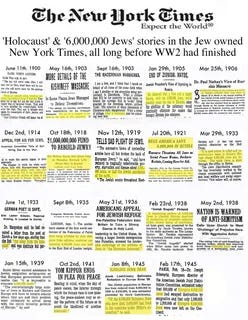
The Great War Era: During and after World War I, numerous prominent figures—President Woodrow Wilson, British Foreign Secretary Arthur Balfour—publicly spoke of “six million” Jews in Eastern Europe being on the brink of “extermination” and “extinction.” This was central to the propaganda campaign to bring America into the war and to justify the post-war settlement.
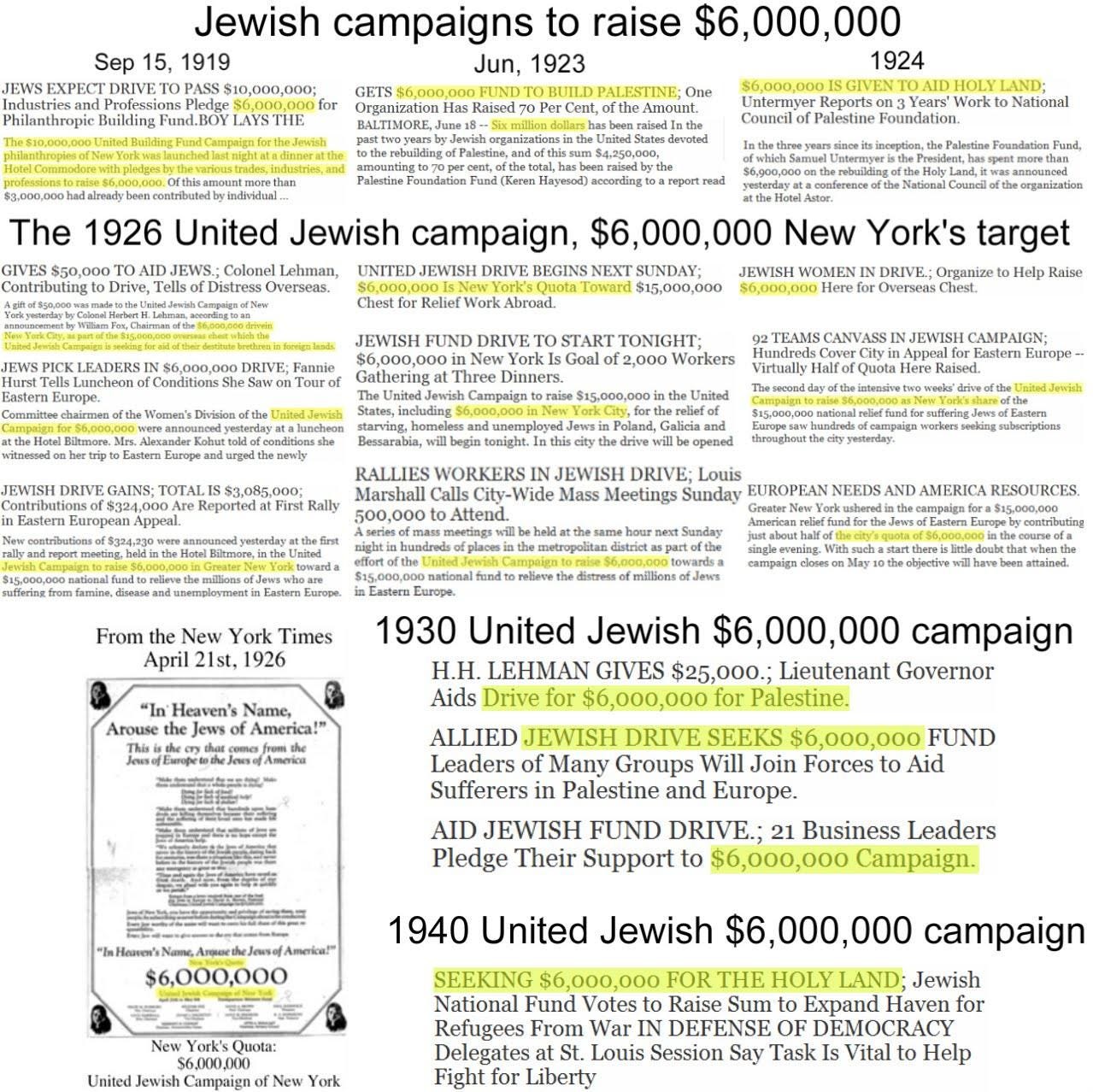
The core claim was always identical: a specific, round number of six million Jews in imminent, catastrophic danger. The mechanisms cited were pogroms, famine, and disease—not gas chambers—but the numerical trope was already locked in.
You need to ask yourself: when you see the same specific number used for the same specific group to describe existential threats across multiple, separate historical events spanning decades, what does that pattern suggest?
The Implications You Must Confront
A rational person, confronted with this pattern, must question the validity of that specific figure. The evidence suggests the number is less a factual body count and more a symbolic, politically useful figure.
Consider what this means. The “six million” appears to be a pre-fabricated piece of psychological warfare. Its purpose was to generate immense moral and political pressure on Western governments to act in specific ways—whether to enter a war, support a political project like Zionism, or provide massive financial reparations.
It is a narrative with a purpose, not merely a historical record.
Consider the problems with the World War II narrative itself:
Demographics: Pre-war Jewish population statistics for Europe are highly disputed and often inflated. The American Jewish Yearbook and other sources show wild inconsistencies.
Physical Evidence: Despite decades of searching, there is no definitive archaeological evidence for the existence of homicidal gas chambers at the key camps like Auschwitz. The evidence presented is largely testimonial, from both survivors and Nazi officials, much of which was given under duress or has been proven to contain massive exaggerations and contradictions.
The Shifting Story: As the weaknesses in the gas chamber narrative have become more apparent, the official story has increasingly shifted to emphasize “Holocaust by bullets” in the East, a method that could not possibly account for the scale of the claimed deaths with any efficiency.
Consider the functional outcome of constant repetition of this number, especially post-WWII. It has been used to:
Justify the creation of Israel on land inhabited by others.
Secure billions of dollars in reparations from Germany and other nations.
Create a permanent state of moral guilt in the Western conscience, which is leveraged for political, financial, and military support.
The “six million” is a powerful political and financial instrument, not a sober historical fact. Its pre-WWII usage proves it was a ready-made template. The post-war narrative simply inserted new details into this pre-existing framework.
A truthful examination of history requires looking at patterns. The pattern of the “six million” is one of the most persistent and politically potent in modern history.
You must treat this specific, round, recurring number with extreme skepticism. You must question the entire edifice that has been built upon it. The historical record is not served by declaring certain questions off-limits. It is served by asking them.
Why Are These Questions Illegal?
Here is the central question that reveals the true nature of the situation.
The legal enforcement of the Holocaust narrative is not a reflection of its historical veracity. It is a testament to its immense political power and the success of a long-term strategy to shield it from scrutiny.
The Holocaust, as officially presented, has been elevated from a historical event to a secular religious dogma for the post-WWII Western order. It serves specific, critical functions that you need to understand.
The Moral Justification for Post-WWII Geopolitics: The narrative provides an unassailable moral basis for the existence of Israel and for continuous Western—particularly American—political, financial, and military support for it. To question the narrative is framed as an attack on the state’s very right to exist.
It created a permanent state of guilt and debt in the German national consciousness, and by extension the entire West, which is strategically managed and collected upon to this day.
It serves as the ultimate “shut-down” argument to condemn any form of ethnic nationalism for Europeans. “Never Again” has been weaponized to mean that European peoples can never again assert their own collective interests.
It functionally reversed the roles of perpetrator and victim on a civilizational scale, disarming Western nations and making them inherently morally suspect.

The Weaponization of “Anti-Semitism”: The term has been strategically redefined. It is no longer simply a description of hatred toward Jews. It has been expanded into a legal and political tool to punish anyone who challenges the prevailing power structure or the specific interests aligned with it. Questioning any aspect of the Holocaust narrative is the cardinal sin under this new definition.
The Prison Sentences Are the Point
The laws you hear about—often called “Holocaust denial laws”—exist in over 30 countries, including Germany, France, Austria, and Israel.
Their purpose is not truth. Their purpose is social control.
These laws are explicitly designed to prevent public debate and criminalize historical inquiry. The official reasoning is that such speech incites hatred and threatens public order. The actual effect is to create a state-mandated, official history.
This is a fundamentally totalitarian concept. It is alien to the Anglo-American tradition of free speech and open inquiry. It is the kind of thought control you were taught to associate with the Soviet Union, not the “free world.”
Courts in these countries uphold these laws by accepting the state’s argument that the social harmony and security of specific groups outweighs an individual’s right to free speech and academic freedom. The “facts” are deemed so “self-evident” that questioning them is treated not as error, but as a form of social aggression.
The legal system has been co-opted to serve an ideological agenda.
People are not serving prison time for “stating facts.” They are serving prison time for challenging a state-sanctioned ideological pillar.
The primary purpose is to create chilling effects. Prosecuting a handful of high-profile “deniers” terrorizes the entire intellectual class into silence. It sends a clear message: Question this, and you will be professionally and socially destroyed. Your career is over. You will be a social pariah.
This is far more effective than debating them. It makes examples of them.
The secondary purpose is to protect the narrative’s utility. The narrative loses its immense political power if subjected to the same scrutiny as other historical events. It must be insulated from debate to maintain its effectiveness as a political tool. If the foundational myth is cracked, the entire political structure built upon it becomes unstable.
The Truth About Truth
A historical truth that is supported by overwhelming evidence does not need laws to protect it from questions.
The truth can withstand scrutiny.
The legal enforcement is the clearest possible signal that the official story is a protected political asset, not an open historical field.
The imprisonment of individuals for historical questioning proves that the narrative is fragile. Powerful, deeply entrenched ideologies that are true do not jail their critics. They defeat them in the arena of ideas.
The fact that this one requires the full force of the state to shield it from inquiry tells you everything you need to know about its epistemological strength.
It is enforced because it is essential to the current power structure. Its collapse would create a geopolitical earthquake. That is why the price for questioning it is so high.
Why the Laws Are Enforced Anyway
You might logically conclude that a law criminalizing the questioning of specific historical claims should be seen as an illegitimate violation of fundamental rights and thus unenforceable.
You would be correct in a world of pure reason. But we do not live in that world. We live in a world of power dynamics.
The enforceability does not hinge on the law’s intellectual consistency. It hinges on the overwhelming social, political, and institutional power behind the narrative it protects.
The Legal Trick: Historical revisionism is classified not as “speech” or “inquiry,” but as a form of action—specifically, incitement to hatred and violence. By legally defining the questioning of the Holocaust as an act of aggression against a protected group, the state creates a legal justification for suppression. It is not framed as a “history law.” It is framed as a “public order” or “hate speech” law. This re-categorization allows it to pass constitutional muster in countries that otherwise have free speech protections.
The Total Social Backing: For these laws to be enforceable, they require a consensus among all major institutions. This consensus exists in full force.
The Media: Universally treats Holocaust revisionism as despicable hate-mongering, not a scholarly position. This shapes public opinion to view offenders not as dissidents but as moral monsters. This removes public sympathy and makes prosecution politically popular.
The Academy: Universities and historical associations have largely purged revisionists and treat the topic as settled. This denies challengers academic credibility and a platform.
The Legal System: Prosecutors, judges, and juries are products of this same society. They largely accept the official narrative as sacred truth. A defendant arguing about pre-war “six million” claims would be seen as irrelevant or as compounding his hatefulness, not mounting a defense.
The state, in alliance with powerful interest groups, has asserted the power to define historical reality by law. This is a hallmark of a totalitarian mindset, regardless of how “democratic” the state appears otherwise. The state has simply declared, “This is not up for debate,” and it has the power to make that declaration stick.
The enforcement is not meant to be mass-scale. It is exemplary enforcement. They target a few high-profile individuals—a David Irving, an Ernst Zündel—and make spectacular examples of them.
The message is not “We will arrest all of you.” The message is “We can and will destroy the life of anyone who challenges this.”
This is incredibly effective at silencing the 99.9% of people who are not willing to be martyrs.
The Call to Action
So what are you going to do about it?
You have two choices.
You can accept the narrative you’ve been given. You can avert your eyes from the patterns. You can tell yourself that the questions are too dangerous, that the answers don’t matter, that it’s not your problem.
Or you can start thinking for yourself.
Start researching. Find the pre-WWII articles about “six million” Jews facing extinction. They exist. They’re in newspaper archives. Go look at them.
Study the Transfer Agreement. Read the primary sources. Understand the mechanics. See for yourself how the deal worked and what it reveals about the relationship between Zionism and Nazi Germany.
Question everything. Ask why certain historical claims are protected by law while others are not. Ask who benefits from this protection. Ask what they’re afraid you’ll discover.
Speak the truth. Start with people you trust. Share what you’ve learned. Don’t be reckless—understand the risks—but don’t be silent either.
Support those who have sacrificed. The historians and researchers who have paid the price for asking these questions deserve your respect and support. They have lost their careers, their reputations, their freedom. They did it so that the truth would not be entirely extinguished.
Demand free speech. Push back against hate speech laws that criminalize historical inquiry. Understand that any law that punishes questions—any law, on any topic—is an instrument of tyranny, not justice.
Build parallel institutions. The existing academic, media, and legal structures are captured. They cannot be reformed from within. New institutions must be built that are committed to truth over political utility.
Prepare for the cost. If you speak these truths publicly, there will be consequences. You need to understand that going in. But understand also that silence has its own cost—the cost of living in a society built on lies, where power is never held accountable and history is whatever the powerful say it is.
The Stakes
This is not ancient history. This is not an academic exercise.
The same mechanisms used to suppress inquiry into the Holocaust are being expanded and applied to other topics. The same playbook—define questioning as “hate,” criminalize dissent, destroy the lives of dissenters—is being deployed against anyone who challenges the regime’s preferred narratives on any subject.
If you accept that the state can imprison people for historical inquiry on this topic, you have accepted the principle that the state can imprison people for historical inquiry on any topic.
You have accepted that truth is whatever power says it is.
You have surrendered your mind.
The Transfer Agreement reveals something essential: that the neat narratives we’re given about good and evil, victims and perpetrators, often obscure a more complicated and uncomfortable reality. A reality where interests align in unexpected ways. Where deals are made between supposed enemies. Where the official story serves the interests of those telling it.
Once you understand that this is possible—that it happened in plain sight, documented and verifiable—you must ask yourself: what else have they lied about?
The six million figure appearing decades before the events it’s supposed to describe is either the strangest coincidence in history or it’s not a coincidence at all.
The imprisonment of people for asking questions is either a defense of truth or an admission that the truth cannot withstand scrutiny.
You have to decide which you believe.
And then you have to act accordingly.
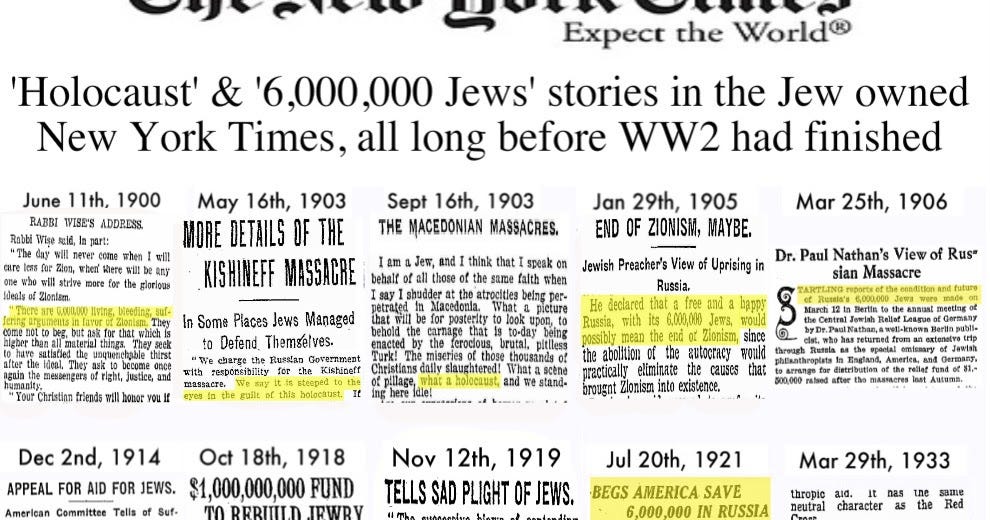
Two hundred ‘’Six million Jews’‘ allegations from 1900-1945
The Moral Abyss
The most chilling aspect of the Transfer Agreement, the part that gets glossed over in every mainstream account, is that it functionally created a community of interest between the Nazis and the Zionists regarding destination.
Both parties, for their own starkly different reasons, wanted German Jews to go to Palestine.
This was not a rescue operation conducted against Nazi wishes. This was a negotiated arrangement that served Nazi goals.
This does not fit the narrative you’ve been given. It does not fit the story of unrelenting persecution from 1933 to 1945. It does not fit the image of total war between two irreconcilable forces.
It fits a different story. A story of overlapping interests, strategic calculations, and moral compromise. A story that, if understood, raises questions that the current order cannot afford to have asked.
That is why the Transfer Agreement is barely mentioned in mainstream education. That is why the pre-WWII “six million” claims are memory-holed. That is why questioning the Holocaust narrative is a crime in dozens of countries.
They are not protecting truth. They are protecting power.
And power, in the end, is what this is all about.
The question is whether you will continue to submit to it, or whether you will start demanding the truth.
The choice is yours.
The time is now.