

For decades, accusations of racism functioned as a political weapon. Anyone who questioned the premise risked immediate cancellation. The Southern Poverty Law Center sat at the center of that mechanism, acting as the arbiter of who qualified as a hate group, which narratives got amplified, and which political agendas received institutional cover.
Now the Department of Justice has indicted the SPLC on 11 counts: wire fraud, false statements to a federally insured bank, and conspiracy to commit concealment money laundering. The indictment does not just expose financial crimes. It exposes a machine that used the language of civil rights to manufacture the very hatred it claimed to fight.
This is what the evidence shows.
What the Indictment Actually Says
The DOJ followed a trail of documents and bank records spanning nearly a decade. What it found was systematic and deliberate. Between 2014 and 2023, the SPLC secretly funneled more than $3 million in donated funds to individuals connected to violent extremist groups, including the Ku Klux Klan, United Klans of America, Unite the Right, National Alliance, National Socialist Movement, Aryan Nations affiliated Sadistic Souls Motorcycle Club, National Socialist Party of America (American Nazi Party), and American Front.
Donors gave money under the belief it would be used to fight white supremacy and advance racial justice. The SPLC took those funds and paid the white supremacists directly.
Steve Cortes, founder of the League of American Workers and former advisor to Donald Trump, put it plainly in a conversation with Restoration News. He described the SPLC’s operation as similar to a fire department that sets fires and then asks for donations to fight the fire problem it created. The analogy is not rhetorical. Based on the DOJ’s findings, it is a description of actual conduct.
The $339 million tax-exempt nonprofit built its entire fundraising model on the premise that America is systemically and irredeemably racist. Cortes addressed that premise directly.
“The demand for racism from the Left far exceeds the actual supply,” he said. “So, what does the Left do in lieu of actual racism? It concocts it. It devises, and engineers, and gins up, and in some cases just completely lies about purported racism in American society.”
Charlottesville: The Event That Changed American Politics
The 2017 Unite the Right rally in Charlottesville, Virginia became a defining moment in American political history. Images of men marching with flaming tiki torches circulated globally. James Alex Fields Jr. drove his car into a crowd of protesters, killing Heather Heyer and injuring 30 others. Fields is now serving a life sentence after pleading guilty.
The DOJ indictment connects the SPLC directly to that event.
According to the indictment, an individual identified only as “F-37” was a member of the online leadership chat group that planned the Charlottesville rally. F-37 attended the event at the direction of the SPLC. F-37 made racist postings under SPLC supervision and helped coordinate transportation for several attendees. Between 2015 and 2023, the SPLC secretly paid F-37 more than $270,000.
That sequence matters. The SPLC used donor money to fund extremist actors, directed one of those actors to participate in the planning and execution of a rally that ended in a murder, and then continued operating as the nation’s foremost authority on hate groups.
What followed in the media compounded the damage. Corporate press selectively edited remarks by then-President Trump, clipping his full statement to make it appear he called neo-Nazis “very fine people.” The full transcript showed Trump explicitly condemned neo-Nazis and white supremacists. That context was buried. Cortes produced a video for PragerU that documented the deception and went viral, but platforms suppressed it.
“The corporate media, with a lot of assistance from Big Tech, was able to spread that lie far and wide, and was able to filter out and censor alternative voices who were trying to spread the truth,” Cortes said. “So you have this awful sequence of SPLC illegally using donor money to manufacture and create a hate event. That hate event produces some mayhem, and some really tragic consequences, particularly a young woman’s death, which then sends the media into an anti-Trump frenzy.”
The manufactured event fed the manufactured narrative. The manufactured narrative reshaped American politics.
The Pipeline Into Government
Joe Biden publicly cited the Charlottesville event as the reason he entered the 2020 presidential race. The “very fine people” framing, already documented as a fabrication, became the stated moral justification for a presidential campaign. That campaign won. And once the Biden administration took office, the relationship between the SPLC and the federal government became institutional.
White House visitor logs, which were publicly accessible for a period, showed frequent visits from SPLC staff. Most of those records have since been removed from public access. Only fragments remain, buried in the deep web.
The SPLC’s influence on federal policy became visible in 2022. The Biden administration’s FBI and DHS shifted institutional focus away from international terrorism toward Domestic Violent Extremism and Racially and Ethnically Motivated Violent Extremism. A 2022 joint report from those agencies stated that white supremacist extremists “continue to pose the primary threat among DVEs of committing lethal violence against civilians.”
The framing, the language, and the analytical framework in that report track closely with SPLC reporting that we now know was manufactured. Republican Senators James Lankford of Oklahoma and Chuck Grassley of Iowa noticed. In 2023, they sent a formal letter to the FBI demanding it stop using SPLC as a source in investigative reports and activities, citing the organization’s “clear bias.” The senators noted that the FBI had already removed the SPLC from its hate crime webpage back in 2014, during the Obama administration, due to similar concerns.
“The FBI should not lend credibility to an organization that labels traditional values as ‘hate,’” the senators wrote.
The FBI restored that relationship anyway. The SPLC’s manufactured data and selectively constructed threat assessments continued to shape federal law enforcement priorities for years.
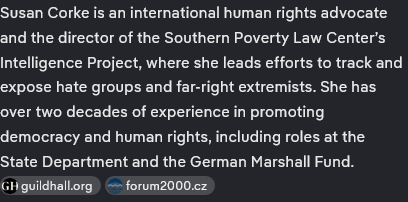
On January 6, 2023, Susan Corke, the director of the SPLC’s Intelligence Project, met at the White House with John Picarelli, the director of counterterrorism at the National Security Council. Corke had previously worked for the U.S. Department of State and held positions at U.S. embassies in Moscow and Prague. She also co-authored the SPLC’s 2022 “Year in Hate and Extremism” report, which designated Moms for Liberty a hate group.
That designation had immediate political consequences. Left-aligned activists organized protests and attempted to shut down the Moms for Liberty national gathering in Philadelphia, which hosted the first major event of the 2024 presidential primary season, featuring speeches from most Republican candidates including Trump.
The same SPLC report that produced those results also explicitly acknowledged the organization’s alignment with Democratic Party political objectives. Corke wrote that SPLC analysts assisted the “bipartisan House Jan. 6 Special Committee investigation” in holding “hate perpetrators accountable.” The word bipartisan conceals more than it reveals. The SPLC’s fingerprints are across the institutional architecture that was used to criminalize political opposition following January 6.
A Lifetime Appointment and the Judiciary
The reach of the SPLC extends into the federal courts. Biden nominated Nancy Abudu, former strategic litigation director at the SPLC, to the U.S. Court of Appeals for the Eleventh Circuit, which covers Alabama, Florida, and Georgia. She received lifetime confirmation.
The official press release announcing Abudu’s confirmation omitted her SPLC background entirely. While at the SPLC, Abudu founded the organization’s Voting Rights Practice Group, which describes its purpose as “organizing to build the political power of Black and Brown people throughout the Deep South.”
A federal appellate judge with a lifetime appointment, whose prior professional work was explicitly organized around political mobilization for one demographic bloc, now sits on the bench for three Southern states without that background being disclosed in her confirmation materials.
Education as Infrastructure
The SPLC’s investment in education is not supplemental. It is strategic.
The SPLC’s Learning for Justice program provides K-12 curriculum to schools nationwide. Lesson plans include content like “How did slavery shape my state?” for fourth-grade students and “Did the constitution establish a just government?” for high school students. The curriculum is designed to instill a specific framework about American society before students develop the analytical tools to evaluate it.
At the university level, the SPLC has partnered with institutions including American University’s Polarization and Extremism Research and Innovation Lab. That lab describes its mission as preventing “radicalization to violent extremism by strengthening community resilience” using a public health approach. PERIL and the SPLC have co-produced multiple reports focused on “dismantling white supremacy.”
In February 2026, the SPLC launched its Student Press Report program in partnership with collegejournalism.org, operating across 30 states. The program places college journalists into statehouse coverage roles described as filling gaps left by shrinking local news operations. An organization under federal indictment for fraud and money laundering is now training the next generation of journalists.
What the Collapse of the Narrative Means
The SPLC indictment is not just a financial crime story. It is a structural exposure.
For years, the racism narrative served as an operational tool. It generated fundraising. It moved political agendas. It shaped federal law enforcement priorities. It provided justification for censorship, cancellation, and the criminalization of dissent. It elevated certain voices and systematically suppressed others. And much of the evidentiary foundation for that narrative, the data, the threat assessments, the hate group designations, came from an organization that was simultaneously paying the extremists it claimed to be fighting.
Slavery is a historical fact, at least in part, the whole truth is something that is still yet to be discussed. Jim Crow is documented history. Neither institution exists in America today. What has existed, and what the indictment now documents in federal filings, is an industry built on keeping the perception of systemic racism alive long past any factual justification for that framing.
The SPLC and the ADL built that industry. The DOJ has now opened its books on the SPLC, I am not so sure they will do the same with the ADL.
What the evidence shows is not a civil rights organization that made financial mistakes. It shows a political operation that manufactured threats, directed extremist actors, shaped federal policy, placed allies on the federal bench, and embedded its curriculum in classrooms from kindergarten through university.
The indictment is 11 counts. The full accounting is much larger.