


The FDA-Approved Drugs That Were Later Withdrawn for Harming the Public
(Timeline + Key Case Profiles)
Between the late 1950s and today, approximately 40 FDA-approved prescription drugs were later removed from the U.S. market due to safety risks.
Not relabeled.
Not restricted.
Removed.
We’re not listing manufacturing recalls.
We’re listing drugs that passed FDA review and later caused significant injury or death.
This is the official public record.
I. The Timeline of Withdrawals
(Listed by decade — calm, factual, unembellished)
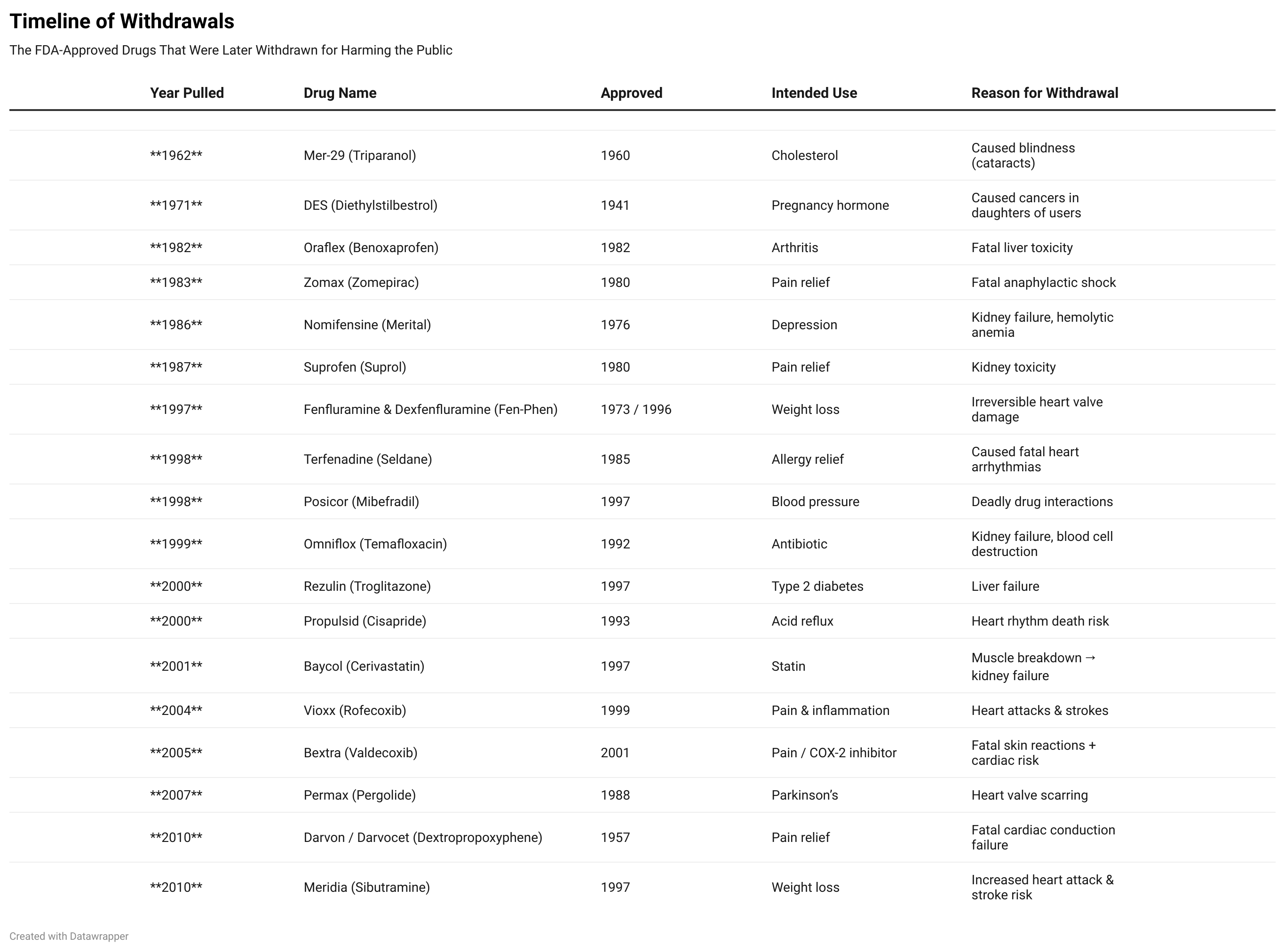
This is not controversial.
These are undisputed withdrawals.
Published in Federal Register & archived FDA notices.
II. The Key Case Profiles
(These are the ones that changed policy — or should have.)
CASE 1 — Vioxx (Rofecoxib, 1999–2004)
Market: 20+ million patients
Estimated deaths: ~38,000 (JAMA, 2005)
Vioxx was marketed as a breakthrough arthritis drug.
Internal Merck documents (released in litigation) show the company identified cardiovascular risk during trials — then downplayed it.
FDA safety officer Dr. David Graham later testified:
“Vioxx was not a mistake. It was a regulatory failure.”
Noted.
Documented.
On Senate record.
CASE 2 — Rezulin (Troglitazone, 1997–2000)
Context: Fast-tracked under pressure for new diabetes drugs.
Outcome: Fatal liver failure.
FDA medical officer Dr. John Gueriguian warned clearly and early.
He was removed from the review team.
Rezulin remained on the market until:
UK regulators forced a withdrawal first.
The U.S. followed afterward.
The drug was removed only after international embarrassment.
CASE 3 — Fen-Phen (1970s–1997)
Market: Diet and weight-loss clinics nationwide.
Outcome: Heart valve fibrosis, lung hypertension.
For over 20 years, the mechanism of harm was suspected.
Withdrawal happened only when:
Echocardiogram evidence became widespread
Lawsuits consolidated
Public awareness crossed into news reporting
Harm existed long before recognition.
Recognition existed long before regulatory action.
CASE 4 — Darvon / Darvocet (1957–2010)
Duration on market: 53 years.
Reason for withdrawal: Electrical instability in the heart → sudden death.
The key fact:
Risk signals were known as early as the 1970s.
Withdrawal did not occur until 2010.
This demonstrates:
Regulators can know.
Doctors can know.
Harm can be ongoing.
And the market can remain unchanged for decades.
III. What the Pattern Shows
Across all cases:
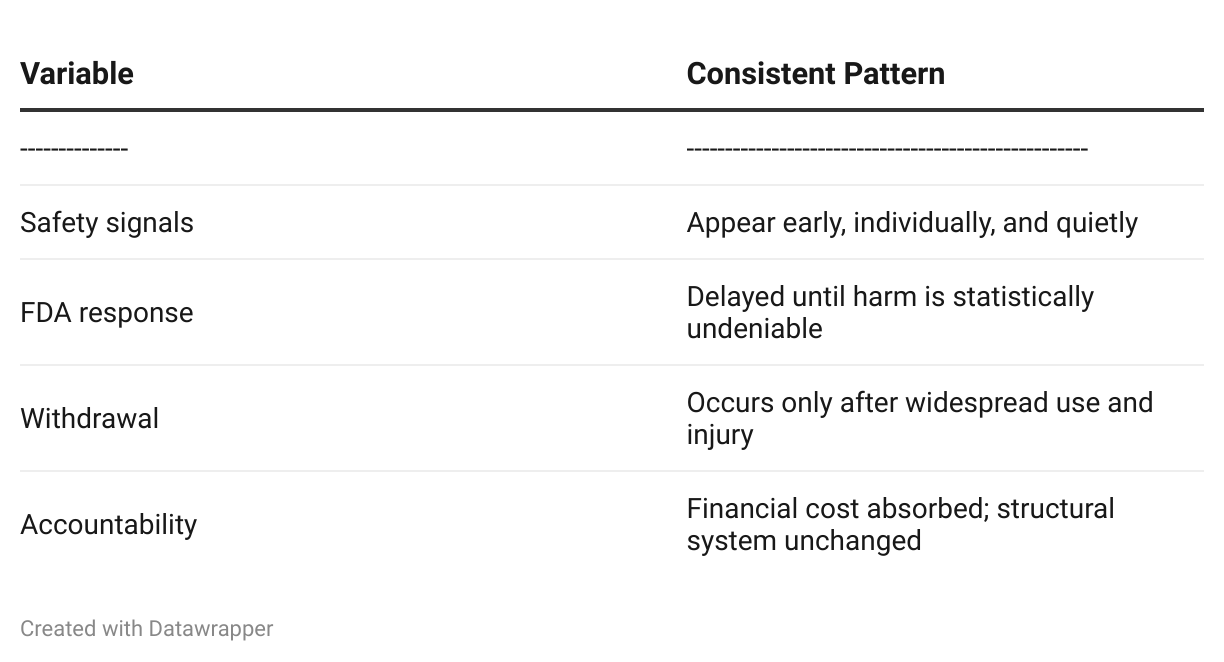
This is not a failure of information.
It is a failure of response.
Because the system is built to:
Approve fast
Detect late
Remove slower still
And in that lag:
People are harmed.
End of Part 4
Next:
PART 5 — The Revolving Door
How approval decisions and career incentives are linked — with names, dates, positions, and transitions.
This is where the series moves from:
“How the system works”
to“Who benefits from the system working this way.”