


How Drug Harm Is Detected, Reported, Delayed, and Denied
When a new drug appears on the market, side effects do not show up all at once.
They show up quietly, individually, and unevenly.
A patient has chest pain.
Another develops liver inflammation.
Someone collapses, but the ER writes it up as “unknown cause.”
A doctor sees something unusual but assumes it’s rare.
These events don’t look like a pattern — at least not at first.
Understanding how harm is detected requires understanding where it is collected.
And here is where the first major fracture in drug safety appears.
The Reporting System
The U.S. system for tracking drug harm is called:
VAERS (for vaccines)
FAERS (for all other drugs)
These systems are:
Passive
Voluntary
Non-verifying
Non-investigative
Meaning:
The FDA does not go looking for harm.
Harm must come to the FDA.
And only if someone decides to report it.
Who Can File a Report?
Doctors
Nurses
Pharmacists
Patients
Family members
Who Usually Does?
Almost no one.
Studies estimate 1–10% of adverse drug reactions are ever reported.
This means 90–99% of side effects never enter the official safety database at all.
Why Reports Don’t Get Filed
NARRATIVE (calm):
Doctors have limited time. Reporting systems are slow. Patients may not recognize the cause. Symptoms are often attributed to pre-existing conditions.
SIDEBAR (sharp):
The system is structured so that silence is the default.
This keeps drugs on the market longer.
When Harm Starts Accumulating
Once scattered individual reports begin to form a pattern, the signal moves through a slow sequence:
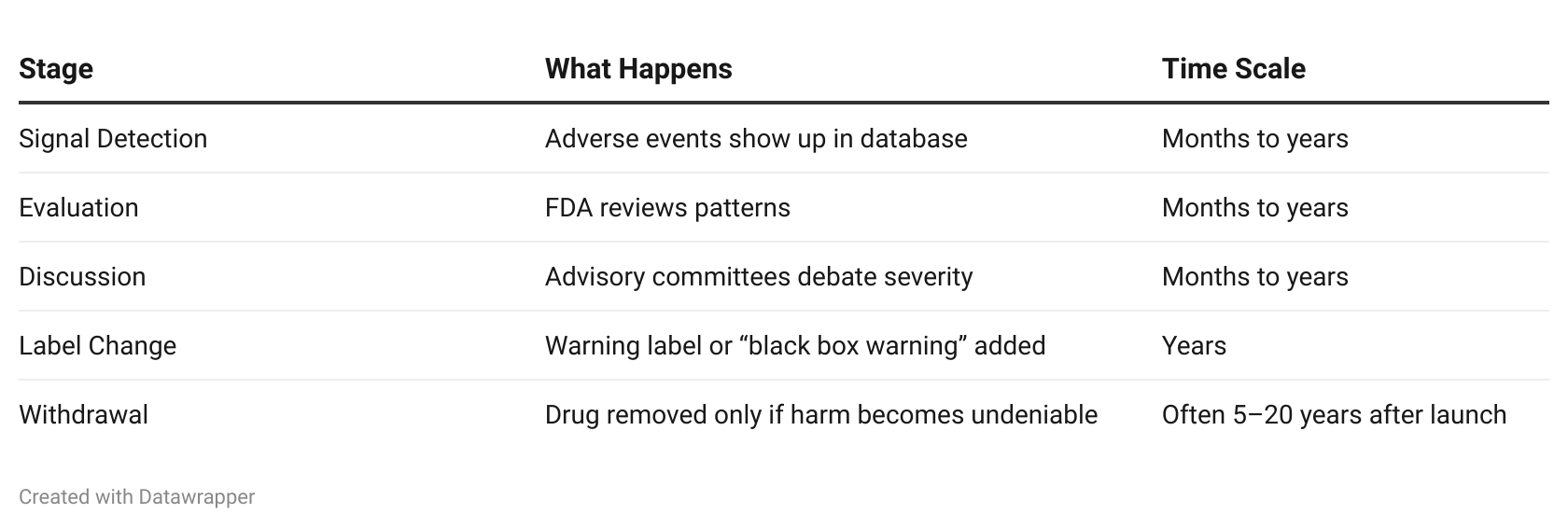
The timeline of harm is not measured in weeks.
It is measured in careers.
The Institutional Vocabulary of Delay
When reading FDA internal memos, the language used to avoid action is consistent:
“No definitive causality established.”
“Signals are not statistically conclusive.”
“Continue post-market monitoring.”
“Risk appears manageable.”
This language does one thing:
Buy time.
Time in which:
Revenue accumulates.
Market share expands.
Prescriptions increase.
Harm compounds.
SIDEBAR: The Most Revealing Phrase
“The benefits outweigh the risks.”
This phrase does not mean the drug is safe.
It means the harms are acknowledged and accepted.
The only question is:
Accepted by whom?
Not the patients.
They were never consulted.
The Human Cost of Delay
This is not abstract.
Vioxx stayed on the market for 5 years after internal data showed cardiovascular damage.
Rezulin stayed 3 years after liver failure signals.
Darvon remained for 53 years after cardiac toxicity was documented.
These delays were not accidental.
They were the result of:
Voluntary reporting
Slow signal assessment
Legal liability calculation
Market valuation pressure
Not science.
Structure.
The Key Understanding
Drug safety is not confirmed at FDA approval.
It is revealed only after the drug has been taken by the public.
Safety is determined retroactively.
Meaning:
The public is the real clinical trial.
End of Part 3 — Next week Part 4
Part 4 is where the series goes from structural explanation to historical evidence.
This is where we lay out:
Names of drugs
Years approved
Years withdrawn
Documented harms
Estimated injuries and deaths
Medical literature supporting each withdrawal
This is the “Body Count File.”