


What a Drug Has to Do to Get on the Market — and What It Doesn’t
Most people imagine drug approval goes like this:
Scientists invent a drug.
The FDA tests it thoroughly.
Only the safest and most effective drugs make it through.
That’s the cultural belief.
What actually happens is different — quietly, structurally, and consistently.
Let’s break it down step-by-step — without emotion, without speculation — just the system as it exists.
1. The Drug Company Designs the Trials
The FDA does not design the clinical trials.
The pharmaceutical company does.
They choose the patient population.
They choose the measured outcomes.
They choose the duration of the trial.
They choose what data gets highlighted.
The FDA reviews submitted data — it doesn’t generate it.
This is the first blind spot.
2. Clinical Trials Are Small, Short, and Selective
Typical Phase III trial population: 2,000–4,000 patients.
Typical drug market population: Millions.
Which means:
Rare side effects won’t appear.
Long-term harm will not appear.
Drug interactions will not appear.
Who is excluded from most trials?
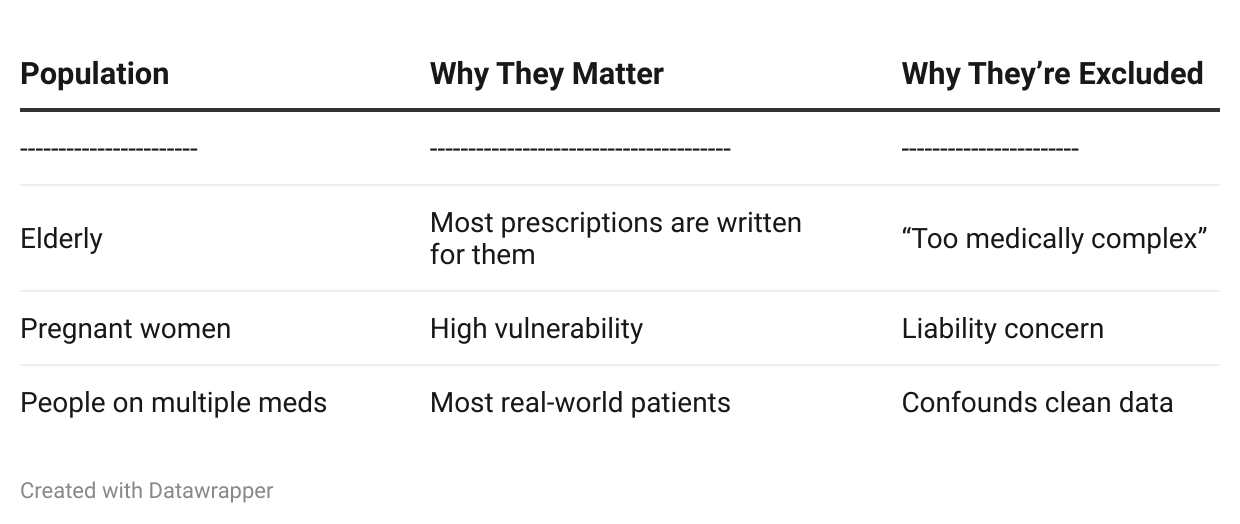
In other words:
The people who will actually use the drug are rarely the people who are tested in the approval trials.
3. The FDA Does Not Replicate the Findings
The agency does not run independent labs to confirm trial data.
It relies on:
Manufacturer-submitted trial packets
Manufacturer-supplied summaries
Manufacturer-disclosed adverse events
The agency trusts the data it is given.
This is not a conspiracy.
This is simply how the law is written.
4. The Approval Vote Is Not Unanimous
Many drugs are approved over the objections of internal FDA scientists.
This is a matter of public record.
When this happens:
The dissenting scientist is documented.
The approval goes forward anyway.
The dissent rarely reaches public awareness.
Opposition is often described internally as:
“Not sufficient to delay approval.”
This phrase appears hundreds of times in the FDA internal memo archive.
5. Post-Market Safety Is The Real Trial
Once a drug is released to the public, that is when real-world data begins.
This is called:
Phase IV, Post-Market Surveillance
But here is the critical failure:
Reporting Harm Is Voluntary
Patients and doctors must choose to report adverse reactions.
Most never do.
Reasons:
Patients don’t connect symptoms to the drug.
Doctors don’t have time to file federal forms.
Many assume “if it were serious, the FDA would already know.”
This is how danger accumulates silently.
6. The Withdrawal Threshold Is Not “Harm”
Drugs are not withdrawn because they cause harm.
They are withdrawn when:
The harm becomes undeniable, and
The *financial or legal cost of keeping it on the market exceeds the profit value.
This is why harmful drugs often remain available for years after red flags emerge.
This is not emotional interpretation.
This is the withdrawal record.
The Key Realization
The system is designed to:
Approve drugs based on short-term controlled data
Detect harm only after mass exposure
Respond only when consequences become politically or financially unavoidable
Therefore:
Approval does not mean safe.
Approval means:
“Safe enough for now, pending real-world results.”
And those real-world results are human lives.
End of Part 2 — Transition to Part 3
Next, we follow the harm forward:
PART 3 — When Things Go Wrong
How adverse events are tracked, ignored, minimized, and finally acknowledged.
This is the part where we show how the damage accumulates without being seen.