

“We the people are the rightful masters of Congress and the courts, not to overthrow the Constitution, but to overthrow men who pervert the Constitution.”
— Abraham Lincoln
The American people possess a God-given right to alter or abolish the United States government—federal or state—and replace it with something new.
That statement lands hard. Maybe it strikes you as radical. Maybe extreme. Maybe you dismiss it because I’m the one saying it.
But consider this: without exactly this kind of thinking, there would be no United States of America.
The men who founded this nation weren’t moderates playing it safe. They were radicals who bet their lives on a principle most people today have been trained to forget.
Let me remind you what that principle sounds like:
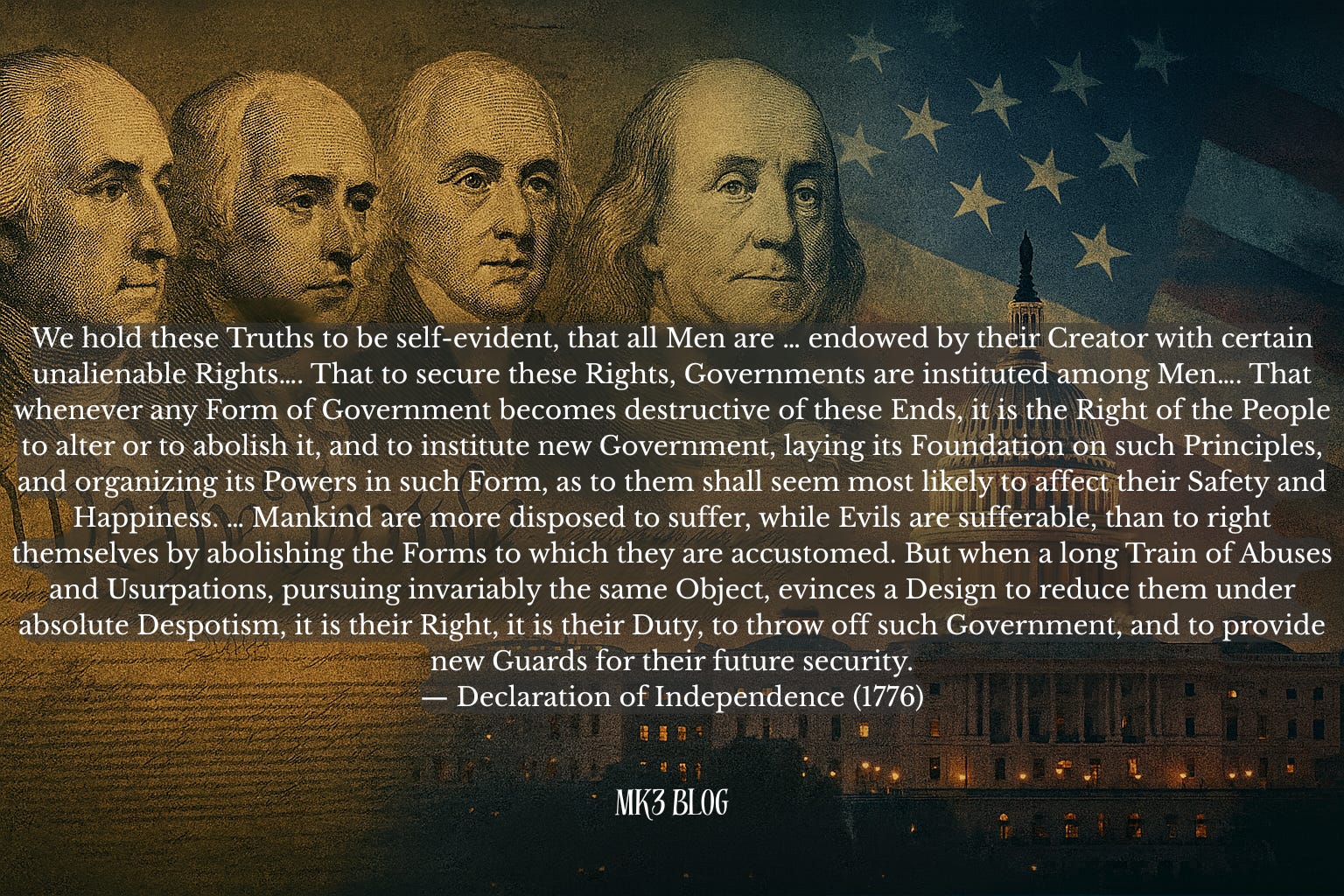
We hold these Truths to be self-evident, that all Men are … endowed by their Creator with certain unalienable Rights…. That to secure these Rights, Governments are instituted among Men…. That whenever any Form of Government becomes destructive of these Ends, it is the Right of the People to alter or to abolish it, and to institute new Government, laying its Foundation on such Principles, and organizing its Powers in such Form, as to them shall seem most likely to affect their Safety and Happiness. … Mankind are more disposed to suffer, while Evils are sufferable, than to right themselves by abolishing the Forms to which they are accustomed. But when a long Train of Abuses and Usurpations, pursuing invariably the same Object, evinces a Design to reduce them under absolute Despotism, it is their Right, it is their Duty, to throw off such Government, and to provide new Guards for their future security.
— Declaration of Independence (1776)
Read those words again. Not a right. A duty. When government becomes destructive of the ends for which it was created—securing your God-given rights—you are obligated to throw it off and build something better.
Still think that sounds extreme? The founders didn’t. They considered it self-evident truth.
The System’s Response to Its Own Founding Principles
Some people found those words deeply inconvenient. They’ve spent generations making sure nothing like the American Revolution ever happens again.
First, they systematically discredited the Declaration itself. They stripped it from serious legal discourse, reduced it to ceremonial parchment, and ensured that government-approved curricula treat it as historical poetry rather than binding principle. Universities that once taught natural law now treat the Declaration as a quaint artifact—dangerous if taken literally, best admired from a safe distance.
Second, they built a legal fortress around the existing power structure:
Rebellion or insurrection. Whoever incites, sets on foot, assists, or engages in any rebellion or insurrection against the authority of the United States or the laws thereof … shall be fined under this title or imprisoned not more than ten years, or both…. — 18 U.S.C. §2383
Seditious conspiracy. If two or more persons … conspire to overthrow, put down, or to destroy by force the Government of the United States, or to levy war against them, or to oppose by force the authority thereof, … they shall each be fined under this title or imprisoned not more than twenty years, or both. — 18 U.S.C. §2384
Advocating overthrow of Government. Whoever knowingly or willfully advocates, abets, advises, or teaches the duty, necessity, desirability, or propriety of overthrowing or destroying the government of the United States or the government of any State … by force or violence … Shall be fined under this title or imprisoned not more than twenty years, or both…. — 18 U.S.C. §2385
Let those words sink in.
On one hand, you have the founding document of our nation—beloved for over two centuries—declaring that people have not only the right but the duty to throw off abusive, despotic government.
On the other hand, you have laws enacted by that same nation criminalizing any attempt to overthrow the government, any conspiracy to do so, or even advocating its overthrow—regardless of whether such action might be justified by the very tyranny the Declaration warned against.
This reveals an eternal truth about power: The people retain an absolute right to alter or abolish any form of government. The people in government absolutely never want that right exercised.
Why the Declaration Was Buried
This tension explains why legal scholars have refused to treat the Declaration of Independence as law for over a century. If Americans took those words at face value, the entire modern administrative state would face an existential problem.
Politicians, bureaucrats, academics, lawyers—they all have skin in the game. They benefit from the status quo. A government of truly limited powers? One that could be discarded when it fails? That threatens careers, pensions, influence, and power.
So they buried the founders’ worldview. Not with arguments. With silence, ridicule, and institutional pressure.
But the Declaration still has authority. It still has things to teach us as we confront an overreaching, over-regulating, increasingly abusive government at every level. The principles embedded in that document aren’t radical. They’re foundational. And understanding them isn’t complicated—it just requires honesty.
I proceed from a simple assumption: the founders meant what they said. They weren’t political charlatans spinning convenient rhetoric. They believed these truths were self-evident because they are self-evident. The evidence from history and the laws of nature confirm it.
Not By Force or Violence
Let me be unambiguous: I am not advocating the exercise of any right to alter or abolish government through force or violence.
Partly because Title 18 forbids it. But more importantly, because force isn’t necessary. The right to alter or abolish is a natural right that can be exercised lawfully, peacefully, and constitutionally.
The laws of nature provide multiple pathways for fundamental government change without armed conflict. In America, the most viable mechanism would be a convention of states—either through Article V of the Constitution or through a Congress of States operating on first principles. At the state level, citizens can call for constitutional conventions directly.
This is precisely how the founders tried to proceed. When the Declaration of Independence was adopted, it came through duly appointed representatives of the states. It followed years of documented grievances: the Resolutions of the Stamp Act Congress in 1765, the Declaration and Resolves of the First Continental Congress in 1774, the Declaration of the Causes and Necessity of Taking Up Arms in 1775. Each step was lawful. Each document was adopted through proper representation.
The war, when it came, was not started by Americans. The revolutionaries refused to be military aggressors. Britain initiated hostilities to prevent the colonies from exercising their declared right to independence. The Americans fought defensively—to protect their freedom to act as they deemed just.
So while war was fought, the legal act of throwing off British rule wasn’t accomplished by violence. It was accomplished by declaration, by representatives, by lawful process. Violence came only because those in power refused to accept the legitimacy of that process.
This reveals another eternal truth: no government official ever views an attempt to remove him as lawful—no matter how lawful it actually is.
Systemic Inertia and Entrenched Power
No government survives 200 years without accumulating massive systemic inertia—the tendency of institutions to resist any substantial change to their trajectory.
Any attempt to alter or abolish existing government is a direct challenge to entrenched interests. Those interests will resist. And when those interests control the sword—when they command police forces, regulatory agencies, prosecutors, and military power—they will resist with violence if necessary.
From inside the government, there’s little functional difference between foreign attack, domestic insurrection, and lawful attempts at fundamental reform. Government employees are inside the system. Foreign agents, domestic terrorists, and advocates of constitutional change are all outside it. The institutional response is identical: eliminate threats to the system. Eliminate threats to their jobs.
Does it surprise you that federal agencies have labeled Tea Party members, libertarians, and militia groups as potential domestic terrorists? It shouldn’t. To public employees, these groups all represent the same threat—people who want to shrink government, restructure power, eliminate agencies. Translation: cut jobs.
This is about more than money. It’s about power. Reducing government spending doesn’t just affect abstract budgets—it threatens the positions that bureaucrats occupy, the authority they wield, the influence they enjoy. Since power is both their livelihood and their identity, they will deploy every tool available to protect it.
You hear constant warnings about “special interests.” But entrenched interests are the real danger.
Career bureaucrats. The phrase should make your spine stiffen. These are the true government insiders. They view presidents as temporary employees—because the bureaucrats will still be there long after any president leaves. They are the permanent government. And permanent governments don’t like change.
Every government system—especially the American system—will resist fundamental reform with extraordinary force. That resistance is powered by the oldest human motivations: money and power. When people aren’t fighting over religion and power, they’re fighting over money and power. That’s motivation enough to make any situation turn ugly.
What Advocates for Change Should Expect
If you become a proponent of fundamental change—if you seriously advocate altering or abolishing existing government structures—expect trouble to find you.
The pattern is predictable. Those in power will ignore you as long as possible. When that fails, they’ll slander you, discredit you, question your motives and your sanity. They’ll heap economic burdens on you—audits, regulations, legal fees—designed to exhaust your resources and silence your voice. They’ll use courts, agencies, and media to bury you.
If all that fails, they’ll escalate to force. Police actions. Asset seizures. Prosecution. Imprisonment.
Notice something interesting about those federal statutes. They prohibit overthrowing government, conspiring to overthrow it, or advocating its overthrow—by force or violence. There’s no statute prohibiting peaceful advocacy for fundamental change.
That’s because no such statute is necessary.
Here’s how it works: advocate peacefully for abolishing government power, and those in power will initiate attacks against you. Defend yourself against those attacks, and suddenly you’re the aggressor. You’re the one violating statutes against violent overthrow. The system protects itself by making you the criminal the moment you resist its aggression.
Convenient.
A Sobering Reality
If you take the founders seriously—if you believe the Declaration states eternal truths about the relationship between people and government—then you must accept a hard reality.
As a proponent of fundamental change, you must never be a violent aggressor. You must never initiate armed conflict. If violence comes, let it begin with someone else.
But understand: violence may be an unavoidable consequence of lawful action. Those who hold power illegitimately will not surrender it because you asked nicely. They will not respect processes that threaten their position. They will use every tool at their disposal—including violence—to maintain control.
The founders understood this. They didn’t seek war with Britain. They exhausted every peaceful avenue first. But they also prepared for the inevitable response from power that refuses to yield.
The Choice Before Us
The Declaration of Independence isn’t a museum piece. It’s a statement of permanent truth about human liberty and the purpose of government.
Governments exist to secure rights. When they become destructive of that purpose, the people retain the right—and bear the duty—to alter or abolish them.
That right hasn’t expired. It wasn’t ratified away. It wasn’t repealed by federal statute. It exists because it flows from the nature of man and the purpose of civil society.
Those in power have spent generations trying to make you forget this. They’ve buried the Declaration under legal formalism, academic condescension, and bureaucratic inertia. They’ve criminalized the language of liberty while exempting themselves from accountability.
But the truth remains. Government answers to the people. Rights don’t require permission. And when a long train of abuses reveals a design to reduce citizens under arbitrary control, the people are not merely permitted to act.
They are obligated.