

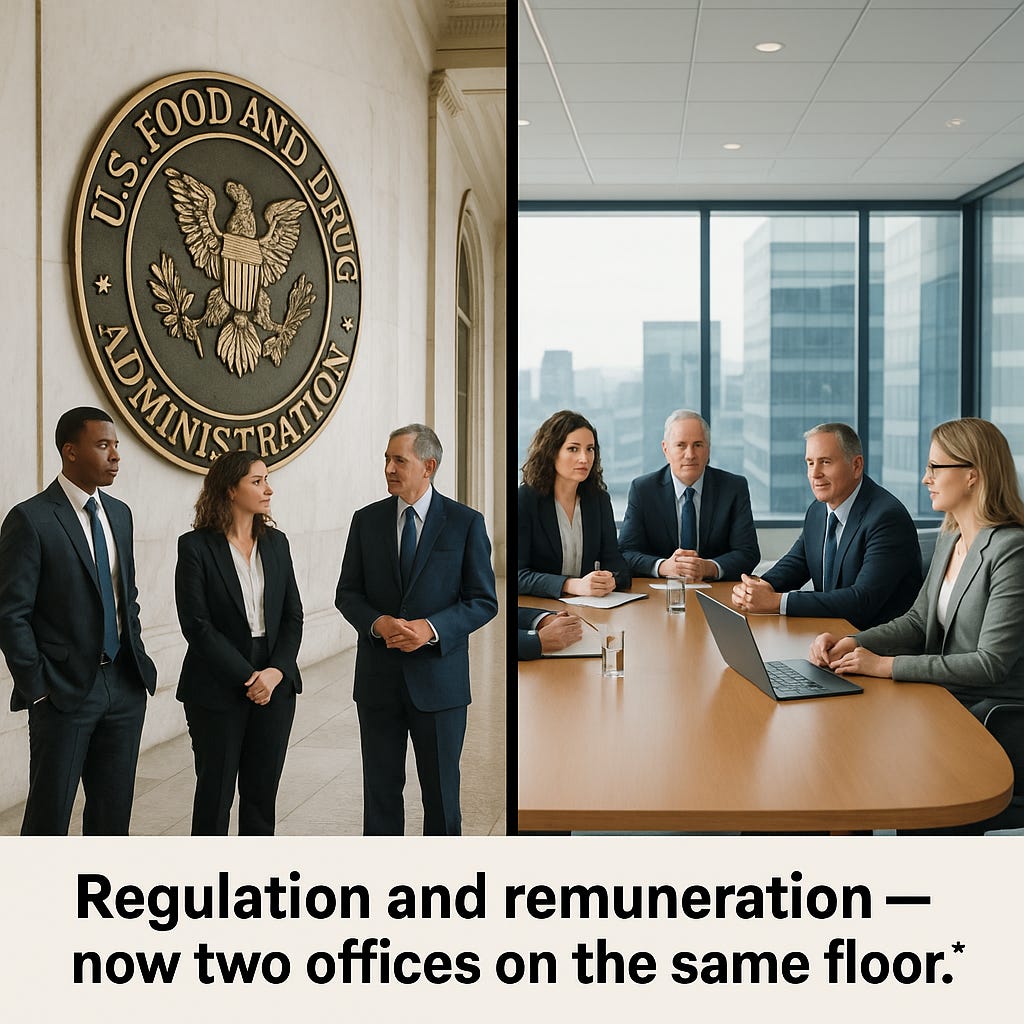
What began as a partnership to protect the public became an algorithm for legalized influence — one career swap at a time.
“You don’t need conspiracies when you have career trajectories.”
— former NIH scientist, 2024
How the Door Spins
A century ago, regulators were public servants in the literal sense. Today, the U.S. health‑bureaucratic complex operates on career fluidity: agency officials rotate into the industries they once policed, cash stock options, then cycle back as “consultants” or “advisers.” Foundations tied to those same agencies absorb corporate donations exempt from federal ethics limits, funding pet projects and grants under the guise of “philanthropy.”
Translation: the referee now works for the team that keeps the ball.
Chronology of Capture
1940s – 1970s: The Prototype Regulator
Early FDA leaders considered detachment a virtue. That norm cracked once pharmaceutical firms began dangling six‑figure “compliance adviser” roles. The message was clear: a few years of leniency could translate into lifetime income.
1980s – 1990s: The Profit Mutation
Bayh–Dole Act (1980) turned publicly funded discoveries into private patents.
NIH scientists could now earn royalties on the very drugs they evaluated.
FDA Commissioner Arthur Hull Hayes Jr. approved aspartame, then joined the manufacturer’s PR agency within months — a career arc that became the industry template.
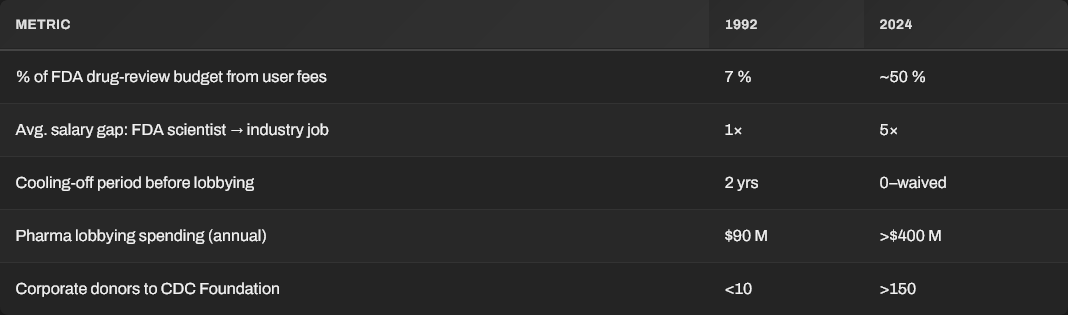
The Prescription Drug User Fee Act (PDUFA) (1992) let corporations finance their own regulators through “user fees.”
Capture in one sentence: The regulator’s salary depends on whom he must regulate.
2000s – 2010s: Capture Becomes Codified
User fees grow to cover ~50 % of FDA drug‑review costs.
CDC & FDA “foundations” receive direct corporate donations — Merck, Pfizer, Gilead among the top donors.
A predictable pattern emerges:
Regulator: crafts pathway for fast approval.
Industry Executive: executes it.
Consultant: returns to “advise” the next rewrite.
2020s: COVID‑Era Exposure
During the pandemic, the revolving door became literal glass. FDA officials who approved mRNA products surfaced months later on biotech boards or venture funds holding those same equities. The illusion of independent judgment dissolved in real time on SEC filings.
What the Numbers Show
Feedback Loop of Influence
Funding – corporations bankroll the review pipeline.
Information – companies generate the safety data regulators rely on.
Career – officials anticipate lucrative exits, biasing oversight subconsciously if not deliberately.
Legitimacy – media funded by pharma ads amplifies agency talking points.
Public perception – trust erodes, breeding polarization that distracts from structural corruption.
Influence doesn’t require conspiracy; it only requires incentives.
The Cure for Capture
Abolish user‑fee financing; restore taxpayer funding for independent oversight.
Mandate a 10‑year cooling‑off period before regulators join firms they oversaw.
Full public disclosure of agency and family royalty streams.
Independent replication labs for all pivotal trials.
Shutter foundation loopholes that allow corporate donations to masquerade as research charity.
Accountability is not anti‑science. It’s pro‑civilization.
“We think the danger is misinformation.
The real danger is approved information — written by those with something to sell.”
The 2025 Reckoning
With William Cohen at the FDA’s helm and RFK Jr. heading HHS, reform proposals are finally back on the table. MAHA committees are debating whether agencies financed by the industries they monitor can constitutionally enforce objectivity. The uncomfortable consensus across parties: they can’t.
Whether Congress now severs this symbiosis or merely re‑brands it will decide whether America has regulators — or partners — for its next generation of drugs.