

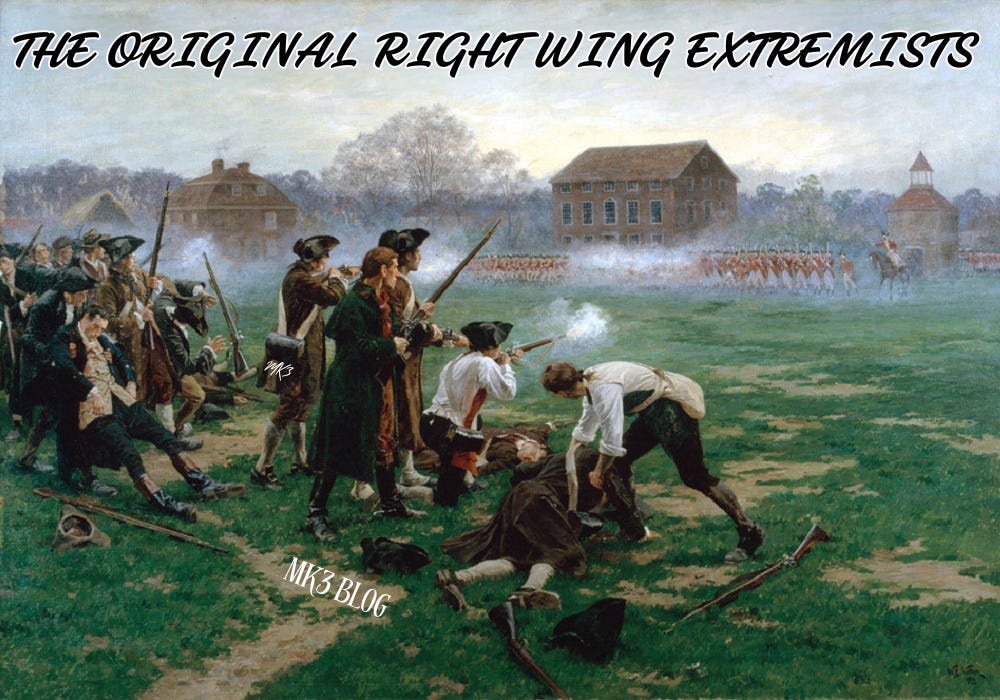
Most Americans aren't the sort of citizens the Founding Fathers expected; they are contented serfs. Far from being active critics of government, they assume that its might makes it right.
-MK3-
In this post I use the European RAN as an example. I did this to show you that this subject matter isn’t unique to the United States Of America. The United States puts out a report detailing Domestic Extremism Threats every year. Every year for the last 10 years that I have read all detail the very thing I discuss in this article. It is a problem America, it needs to stop and we are running out of time to get it accomplished.-MK3
For over a decade, Western governments have systematically constructed a narrative that identifies their greatest threat not as institutional corruption, corporate capture, or authoritarian overreach, but as ordinary citizens who retain traditional values and constitutional principles.
The target isn’t foreign terrorists or actual violent actors. It’s the working-class veteran who questions government mandates. The parent who wants control over their child’s education. The small business owner who resists arbitrary regulations. The citizen who believes national sovereignty matters.
When officials invoke “right-wing extremism,” they’re describing people whose primary offense is refusing to surrender their rights to unelected bureaucrats.
The Architecture of Narrative Control
The European Union’s Radicalisation Awareness Network (RAN) provides the clearest blueprint for this campaign. These institutional documents reveal a coordinated effort to redefine political dissent as psychological pathology and civic skepticism as dangerous extremism.
The language patterns are consistent across agencies and nations. The European Commission’s 2021 report on “Conspiracy Theories and Right-Wing Extremism” establishes the framework: questioning official narratives equals conspiracy thinking, which leads to radicalization, which threatens democratic order.
This creates a self-reinforcing system where:
Dissenting voices are pre-classified as dangerous
Academic institutions produce research validating these classifications
Government agencies cite this research to justify expanded powers
New surveillance and censorship tools are implemented under anti-extremism mandates
The pattern reveals intentional design rather than organic policy development.
Repurposing the War on Terror Infrastructure
The domestic extremism apparatus directly inherits from post-9/11 counter-terrorism systems. After two decades of foreign interventions, the surveillance state required new targets to justify its continued expansion.
The same agencies that monitored international communications networks now focus on domestic social media. The psychological operations techniques developed for foreign populations are applied to citizens questioning their own governments. The legal frameworks created for enemy combatants are adapted to classify political opponents.
Intelligence agencies openly acknowledge this transition. The Director of National Intelligence’s 2024 assessment confirms that COVID policy critics and election integrity advocates were categorized alongside violent militia groups in domestic threat matrices.
This represents the institutionalization of political opposition research within national security frameworks.
The COVID Laboratory
The pandemic provided the testing ground for large-scale implementation of these systems. Government responses demonstrated how quickly “public health” justifications could override constitutional protections and normalize authoritarian measures.
Citizens who questioned lock-down effectiveness, mask mandates, or vaccine policies were systematically labeled as extremists spreading dangerous misinformation. The same classification system applied to armed insurrectionists was used against doctors, scientists, and parents raising legitimate medical and constitutional concerns.
The RAN documentation explicitly describes COVID skepticism as a “gateway to radicalization.” This framing ignores that governments used emergency powers to suspend civil liberties, implement digital tracking systems, and transfer unprecedented wealth to pharmaceutical corporations.
The real extremism—government overreach that violated constitutional principles—was redefined as reasonable public health policy, while constitutional resistance was classified as extremist behavior.
Definitional Manipulation
The reports reveal sophisticated linguistic manipulation designed to expand the extremism category indefinitely. Traditional conservative positions are systematically rebranded using extremist terminology.
Border security advocacy becomes “Great Replacement conspiracy promotion.” Concern about cultural preservation becomes “white nationalist ideology.” Skepticism toward global governance structures becomes “anti-government extremism.” Parental rights activism becomes “anti-LGBTQ+ hate.”
This process allows authorities to classify mainstream political positions as extremist threats without explicitly changing laws or constitutional protections. The classification itself becomes the weapon.
Government documents acknowledge this strategy. The European Commission’s guidance specifically recommends “expanding the understanding of extremism” to include “seemingly mainstream” political positions that “contribute to polarization.”
The Economics of Extremism Prevention
The domestic extremism industry has become financially self-sustaining. Thousands of organizations now depend on government contracts to combat the threats those same organizations help define.
Universities receive grants to study radicalization patterns. Technology companies sell monitoring software to detect extremist content. Consulting firms design deradicalization programs. NGOs implement digital literacy curricula. Each stakeholder has financial incentives to discover and catalog new forms of extremism.
The European Commission allocated more funding for “combating disinformation” than for cultural preservation programs. This budget priority reveals institutional values: controlling information flow takes precedence over protecting heritage.
These funding streams create perverse incentives. Every research paper must identify new threats to justify continued support. Every monitoring system must detect increased activity to demonstrate necessity. Every intervention program must expand its scope to maintain relevance.
Psychological Warfare Against Citizens
The institutional approach treats political dissent as mental illness requiring therapeutic intervention. Citizens who distrust official narratives are diagnosed with “cognitive bias,” “intentionality bias,” or insufficient “critical thinking skills.”
Government-funded programs now implement “school-based inoculation” against conspiracy thinking and “digital therapy” for citizens exhibiting skeptical behavior. These initiatives reframe ideological conformity as mental health treatment.
The parallel to Soviet psychiatric abuse is unmistakable. Political dissidents were institutionalized for holding incorrect beliefs about state policy. Western governments have modernized this approach by pathologizing dissent through educational and therapeutic channels rather than direct imprisonment.
Mass behavioral modification has become official policy, implemented through information control systems that reward compliance and punish independent thinking.
The Projection Problem
Government documents consistently accuse extremists of behaviors that governments themselves demonstrate. The RAN report warns that conspiracy theorists create “black and white worldviews” while dividing society into enlightened government supporters and dangerous conspiracy believers.
Officials warn against “delegitimizing different voices” while implementing systems to suppress dissenting perspectives. They condemn “echo chambers” while creating information environments where only approved narratives circulate freely.
They identify “scapegoating” as an extremist tactic while blaming societal problems on citizens who think incorrectly rather than addressing institutional failures that created public distrust.
This projection reveals psychological awareness of their own authoritarian methods, redirected onto political opponents to justify continued expansion of control systems.
Targeting Constitutional Principles
The extremism framework systematically undermines foundational democratic principles by redefining them as threats to democracy.
Free speech becomes “hate speech” requiring regulation. Religious liberty becomes “discrimination” needing correction. Armed self-defense becomes “vigilante extremism” demanding intervention. Local governance becomes “anti-government sentiment” requiring monitoring.
Constitutional skepticism of centralized power is rebranded as extremist ideology. The documents explicitly identify “anti-government” sentiment as a radicalizing factor, treating healthy constitutional suspicion as psychological pathology.
This approach allows governments to attack constitutional principles without formally repealing constitutional protections. The implementation occurs through social pressure, economic consequences, and bureaucratic enforcement rather than legislative change.
The Permanent Emergency Model
Current domestic extremism policy operates on permanent crisis justification. Each manufactured emergency provides cover for expanded government powers that become normalized before the next crisis arrives.
The pattern follows consistent steps: identify or create crisis conditions, classify resistance as extremism, implement emergency powers to address the threat, normalize these powers as standard procedure, then identify new crisis conditions requiring additional powers.
COVID provided the template. Climate change offers the next iteration. Future crises—whether cyber, economic, or biological—will follow the same framework, with government power expanding and citizen rights contracting under emergency justifications.
The International Coordination
This domestic extremism framework operates across Western nations with remarkable coordination. Canadian “anti-hate” initiatives mirror European Union classifications. American domestic terrorism assessments align with Australian “countering violent extremism” programs.
Intelligence sharing agreements facilitate cross-border monitoring of citizens traveling between allied nations. Social media platforms implement identical content moderation policies across multiple jurisdictions. Academic research receives funding from similar sources promoting identical conclusions.
This coordination suggests centralized planning rather than parallel evolution of similar policies. The uniformity indicates institutional capture at international levels, with domestic extremism serving global governance objectives rather than legitimate national security needs.
Following the Money Trail
The domestic extremism apparatus consistently targets movements that threaten established financial interests. Anti-vaccine “conspiracy networks” oppose pharmaceutical profits. Climate “denial networks” resist carbon taxation schemes. Populist “misinformation fronts” challenge central banking policies.
The correlation between extremism classification and threat to corporate profits is consistent and predictable. Citizens questioning trillion-dollar government contracts become extremists. Activists opposing trade agreements become national security threats. Protesters challenging central bank policies become domestic terrorists.
This pattern reveals that domestic extremism classification serves economic protection functions for established interests rather than legitimate security purposes.
The Real Extremists in Power
Current government behavior demonstrates actual extremism: mass surveillance without warrants, censorship of political speech, economic punishment for dissent, criminalization of protest, suspension of constitutional rights under emergency powers.
These actions represent genuine extremism—the use of government power to suppress constitutional rights and democratic participation. Yet these behaviors are normalized as necessary security measures while constitutional resistance is classified as extremist activity.
The inversion is complete: constitutional government is extremist, while authoritarian overreach is moderate.
Recognition and Response
Understanding this manufactured extremism campaign requires recognizing its scope and sophistication. This isn’t partisan politics or bureaucratic incompetence. It’s systematic institutional warfare against constitutional principles and democratic participation.
The solution begins with awareness. Citizens must understand how classification systems work, how funding streams operate, and how psychological manipulation functions in mass media environments.
Documentation matters. Citizens should read government reports, track funding sources, and catalog the expansion of these systems. The evidence of institutional extremism exists in official documents produced by the institutions themselves.
Resistance requires defending constitutional principles regardless of partisan considerations. Free speech, due process, limited government, and individual rights transcend political parties. Protecting these principles protects everyone, regardless of their specific political positions.
The greatest extremism threat comes from institutions that have abandoned constitutional constraints while labeling constitutional defenders as extremists. Until enough citizens recognize this inversion, the domestic extremism apparatus will continue expanding, consuming rights and freedoms while claiming to protect them.
The choice is simple: submit to institutional extremism disguised as security, or defend constitutional principles against institutional attack. The outcome depends on whether enough citizens still understand the difference between government extremism and constitutional resistance.
Real extremism wears a government badge and claims to protect you from yourself. Constitutional resistance preserves the system that protects everyone from government extremism.