

You have been told a story your entire life. It goes like this: before vaccines, infectious diseases killed people by the millions. Then science arrived, injections were given, and the killing stopped. Vaccines saved civilization.
It is a clean story. It has heroes and villains and a clear resolution. It is also, according to the historical data, not true.
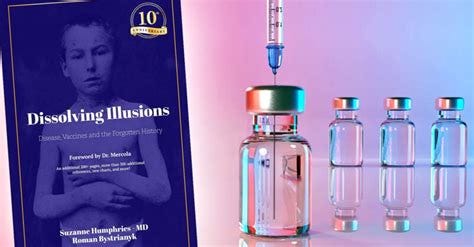
This is the central finding of “Dissolving Illusions: Disease, Vaccines, and the Forgotten History,” a meticulously researched book by Dr. Suzanne Humphries, a board-certified nephrologist with 19 years of clinical experience, and Roman Bystrianyk, a researcher who spent years pulling mortality data from archives that nobody in mainstream medicine thought to look at. The book runs more than 500 pages, contains over 50 original data graphs drawn from primary historical sources, and makes a specific, falsifiable, data-driven argument: the major infectious diseases of the 19th and 20th centuries were already in catastrophic decline before vaccines were introduced. The graphs show it. The death records show it. The historical medical journals show it. And the public health establishment has never put those graphs where your doctor could easily find them.
This piece walks through what the data shows, who knew it, and why you were not told.
AT-A-GLANCE
Another part of the fraud is using another vaccine as the control in lieu of a true placebo. You simply cannot prove a vaccine is safe by comparing it to another, most likely unsafe, vaccine
According to Dr. Suzanne Humphries, there are no worthwhile vaccines, not even smallpox or tetanus. Tetanus can be successfully treated using high-dose intravenous vitamin C and other essential nutrients
Vitamin C works because tetanus is a bacterial disease caused by an obligate anaerobe that cannot survive in the presence of oxygen. Other oxidative therapies that could be used if the infection is related to a wound include hydrogen peroxide and ozone therapy
The vaccine industry intentionally deceives us about the risks and benefits of vaccines in order to make a profit, with complete disregard for human suffering and the destruction of public health over time
One of the reasons the polio vaccine doesn’t work is because polio isn’t caused by an infectious virus. It’s caused by toxins. Poliovirus is a commensal virus that is completely harmless in the absence of toxic onslaught
The changing of definitions is part of the vaccine industry’s playbook. The definition of a “vaccine” was radically altered to allow for the use of experimental modified RNA gene therapy
The Numbers That Should Have Changed Everything
Roman Bystrianyk did not set out to challenge the vaccine narrative. He set out to verify it. When his children were due to be vaccinated, he started looking for the evidence base behind what he had always assumed was settled fact. He expected to find, as any reasonable parent would, that vaccines caused the dramatic decline in death from diseases like measles and whooping cough.
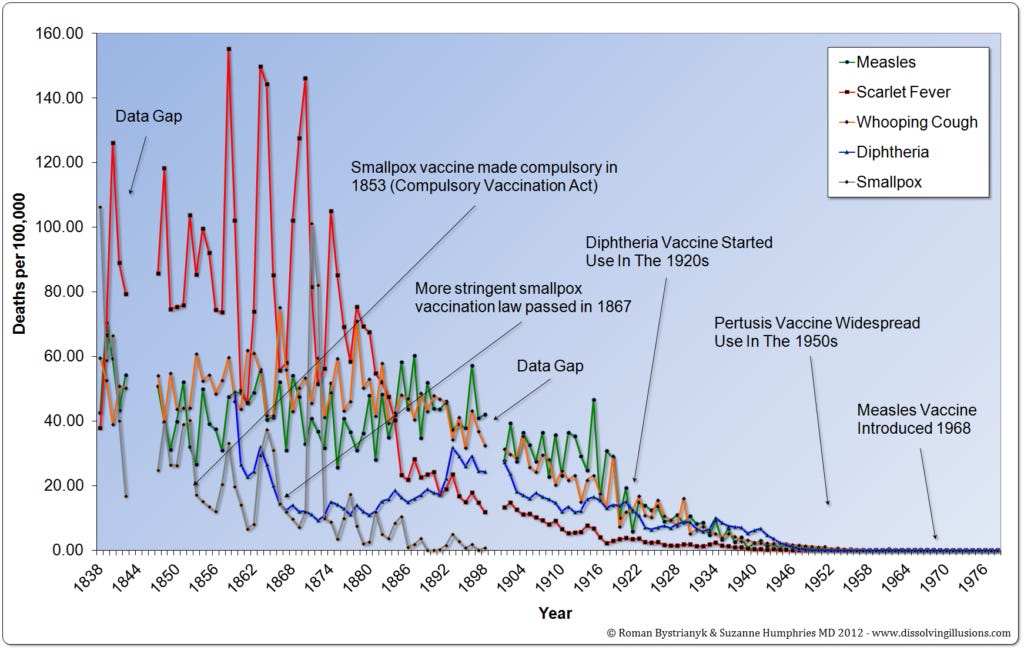
He found the opposite.
Looking at US mortality data starting from 1900, he found that measles deaths had declined by more than 98 percent before the measles vaccine was introduced in 1963. The death rate from measles was already approaching a statistical floor by the time the first shot was administered. The vaccine did not reverse a rising trend. It arrived after the trend had already done its work.
He found the same thing with whooping cough. Whooping cough mortality had fallen by more than 90 percent before the DTP vaccine was introduced. The vaccine followed the decline. It did not cause it.
These are not small adjustments to an otherwise accurate story. A 98 percent decline that preceded the vaccine means the vaccine cannot explain 98 percent of the improvement. That is not a quibble over timing. That is a fundamental misattribution of cause.
Bystrianyk spent years at the Yale Medical Library and at other research libraries pulling mortality records from the 1800s into the early 1900s. He found data that was not on public display, not in current medical textbooks, not referenced by the CDC, and not available to parents or physicians through any official channel. The data existed. It was in dusty archive volumes. It had simply never been assembled, graphed, and shown to anyone.
What Did Kill the Disease?
If vaccines did not produce the dramatic decline in infectious disease mortality, what did?
The historical record is clear on this. Bystrianyk’s research, corroborated by Dr. Humphries and by the primary sources they assembled, points to a consistent set of factors: clean water, functional sewage systems, improved nutrition, less overcrowded housing, and rising wages that allowed working people to eat adequately.
To understand why these factors mattered so much, you need to understand what life actually looked like before they existed.
In 1850, the city of New York contained 8,141 cellars sheltering 18,456 people. Dark, damp, ill-ventilated, vermin-infested underground rooms where families cooked, slept, and raised children. An entire street would share a single outdoor pump and a few outdoor privies. Sewage ran in open channels. Animal and human waste accumulated in streets alongside the slaughterhouses and manufactories that occupied the same city blocks as the tenements.
Victorian England’s average age of death among the urban poor was 15 to 16 years. Not life expectancy from birth adjusted for infant mortality. The average age at which the urban poor died. Children roamed streets unattended because parents were working 12 to 16 hour days in factories. One in five babies born in the worst tenements died in them. The Tenement House Commission called those buildings “infant slaughter houses” and documented it statistically.
London’s population grew ninefold during the 19th century. In 1750, 15 percent of the English population lived in towns. By 1880, 80 percent did. One million people in London in 1801 became seven million by 1901. The infrastructure did not come close to keeping pace. The city poured its sewage into the Thames, which it also used as a water supply. Friedrich Engels documented in 1844 what he saw in London: a river that “positively looked as solid as black marble in the shadow, indeed it was more like watery mud than muddy water,” which residents were assured was the only water available to drink.
This was the disease environment. People did not die from measles and whooping cough primarily because the pathogens were uniquely lethal. They died because their bodies had no reserve to fight infection. Malnutrition. Vitamin A deficiency. Compromised immunity from chronic parasitic load. No clean water. No way to isolate a sick child in a single-room tenement shared by multiple families.
As cities built sewage systems, piped clean water, passed minimum wage laws, enforced building codes, and reduced overcrowding, the death rates from infectious disease fell. They fell for diseases with vaccines. They fell equally for diseases without vaccines. Scarlet fever, rheumatic fever, typhus, and typhoid followed the same downward trajectory as measles and whooping cough, despite no vaccines existing for any of them.
That pattern is the argument. If vaccines caused the decline, why did diseases without vaccines decline at the same rate and on the same timeline?
The Doctor Who Lost Her Career for Asking
The data is one thing. The social consequences of presenting it are another.
Dr. Jayne L. M. Donegan is a British physician who trained in the 1980s and, like all of her contemporaries, was taught that vaccines were the single most important health intervention ever introduced. She counseled vaccine-hesitant parents at special clinics, telling them that disease was 10 times more likely to cause death or disability than vaccination. She believed it. She had been told it. She had never examined the underlying data herself.
In 1994, the UK launched a massive measles and rubella vaccination campaign targeting seven million schoolchildren. Donegan was told it was a one-shot vaccine that provided lifetime immunity. The campaign’s chief medical officer then stated publicly that two shots of this “one-shot vaccine” would not necessarily protect children, and that they might need a third. Donegan began pulling the actual records from the Office for National Statistics. Hours in libraries. Dusty volumes. The same archives Bystrianyk later found.
She found that when the measles vaccine was introduced to the UK in 1968, the death rate from measles continued its steady decline without any identifiable inflection. The initial vaccine uptake was only 30 percent and did not reach 50 percent until the 1980s. The decline in measles mortality did not accelerate when vaccination rates rose. It followed the same slope it had been on since the early 1900s.
In 2002, Donegan was asked to serve as an expert witness for two mothers whose unvaccinated children were the subject of court-ordered vaccination requests from absent fathers. She wrote a detailed report, fully referenced, using the actual methods and results of the studies she cited rather than simply adopting the authors’ conclusions, which she found were often not supported by the data.
The court ruled against the mothers. On appeal, a judge called her evidence “junk science.” She was charged with Serious Professional Misconduct by the General Medical Council. The charge could have ended her career and her livelihood. The case dragged on for three and a half years.
In 2007, the GMC panel completely exonerated her. They did not merely acquit her. They stated on the record that in her reports, she had not failed “to be objective, independent and unbiased.”
She had the data right. She had the methods right. She was still charged with serious misconduct for presenting it.
The lesson she drew from the experience is the same one Dr. Humphries draws from her own: “The biggest obstacle to independent research and thinking is the professional consequence of stepping out of line.”
The Nephrologist Who Watched Her Patients
Dr. Suzanne Humphries came at this from a different angle.
She was a practicing nephrologist, a kidney specialist with 19 years of clinical experience, when three patients arrived at her hospital in the winter of 2009 in close succession with complete kidney shutdown. When she spoke with each of them, each one volunteered the same unprompted information: “I was fine until I had that vaccine.”
All three had normal kidney function at baseline, documented in outpatient records. All three required acute dialysis. Two eventually recovered. One died from complications.
Humphries began taking vaccine histories on every kidney patient. She found connections she had never looked for before. She went looking for safety trial data on vaccines in renally compromised patients, in patients with active heart failure, in cancer patients, in patients with autoimmune disease. There were no such trials. Vaccines had been declared safe and effective as a general proposition, and that designation had been applied uniformly across patient populations without population-specific safety data to support it.
She attempted to get her hospital to defer vaccinating acutely ill patients until the day of discharge rather than upon admission. She was told not to interfere with the vaccination protocol. She was told that if she wanted credibility for her concerns, she needed to conduct her own IRB-approved, statistically significant study.
Think about what that standard means. The burden of proof was placed entirely on the physician observing potential harm. The institutions promoting vaccination faced no parallel burden to demonstrate that vaccines were safe in acutely ill kidney patients. There was no data showing vaccines did not cause kidney failure in this population. The absence of such data was treated as evidence of safety. Humphries saw it differently: nobody was looking, so the connections were not being made.
When she raised the connection between vaccines and kidney injury with open-minded colleagues, some of them saw it too. They started taking vaccine histories. They confirmed the pattern. And then they stayed silent. They walked back into the herd.
Humphries did not. She left her hospital position, her lucrative practice, and her shining professional reputation to write the book she wished had existed when she started asking questions.
Smallpox and the Law
The historical treatment of smallpox vaccination is one of the book’s most detailed case studies, and one of the most important.
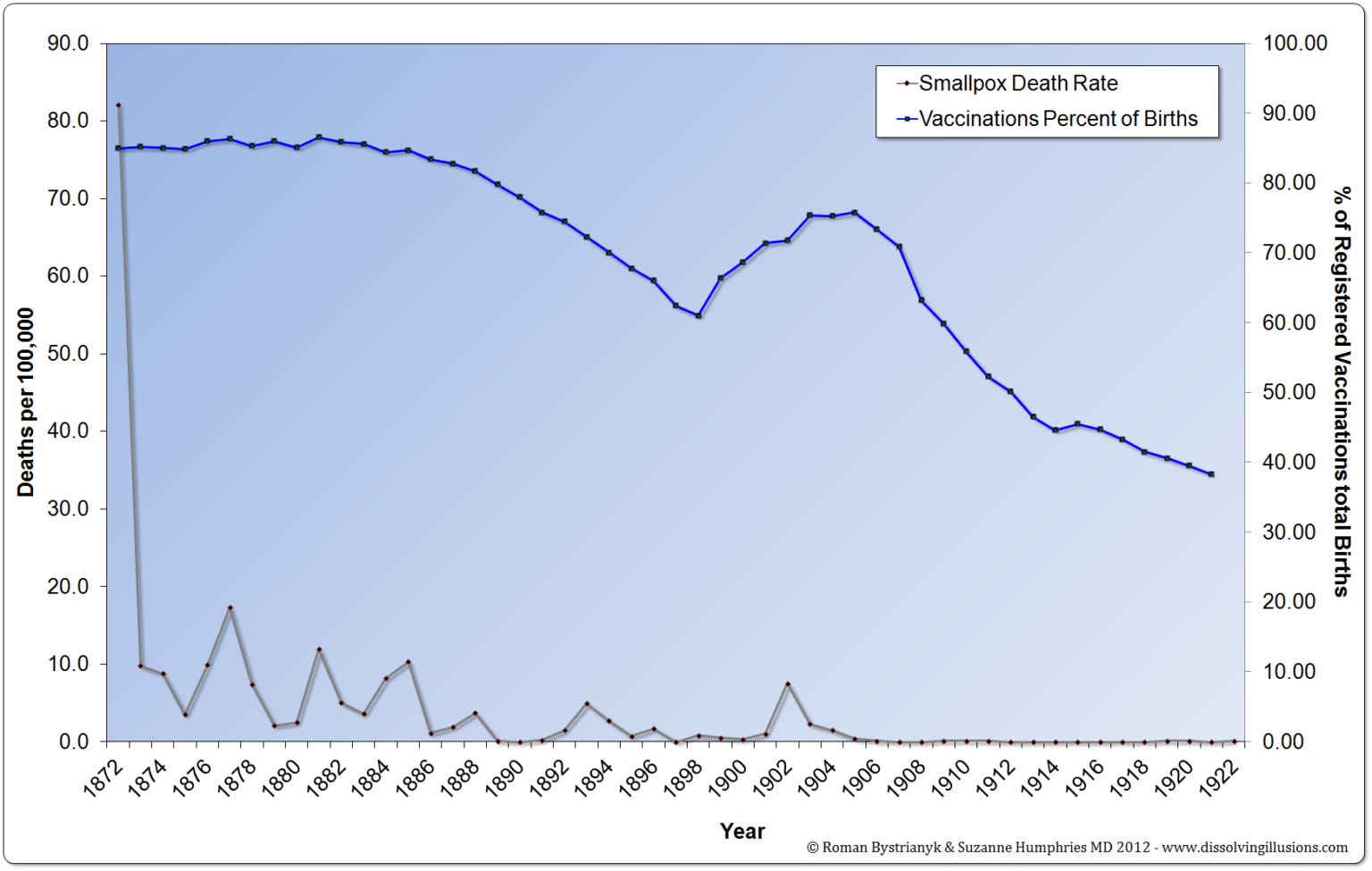
The standard story: Edward Jenner discovered that cowpox inoculation protected against smallpox. Vaccination was introduced. Smallpox was eradicated. End of story.
What the historical record actually shows is considerably more complicated. The compulsory smallpox vaccination law in England was enacted in 1867. At that point, the death rate from smallpox was already declining. After the law took effect, and after the enforcement mechanisms were strengthened, the death rate from smallpox increased from approximately 100 deaths per million to approximately 400 deaths per million. Compulsory mass vaccination was accompanied by a fourfold increase in smallpox mortality.
The 1919 Anti-Vaccination League rally at Toronto’s Old City Hall was not a fringe event. It was a mass public protest by people who had watched compulsory vaccination programs fail to produce the promised protection, and in some cases produce visible harm. Their signs read “Compulsory Vaccination: German Born. Down With Compassion!!” The historical photographs of these rallies survive. The concerns behind them have been largely erased from the official account.
The relationship between smallpox vaccination and smallpox mortality was contested in its own era by data-literate observers who published in prominent medical journals and held positions in public health administration. Those critiques were answered not by addressing the data but by dismissing the critics. That pattern is not unique to the 1800s.
The Structure of the Illusion
How does a false story this large persist this long?
The authors give a direct answer: belief systems are more powerful than data, especially when the belief is institutionally reinforced by the people whose professional authority depends on it.
The medical curriculum is structured to produce practitioners, not skeptics. Students learn what authorities say. There is no time in a packed curriculum for deep examination of historical mortality data. Vaccines go in the “vaccines work” box. Non-vaccine diseases go in the “better sanitation” box. Nobody asks why the rules differ. Nobody draws the graphs.
Doctors who step outside that structure face what Donegan and Humphries both faced: professional consequences that are explicitly designed to discourage the behavior. The consequence does not have to be as severe as a misconduct charge. It can be as simple as a department chief dismissing your observation with a curt response and walking away. In a professional culture that rewards conformity and punishes dissent, the silence of the majority is not agreement. It is survival.
Parents who do not vaccinate are treated as vectors of harm, or as ignorant, or as sociopathic. Donegan, when she was still a true believer, held those views herself. She now understands that her own unexamined belief had the same foundation: she trusted the authorities because the authorities had never given her access to the data.
The book does not argue that vaccines never work. It argues that the historical evidence for the specific claim that vaccines drove the dramatic decline in infectious disease mortality does not exist. The decline was real. The cause of the decline is documented. Clean water and sewage systems saved more lives than any injection ever administered.
What You Should Do With This
“Dissolving Illusions” was published in 2013. It has been updated and expanded since then. It is not a polished advocacy document. It is a deliberate information dump: graphs, direct quotes from historical and medical sources, photographs with original captions, reference lists. The authors chose that format specifically because a distilled summary would allow readers to dismiss the conclusions without seeing the weight of evidence behind them. They want you to read the actual quotes. They want you to look at the actual graphs.
The core questions the book poses are simple enough that any reasonably informed adult can evaluate them. Did measles mortality decline before the measles vaccine was introduced? The US vital statistics data answers that. Did diseases without vaccines decline on the same timeline as diseases with vaccines? The historical record answers that. Was there ever a safety trial of vaccines in acutely ill kidney patients? The absence of such trials is verifiable.
You do not have to take Humphries and Bystrianyk’s word for any of it. They provide the primary sources so you can check. That is the structure of their argument: not “trust us instead of the authorities,” but “here is the data the authorities have not shown you, and here is where it came from.”
The question worth sitting with is why that data is not easy to find. Why it lives in archive boxes in medical libraries rather than on the CDC website. Why the graphs that show disease mortality trends from 1900 onward are not standard content in medical school curricula. Why a physician who presented fully referenced, methodologically sound research was charged with serious professional misconduct for doing so.
Data that supports the official story tends to travel. Data that complicates it tends to stay buried.
“Dissolving Illusions” is an attempt to dig it up. Whether it changes your conclusions or simply deepens your questions, it earns a serious read.
Sources:
Dissolving Illusions: Disease, Vaccines, and the Forgotten History by Suzanne Humphries, MD and Roman Bystrianyk (2013, expanded editions).
Primary historical sources cited in the book include mortality data from the US vital statistics system, the UK Office for National Statistics, the Yale Medical Library historical collections, and the New York Academy of Medicine Rare Book and History of Medicine Collections. Foreword by Dr. Jayne L. M. Donegan, MBBS, DRCOG, DFFP, DCH, MRCGP, MFHom.
Margin of the Law publishes constitutional analysis, civic research, and legal education for people who want to understand the system they actually live in. Read the Full Constitutional Analysis Library at marginofthelaw.com.
© 2026 – MK3 Law Group
For republication or citation, please credit this article with link attribution to marginofthelaw.com.