

The Official Narrative Versus the Documentary Record
The history taught in American schools follows a familiar arc. Early settlers carved communities from wilderness. Visionary leaders fought for democracy. A determined populace defended founding ideals against British imperialism. The revolution succeeded, launching an independent nation into the industrial age. After World War II, America became the wealthiest and most powerful nation in recorded history.
This narrative contains truth. It also contains significant omissions.
The documentary record reveals a parallel history that diverges sharply from the official version. Both histories begin in the revolutionary ferment of colonial America. But the unofficial history tracks a different trajectory, following an actor that receives minimal attention in standard accounts yet proves central to understanding how American governance actually evolved.
That actor is the corporation.
Colonial America and Corporate Power
The United States emerged from rebellion against British monarchs, British parliament, and British corporations. Contemporary Americans often associate corporations with late nineteenth-century industrialists like Rockefeller and Carnegie. The historical record shows corporations wielded enormous power in prerevolutionary America.
The Massachusetts Bay Company, Hudson’s Bay Company, and British East India Company operated as extensions of royal authority. British monarchs used these chartered entities to control colonial commerce and extract resources for the motherland. Colonists recognized this arrangement and resisted it.
The British East India Company’s tea monopoly triggered direct action. When the company imposed duties and eliminated competition, colonial merchants organized boycotts. Ships were turned away at ports. On December 16, 1773, protesters dumped 342 chests of tea into Boston Harbor.
The Boston Tea Party demonstrated something beyond opposition to taxation. It revealed a population awakening to its capacity for self-determination and recognizing corporate monopoly as incompatible with liberty.
The Post-Revolutionary Framework
The Declaration of Independence in 1776 severed ties with Britain and British corporate control. For roughly a century afterward, Americans maintained deep suspicion of corporate power and constructed legal frameworks reflecting that suspicion.
Early American corporate charters operated on specific principles. Corporations existed as legal conveniences created by the people for defined purposes. The law classified them as “artificial, invisible, intangible” financial instruments. Individual states, not the federal government, issued charters, enabling close local oversight. Charters included automatic dissolution provisions if corporations violated their terms. Legal limits constrained corporate size and influence.
Even prominent capitalists acknowledged these constraints as necessary. Railroad magnate J.P. Morgan stated that corporations must never become so large they “inhibit freedom to the point where efficiency is endangered.”
By 1800, approximately two hundred corporations operated in the United States under strict conditions. They could not participate in political processes. They could not purchase stock in other corporations. Violations brought severe consequences.
The historical record documents enforcement. In 1832, President Andrew Jackson vetoed extension of the Second Bank of the United States charter, citing corruption and tyranny. That same year, Pennsylvania revoked charters of ten banks for operating contrary to public interest. By mid-century, antitrust legislation existed across multiple states.
The early American framework positioned corporations as subordinate tools serving public purposes. Citizens, not corporations, held primary authority.
The Civil War Transformation
The shift in corporate power began in the final third of the nineteenth century, inaugurating an extended conflict between corporations and civil society. The Civil War marked the turning point.
Corporations accumulated substantial wealth through procurement contracts. Wartime disorder and corruption created opportunities to influence legislators, judges, and executives. President Abraham Lincoln observed these developments and issued a warning before his assassination:
“Corporations have been enthroned. An era of corruption in high places will follow and the money power will endeavor to prolong its reign by working on the prejudices of the people until wealth is aggregated in a few hands and the republic is destroyed.”
Lincoln’s warning produced no corrective action. Corporate influence continued expanding through amended charter laws. State charters became irrevocable. Profit limitations disappeared. Only courts could restrain corporate activity, and judicial decisions consistently favored corporate interests through incremental expansions of rights and privileges.
Santa Clara and Corporate Personhood
In 1886, the Supreme Court case Santa Clara County v. Southern Pacific Railroad produced a legal determination that altered American constitutional structure. The Court deemed private corporations “natural persons” under the Constitution, entitled to Bill of Rights protections.
This ruling granted corporations rights previously reserved for individual citizens, including free speech protections. Given their financial resources, corporations could defend and exploit these rights more vigorously than any individual. The practical result: corporations became more free than the citizens who created them.
The American Constitution’s foundational premise—equal voice for all citizens in public deliberation—had been fundamentally compromised. Supreme Court Justice William O. Douglas later assessed that the Santa Clara decision “could not be supported by history, logic or reason.”
A single judicial determination restructured the relationship between corporations and democratic governance.
Post-Santa Clara Consolidation
The decades following Santa Clara demonstrated the ruling’s consequences. By 1919, corporations employed over 80 percent of the American workforce and generated most national wealth. Corporate trusts achieved sufficient power to resist legal challenges. Courts consistently ruled in corporate favor.
Workers lost legal recourse for workplace injuries under the doctrine that employment constituted voluntary assumption of risk. Railroad and mining companies acquired vast land holdings at minimal cost through favorable legal treatment.
The trajectory represented what historians describe as gradual institutional capture—not sudden military takeover but systematic subversion of state power by aligned government and business interests. Franklin Roosevelt’s New Deal programs produced temporary constraints during the 1930s. Otherwise, the corporate state framework has operated continuously.
The Postwar Acceleration
After World War II, corporate power expanded through mergers, consolidations, and restructuring into increasingly large and complex entities controlling extraction, production, distribution, and marketing. Many corporations became economically larger than national governments.
By 1997, fifty-one of the world’s hundred largest economies were corporations rather than countries. The top five hundred corporations controlled forty-two percent of global wealth. Contemporary corporations freely purchase stock in other corporations, lobby legislators, finance elections, control broadcast media, set industrial and cultural agendas, and operate without meaningful size constraints.
Contemporary Manifestations
The current landscape produces scenarios that would have appeared impossible to previous generations.
At Morain Valley Community College in Palos Hills, Illinois, student Jennifer Beatty protested corporate sponsorship by locking herself to metal mesh curtains at the McDonald’s Student Center. She was arrested and expelled.
At Greenbrier High School in Evans, Georgia, student Mike Cameron wore a Pepsi shirt on “Coke Day” when Coca-Cola representatives visited the company-sponsored school. Cameron was suspended.
In Toys “R” Us stores across North America, children push miniature shopping carts labeled “Toys ‘R’ Us Shopper in Training” while following parents through aisles.
In St. Louis, Missouri, Monsanto’s legal team targeted anyone spreading information about company practices. A Fox TV affiliate prepared an investigative report on synthetic bovine growth hormone. Monsanto attorneys threatened “dire consequences.” The network pulled the story. A publisher later shelved a book on genetic agricultural technologies after similar legal pressure.
The Global Architecture
In corporate boardrooms worldwide, executives have pursued frameworks that would function as global corporate charters of rights. The Multinational Agreement on Investment represented one such effort, supported by the World Trade Organization, World Bank, International Monetary Fund, International Chamber of Commerce, European Round Table of Industrialists, and Organization for Economic Co-operation and Development.
The MAI would have created unified global economic rules allowing corporations unrestricted rights to buy, sell, and relocate assets across borders. It was designed to override local, state, and national laws deemed nonconforming and enable corporations to sue governments for noncompliance. Grassroots opposition temporarily suspended negotiations in April 1998. The underlying objectives remain active in various trade frameworks.
The Constitutional Erosion
Legal scholar William F. Pepper documented the broader governmental transformation in “An Act of State: The Execution of Martin Luther King”:
“The American government could already be described as authoritarian. Due process of law and the right of habeas corpus, which for centuries have characterized the rule of law in democratic states, have been eliminated. At the discretion of the president, non-citizens and citizens alike may be classified as enemy combatants, picked up and held for an indeterminate period of time without access to counsel. A network of secret prisons and camps is being established both inside and outside of the United States. Paramilitary forces or private mercenary armies are being developed to make up for the inadequate numbers of the existing volunteer army. This is effectively resulting in the privatization of the US military.”
The Structural Inversion
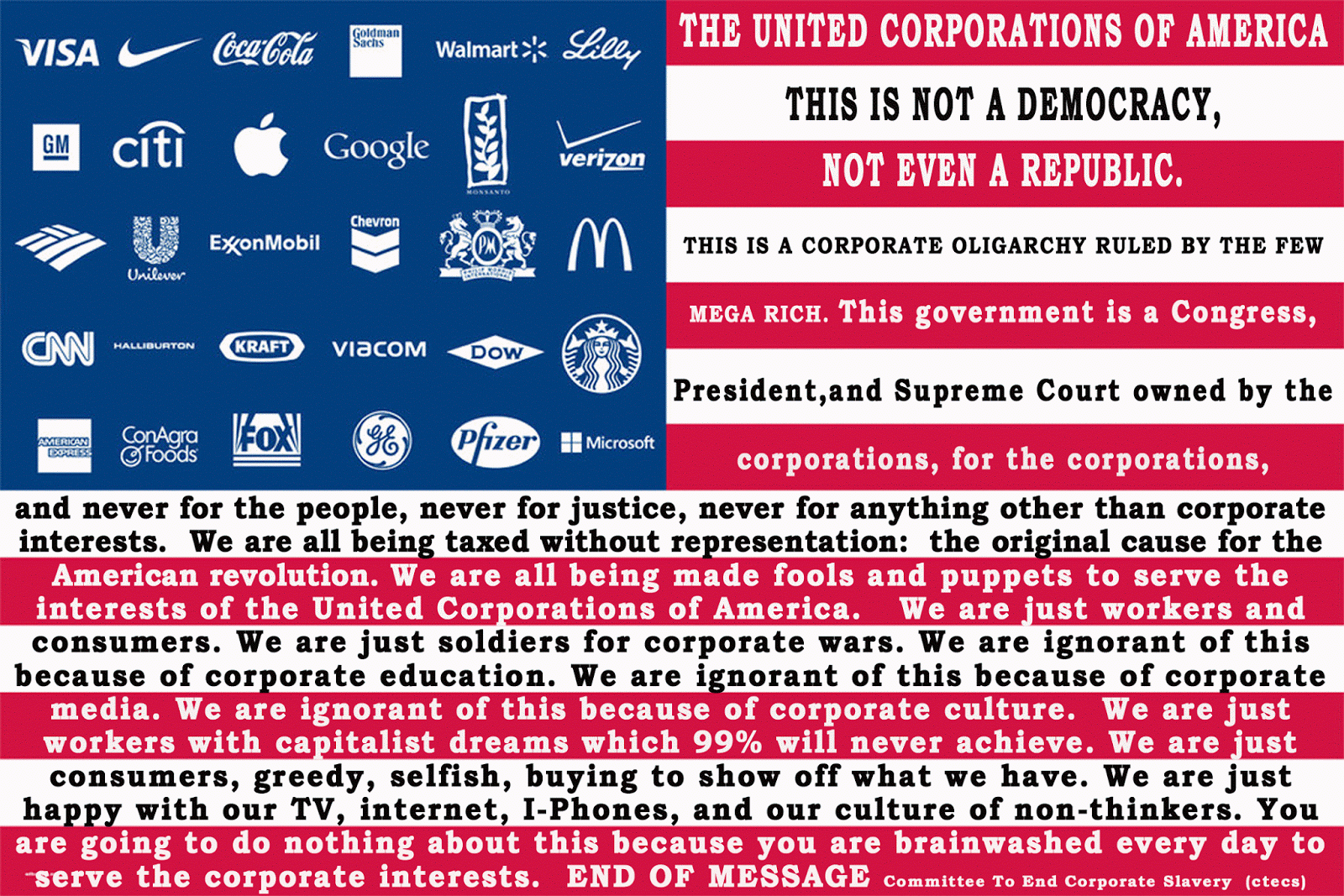
The documentary evidence reveals a structural inversion of the original American framework. Corporations, legal constructs created by citizens two centuries ago, now possess more rights, freedoms, and powers than the citizens who created them.
This arrangement operates as normalized reality. Citizens petition corporations rather than regulate them. They request that corporations refrain from destroying ancient forests, polluting waterways, using exploitative marketing toward children, or leveraging governments against each other for favorable terms. These requests acknowledge corporate authority while abandoning citizen sovereignty.
The posture of supplication has become habitual. The constitutional framework establishing popular sovereignty over artificial legal entities has inverted into a system where legal fictions exercise authority over the citizens they theoretically serve.
The Documentary Conclusion
The unofficial history of America differs fundamentally from the official version. It does not describe rugged individualism and heroic sacrifice in pursuit of noble ideals. It documents a democratic experiment progressively captured by the commercial entities it created, a revolutionary spirit systematically contained, and a constitutional framework structurally compromised.
The original American premise held that government answers to citizens, that rights require no permission, and that institutions serve public purposes or lose legitimacy. The historical record shows how that premise was undermined through judicial interpretation, legislative capture, and gradual normalization of corporate authority over public life.
The evidence is available to anyone who examines it. The question is not whether this history occurred. The question is what citizens who understand it choose to do with that knowledge.