

“We the people are the rightful masters of Congress and the courts, not to overthrow the Constitution, but to overthrow men who pervert the Constitution.”
— Abraham Lincoln
I. Introduction
The battle over who defines the “Supreme Law of the Land” strikes at the core of the American experiment. Article VI of the Constitution states it plainly:
“This Constitution, and the Laws of the United States which shall be made in Pursuance thereof, and all Treaties made... shall be the supreme Law of the Land.”
No ambiguity. No asterisks. No footnotes referencing judicial interpretation.
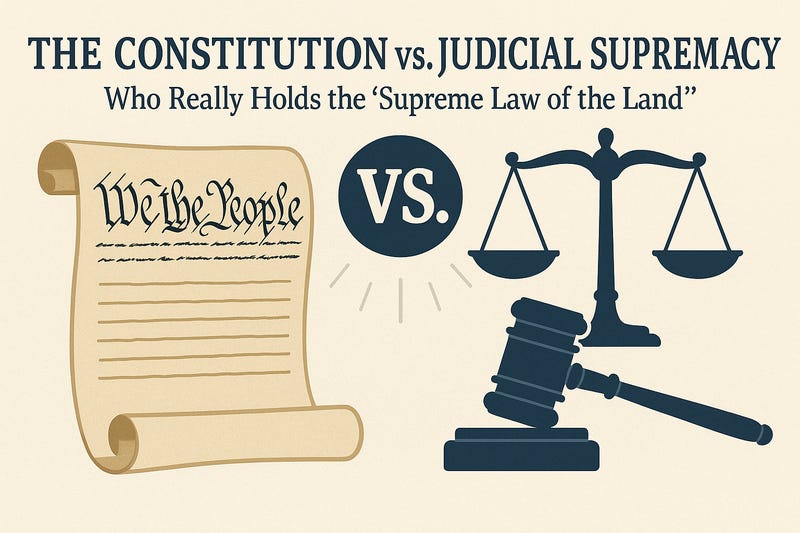
Yet over two centuries, the constitutional order the framers designed has mutated into something they would not recognize. The judiciary—particularly the Supreme Court—now claims final authority over constitutional meaning. This concentration of interpretive power constitutes judicial supremacy: the doctrine that the Court’s interpretations bind all branches of government and all states, full stop.
From Marbury v. Madison (1803) to the sweeping social engineering of the Warren Court and the explicit demands for deference in Cooper v. Aaron (1958), judicial power expanded from code-bound interpretation to quasi-legislative authority. The question demanding examination—especially amid modern debates about the administrative state, federal overreach, and eroding individual liberty—is whether this arrangement aligns with constitutional design or represents a quiet usurpation of the people’s sovereignty.
The answer carries real-world consequences for every American who believes government answers to citizens, not the reverse.
[E]very act of a delegated authority, contrary to the tenor of the commission under which it is exercised, is void. No legislative act, therefore, contrary to the Constitution, can be valid. To deny this, would be to affirm, that the deputy is greater than his principal; that the servant is above his master; that the representatives of the people are superior to the people themselves; that men acting by virtue of powers, may do not only what their powers do not authorize, but what they forbid.
— Alexander Hamilton, Federalist #78
II. The Foundational Principle: Sovereignty Resides in the People
The Framers’ Design
The founding generation built a government whose powers operated derivatively—flowing from the people, not imposed upon them. Joseph L. Call’s 1957 analysis in the Dickinson Law Review put it directly: the founders “repudiated the principle of absolute sovereignty in the government, and replaced it with the principle that sovereignty vested in the people—that magistrates were consequently their trustees.”
Every power held by Congress, the Executive, and the Judiciary exists under the Constitution as a trust delegated by the people. A trust that remains revocable.
Call’s observation cuts to the structural truth: “There being no statement in the Constitution that any one branch is superior to any other, it can only be concluded that all three branches are coordinate divisions, each supreme within its own sphere.”
Under the Madisonian model, neither popular sovereignty nor legislative majoritarianism held absolute sway. Each department checked the others. None served as the supreme interpreter of the rulebook itself.
The Constitution’s Textual Hierarchy
The Supremacy Clause constructs a clear legal hierarchy:
The Constitution itself
Federal laws made in pursuance of the Constitution
Treaties made under United States authority
Notice what this list excludes. Judicial decisions appear nowhere in the hierarchy of supreme law. Courts interpret law. They do not create it. They are not co-sovereigns alongside the people or the Constitution.
This distinction matters. It is the difference between a republic and a robed oligarchy.
Sometimes equated with regula iuris, the “Rule of Law”, holds that government can and should be legally limited in its powers, and that its authority depends on enforcing those limitations.
III. The Rise of Judicial Review
Marbury v. Madison and the Seeds of Power (1803)
When Chief Justice John Marshall wrote that “it is emphatically the province and duty of the judicial department to say what the law is,” he was not claiming political supremacy. He asserted a logical necessity: courts must interpret law to adjudicate cases properly. Within this narrow function—resolving cases under law—Marshall introduced judicial review, empowering courts to strike down legislation conflicting with the Constitution.
This was a check. A necessary function. Not a coronation.
But subsequent generations inflated Marshall’s reasoning into something approaching theology. Michael Stokes Paulsen’s analysis in “The Irrepressible Myth of Marbury” identifies the distortion clearly:
“Nearly all of American constitutional law today rests on a myth... The myth is that Marbury v. Madison created the doctrine that the Supreme Court’s word is final—that its interpretations themselves become the Constitution.”
The transformation was complete. Judicial review—a check—became judicial supremacy—an overlordship.
The Expansion: Cooper v. Aaron (1958)
The Supreme Court’s 1958 decision in Cooper v. Aaron, responding to southern resistance to Brown v. Board of Education, declared without qualification:
“The federal judiciary is supreme in the exposition of the law of the Constitution.”
This pronouncement meant that state officials acting on their own understanding of the Constitution remained bound by the Supreme Court’s interpretations. In one stroke, the Court elevated its own precedents to the status of constitutional text—without amendment, without ratification, without the people’s consent.
Legal scholar Dale Carpenter characterized Cooper as the pivot from judicial review to judicial supremacy. Thereafter, the Court claimed not just a word, but the final word, on constitutional meaning.
Do not separate text from historical background. If you do, you will have perverted and subverted the Constitution, which can only end in a distorted, bastardized form of illegitimate government.
— James Madison (unverified)
IV. The Competing Doctrines
Judicial Supremacy
The doctrine holds that the Supreme Court’s interpretation of the Constitution binds all branches of government and all citizens unless the Court overrules itself or the Constitution undergoes formal amendment.
Advocates argue this centralization ensures uniformity, prevents interpretive anarchy, and protects minority rights against transient majorities.
The criticism runs deeper. Judicial supremacy contradicts the Constitution’s allocation of powers. It converts unelected judges into de facto lawmakers. It discourages democratic responsibility as legislators defer hard constitutional questions to courts rather than doing their jobs.
Nelson Lund’s analysis in “Judicial Supremacy: Palladium of Liberty or Academic Paradox?” traces this development through what he termed “the doctrinal adventurism of the Warren and Burger Courts,” producing virtual amendments through judicial decree rather than constitutional process.
Departmentalism (Constitutional Supremacy)
An opposing theory—departmentalism—argues that each branch holds coequal authority to interpret the Constitution within its functional sphere. Presidents, Congresses, and judges all swear the same oath to support and defend the Constitution. Not the Supreme Court. The Constitution.
Thomas Jefferson, Andrew Jackson, and Abraham Lincoln all rejected the notion that Court opinions bind the entire government. Jackson’s 1832 veto of the national bank stated the principle explicitly:
“Each public officer swears that he will support the Constitution as he understands it, and not as it is understood by others.”
Modern scholars like Larry Kramer and Michael Paulsen view this position as essential to preserving the people’s ultimate sovereignty over government institutions. Without departmentalism, the oath of office becomes a formality—a pledge of loyalty not to the Constitution but to whatever nine lawyers in Washington decide.
V. Structural Arguments: The Supremacy Clause and Separation of Powers
Bradford Clark’s analysis of the Supremacy Clause makes a critical textual argument. The Clause declares as supreme only those laws “made in pursuance of” the Constitution—meaning laws consistent with it.
Who decides whether a law was made in pursuance? All courts and officers applying law, not only the Supreme Court. Clark’s conclusion follows logically:
“If a federal statute fails this condition, it does not qualify as ‘the supreme Law of the Land,’ and courts remain free to apply state law.”
Supremacy flows from constitutional conformity, not judicial interpretation. The Court’s modern practice reverses this hierarchy—substituting judicial will for constitutional text.
The Rational Basis Problem
Joseph Diedrich’s analysis of the rational basis test illustrates how judicial supremacy paradoxically enables judicial passivity. By upholding almost any statute with the faintest “rational relation” to a “legitimate government interest,” courts have abandoned their duty to apply the Constitution as supreme law.
The rational-basis doctrine violates separation of powers because it transfers the judicial function back to legislatures. Courts that defer to legislative judgment on constitutional questions are not doing their job. They are delegating it.
The Counterrevolution Against Political Sovereignty
Nikolas Bowie and Daphna Renan’s research documents how judicial supremacy emerged not from the Founding but from post-Reconstruction backlash. Modern separation-of-powers jurisprudence—empowering courts to nullify legislative-executive arrangements—originated as a reactionary movement to cripple democratic reconstruction efforts.
Under the earlier republican vision, political branches collectively defined separation through legislation. The Taft Court’s Myers v. United States (1926) enshrined a juristocratic model, displacing elected authority.
Today’s judicial supremacy represents not constitutional continuity but a counterrevolution against republican self-government. Understanding this history exposes the doctrine’s contested origins.
An unconstitutional act is not a law; it confers no rights; it imposes no duties; it affords no protection; it creates no office; it is in legal contemplation as inoperative as though it had never been passed.
VI. Competing Philosophies Compared
The divide between judicial supremacy and constitutional supremacy reflects fundamentally different visions of American government.
Under judicial supremacy, authority flows from Court decisions. The Supreme Court serves as ultimate interpreter. Checks and balances mean courts standing above other branches. Democratic accountability remains minimal since justices face no elections. The philosophical basis rests on legal formalism and rule by credentialed experts. The risk is judicial tyranny and erosion of popular sovereignty.
Under constitutional supremacy, authority flows from the Constitution itself. The people through their elected branches serve as ultimate interpreters. Checks and balances mean coequal branches, each checking the others. Democratic accountability remains robust since the people can alter representation or amend the Constitution. The philosophical basis rests on natural-law republicanism and rule by consent. The risk is legislative majoritarianism and inconsistent interpretations.
Judicial supremacy may offer stability, but it purchases that stability at the cost of self-government. The purpose of a written Constitution—fixed, knowable, enforceable—was precisely to constrain rulers, including judges, by the consent of the governed.
Judicial supremacy transforms interpretation into legislation by robe. The founding generation explicitly rejected such arrangements as monarchical.
On every question of construction [of the Constitution] let us carry ourselves back to the time when the Constitution was adopted, recollect the spirit manifested in the debates, and instead of trying what meaning may be squeezed out of the text, or intended against it, conform to the probable one in which it was passed.
— Thomas Jefferson (1743-1826), letter to Judge William Johnson, (from Monticello, June 12, 1823)
VII. Case Illustrations: Consequences of Judicial Supremacy
Roe v. Wade (1973)
The Court discovered a right to abortion within “penumbras” of privacy, effectively rewriting the criminal codes of fifty states without legislative process. By federalizing moral legislation, the Court displaced centuries of state police power and ignited half a century of political polarization.
Even the later reversal in Dobbs v. Jackson (2022)—while curbing Roe’s reach—illustrated how deeply judicial supremacy shapes national life. Policy debates that belong in legislatures get fought in confirmation hearings instead.
Obergefell v. Hodges (2015)
Invoking constitutional “dignity,” the Court declared same-sex marriage a fundamental right. Justice Scalia’s dissent stated the structural objection plainly: such opinions “rob the people of the freedom to govern themselves.”
Whatever one thinks of the policy outcome, the ruling extended beyond constitutional text into judicial legislation.
Chevron Deference (1984)
By deferring to agencies’ interpretations of ambiguous laws, courts transferred constitutional decision-making to the bureaucracy—another unelected layer. Judicial supremacy, paradoxically, enables executive supremacy through judicial passivity. The administrative state expands while courts step back.
Federal Preemption and State Sovereignty
Modern preemption doctrine, derived from the Supremacy Clause, has been reinterpreted to favor federal dominance even absent explicit statutory conflict. Courts presume federal “occupancy” of entire regulatory fields, limiting state autonomy contrary to the original understanding of limited enumerated powers.
The Tenth Amendment becomes decorative language rather than operative law.
VIII. The Republican Remedy: Reasserting Constitutional Supremacy
Restoring Balance Through Departmentalism
Alexander Hamilton’s Federalist No. 78 describes the judiciary as “the least dangerous branch,” possessing “neither force nor will, but merely judgment.” Restoring constitutional balance means reembracing that limited conception.
The executive and legislative branches possess both constitutional authority and moral duty to interpret the supreme law independently when executing their functions.
Congress can refuse to fund or execute judicially created mandates that exceed constitutional bounds. The President can exercise independent constitutional judgment when vetoing, enforcing, or declining to enforce laws. The states, under the Tenth Amendment, retain concurrent interpretive powers regarding powers not delegated to the federal government.
Constitutional Originalism and Public Virtue
Judicial restraint must rest not merely on procedural doctrine but on civic virtue—awareness that the Constitution belongs to the people, not to a priestly caste of judges. The judicial oath is to the document, not to precedent. Overturning erroneous decisions like Plessy or Roe represents fidelity, not activism.
Legal Education and Cultural Reform
Most law schools teach students that the Supreme Court decides what the Constitution means. This cultural assumption of oligarchic finality perpetuates judicial overreach.
Reversal begins with civic education emphasizing the actual hierarchy: Constitution, then Law, then Court interpretation. Not the reverse. Citizens who understand this order can demand accountability from all branches.
So long as the people do not care to exercise their freedom, those who wish to tyrannize will do so; for tyrants are active and ardent, and will devote themselves in the name of any number of gods, religious and otherwise, to put shackles upon sleeping men.
— Voltairine de Cleyre (1886-1912)
IX. The Path Forward
Popular Constitutionalism
Larry Kramer and Bruce Ackerman’s schools of popular constitutionalism argue that constitutional meaning evolves through public deliberation, elections, and amendments—not through judicial discovery. While these approaches risk relativism, they correctly restore sovereignty to the civic body.
The people wrote the Constitution. The people can amend it. The people should understand it.
Judicial Engagement on Constitutional Terms
A constructive alternative emerges from scholars like Randy Barnett and Clark Neily, who promote judicial engagement: courts should diligently enforce constitutional boundaries but should not create rights from whole cloth.
This approach repudiates both hyper-deference—the rational basis rubber stamp—and hyper-activism—inventive doctrines unmoored from text. A faithful judiciary enforces the Constitution’s supremacy, not its own preferences.
The general rule is that an unconstitutional statute, though having the form and name of law, is in reality no law, but is wholly void, and ineffective for any purpose; since unconstitutionality dates from the time of it’s enactment, and not merely from the date of the decision so branding it... No one is bound to obey an unconstitutional law, and no courts are bound to enforce it.
X. Philosophical Dimension: Law as Reason vs. Law as Power
The philosophical divide underpinning this debate mirrors an ancient one: nomos (law as reason) versus kratos (law as power).
Judicial supremacy redefines law as what those in black robes decide, aligning with positivism—the idea that legal validity stems from authority alone. Constitutional supremacy aligns with natural law traditions: law is right reason ordering society toward justice, discernible through text, history, and logic, not merely judicial decree.
Justice Oliver Wendell Holmes wrote cynically that “the life of the law has not been logic; it has been experience.” Yet pragmatism unmoored from fixed principle breeds instability and eventually tyranny.
The Founders sought a middle path: a written Constitution as the people’s covenant, governing passions through reason, constraining power through law.
Liberty cannot be preserved without a general knowledge among the people, who have a right, from the frame of their nature, to knowledge, as their great Creator, who does nothing in vain, has given them understandings, and a desire to know; but besides this, they have a right, an indisputable, unalienable, indefeasible, divine right to that most dreaded and envied kind of knowledge; I mean, of the characters and conduct of their rulers.
— John Adams, Dissertation on Canon and Feudal Law, 1765, From: Our Sacred Honor, Bennett, 253.
XI. Conclusion: Returning to the True “Supreme Law”
Two centuries of precedent have obscured a simple truth: the Constitution—not the Supreme Court—is the supreme law of the land. The judiciary’s proper role is neither sovereign nor oracle, but faithful servant.
Judicial supremacy, while practical in ensuring uniformity, undermines the republican compact by locating ultimate sovereignty in an unelected elite. This arrangement contradicts both the Constitution’s text and the principles underlying it.
The way forward lies in restoring interpretive balance among coequal branches, reaffirming that government exists under the Constitution, not above it. The principle of limited government demands not judicial deference nor judicial domination, but constitutional obedience by all three branches.
As Joseph Call warned nearly seventy years ago:
“If the Constitution is disregarded in any one of its essential provisions—no matter under what plea or pretext—the life of the republic will, in fact, have departed.”
The supreme law of the land is the Constitution and laws made in pursuance thereof—not judicial decisions.
The guardians of liberty are the people, through their constitutional processes of self-government.
The proper judicial role is to declare what the Constitution is, not to decide what it ought to be.
Only by reasserting constitutional supremacy can the United States preserve the delicate equilibrium of freedom envisioned in 1787—an equilibrium where government remains the servant, not the master, of the people.
The Constitution does not belong to the Supreme Court. It belongs to us.
Of all tyrannies, a tyranny exercised for the good of its victims may be the most oppressive. It may be better to live under robber barons than under omnipotent moral busybodies. The robber barons cruelty may sometimes sleep, his cupidity may at some point be satiated; but those who torment us for our own good will torment us without end, for they do so with the approval of their own conscience. — C.S. Lewis