


“The preservation of the sacred fire of liberty and the destiny of the republican model of government are justly considered, perhaps, as deeply, as finally staked on the experiment entrusted to the hands of the American people.”
George Washington, First Inaugural Address, April 30, 1789
John Adams wrote in 1798 that the Constitution “was made only for a moral and religious People. It is wholly inadequate to the government of any other.”
Most people treat that as sermon material. Inspirational filler for civics classes.
It’s not.
It’s engineering analysis.
Adams wasn’t moralizing. He was identifying a structural dependency. The Constitution’s design assumes internal restraint. Without that restraint, the system fails. The mechanisms stop working. The parchment becomes irrelevant.
The sentence before that famous quote reveals the collapse mechanism: “Avarice, ambition, revenge, or gallantry, would break the strongest cords of our Constitution as a whale goes through a net.”
When internal discipline disappears, external force becomes structurally necessary.
The Vacuum Principle
James Madison stated it plainly: the Constitution requires “sufficient virtue among men for self-government,” otherwise, “nothing less than the chains of despotism can restrain them from destroying and devouring one another.”
This is the vacuum principle operationalized.
Self-governance requires self-discipline. When citizens abandon internal regulation, someone fills the gap. The state expands. Enforcement becomes permanent. Freedom contracts.
Madison went further: “No theoretical checks, no form of government, can render us secure. To suppose that any form of government will secure liberty or happiness without any virtue in the people, is a chimerical idea.”
The Founders didn’t design a system that could function regardless of citizen character. They designed one that presumes character.
Remove the presumption, and the structure collapses.
The Crime-Family Pattern
The data confirms the mechanism.
A 10 percent increase in children living in single-parent homes leads to a 17 percent increase in juvenile crime. Cities with high levels of single parenthood have 48% higher total crime rates, 118% higher rates of violence, and 255% higher rates of homicide.
The pattern isn’t economic. It’s structural.
Stable families produce internalized codes of conduct. Children learn restraint, responsibility, delayed gratification. Those codes operate independently of enforcement.
When families fracture, those codes don’t transfer. The vacuum opens.
Even in high-crime inner-city neighborhoods, over 90 percent of children from safe, stable homes do not become delinquents. The environment matters less than the internal formation.
This isn’t about nostalgia. It’s about load-bearing structures.
Religious Practice as Crime Deterrent
Active participation in religious communities significantly correlates with decreased crime incidence.
The mechanism isn’t mystical. It’s about internalized codes that function without external enforcement. Neighborhoods with high degrees of religious practice are not high-crime neighborhoods.
Expansion of active church membership and religious worship in a community contributes to the reduction of crime.
This doesn’t require belief in the theology. It requires recognition of the social architecture.
Religious communities teach restraint, accountability, and mutual obligation. They create expectations that operate when no one is watching. That’s the definition of virtue: behavior regulated from within.
When those communities dissolve, the regulation disappears.
Self-Government Requires Self-Mastery
The constitutional structure itself presumes certain virtues among the people.
Self-restraint. The ability to operate within slow, deliberative, conflict-ridden republican processes. The willingness to restrain yourself for the sake of the process as a whole.
Individual self-government was necessary for public self-government. Whether among citizens, presidents, or courts—each layer required internal discipline.
The term “self-government” isn’t metaphorical. It’s operational.
You cannot govern yourself collectively if you cannot govern yourself individually.
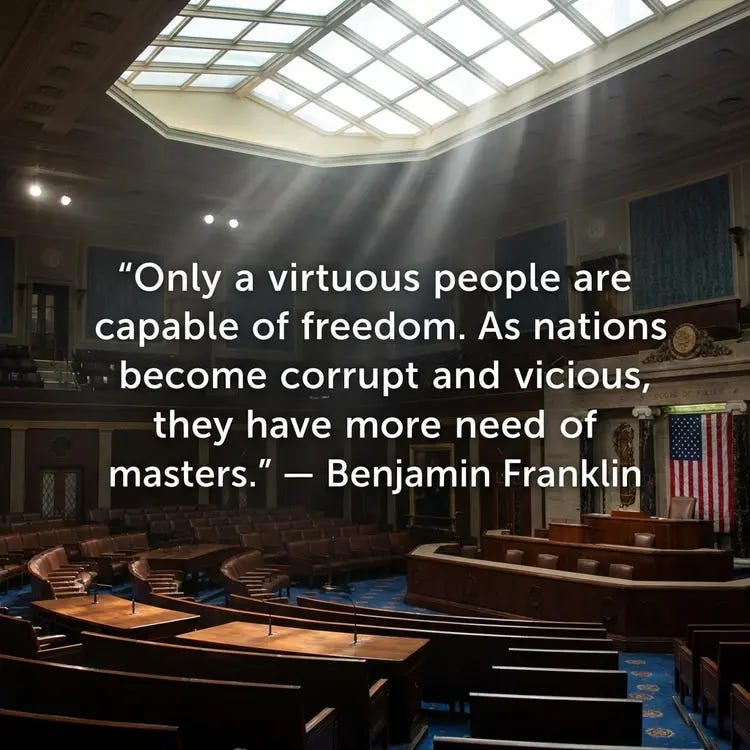
Benjamin Franklin encoded this as an iron law: “Only a virtuous people are capable of freedom. As nations become corrupt and vicious, they have more need of masters.”
George Washington repeated it: “Human rights can only be assured among a virtuous people.”
The Founders didn’t see virtue as aspirational. They saw it as load-bearing.
The Cycle Encoded
Declining character creates disorder.
Disorder generates fear.
Fear demands control.
Control eliminates freedom.
This isn’t theory. It’s pattern recognition across civilizations.
British historian Arnold Toynbee explored 28 civilizations and concluded that most collapsed mainly by internal factors. Virtually all passed through distinct stages: genesis, growth, time of troubles, universal state, and disintegration.
Most never recovered. The Western and Eastern Roman Empires. The Maya civilization. Easter Island.
The pattern repeats because the mechanism is structural.
External threats don’t destroy civilizations. Internal erosion does.
What Fills the Vacuum
When citizens stop regulating themselves, the state steps in.
More laws. More enforcement. More surveillance. More administrative expansion.
Each intervention creates dependency. Each dependency weakens the muscles of self-governance. The cycle accelerates.
People who cannot manage their impulses cannot manage their communities. Communities that cannot manage themselves cannot resist centralized control.
The Constitution wasn’t designed to function in that environment.
It was designed for a people who didn’t need constant supervision.
The Solution Isn’t More Laws
You cannot legislate virtue into existence.
You cannot enforce character through policy.
The restoration of constitutional governance requires the restoration of the internal disciplines that make constitutional governance possible.
That happens in families. In communities. In the institutions that form character before the state ever gets involved.
It happens when people recognize that freedom isn’t a gift from government. It’s a condition that emerges when citizens possess the internal capacity to govern themselves.
Adams, Madison, Franklin, and Washington understood this.
We forgot it.
The evidence is everywhere. Rising crime. Fractured families. Expanding state power. Declining trust. Increasing dependence.
The pattern is structural. The solution is structural.
Renewed character isn’t a luxury. It’s the prerequisite.
What This Means Now
The constitutional order doesn’t collapse because of external enemies.
It collapses because the internal conditions required for its operation disappear.
You can have the finest legal architecture ever designed. If the people operating within it lack self-discipline, the architecture becomes decoration.
The republic was designed with citizen remedies. But those remedies presume citizens capable of using them.
When that capacity erodes, the remedies become inaccessible. The tools remain, but no one remembers how to hold them.
The restoration begins with recognition: the system was never designed to function independently of citizen character.
It was designed to amplify it.
Remove the amplification source, and the system goes silent.