


I. The Foundations (1970s–1990s): Control of the Genetic Narrative
1970s–1980s — Recombinant DNA Revolution
Genetic engineering matured, but early recombinant DNA research was recognized as inherently oncogenic because inserting genes into host cells often activated oncogenes or silenced tumor suppressor genes.
Laboratories obtained biohazard classification upgrades—level 3 facilities for gene work—because of clear mutagenic and carcinogenic potentials.
NIH guidelines (1976 onward) explicitly categorized random integration of genetic material into mammalian cells as a carcinogenic risk, emphasizing containment and gene therapy-style oversight.
1990–1995 — mRNA Therapeutics Concept Born
Karikó and Weissman began developing mRNA as a therapeutic delivery tool. Early in vitro experiments showed massive inflammatory and cytotoxic responses, leading nearly all pharmaceutical funders to abandon the idea.
To avoid immune destruction of mRNA, they chemically modified nucleobases, leading to N¹-methylpseudouridine incorporation—a key pivot that later fuels today’s concerns about epigenetic disruption and prolonged persistence.
Ignored Carcinogenic Implication:
Altering genetic material to mimic natural RNA while evading immune clearance was known to create immortalized expression. In other words, cellular machinery might keep producing the encoded protein indefinitely. No serious discussion on long-term oncogenic potential followed—because it was considered “too niche” for animal model funding.
II. The 2000s: The Gene Therapy Disguise Strategy
2000–2010 — Rebranding Begins
When gene therapy trials caused leukemia in children (due to vector integration), public funding and investor confidence plummeted. In response, biotech firms reconceived mRNA delivery as something “different from gene therapy” using non-viral delivery systems.
Key Shift:
The delivery mechanism changed from viral vectors to Lipid Nanoparticles (LNPs)—synthetic carriers that still transfect cells but were marketed as “chemical delivery” instead of biological integration vectors.
This sleight of hand rerouted regulatory oversight: mRNA vaccines were no longer treated as gene therapy even though the process—cellular production of foreign protein—was identical in end effect.
Preclinical studies on LNP toxicity showed liver inflammation, oxidative damage, and necrosis in animals. None of these data were used to mandate long-term cancer bioassays.
Ignored Carcinogenic Implication:
The genetic cargo remained biologically active RNA capable of modifying cellular behavior. But regulators agreed it was “transient” and therefore exempt from oncology classification. No long-term carcinogenicity studies were conducted; the justification was theoretical rapid degradation—an assumption not later borne out by biodistribution data.
III. 2010–2019: The Corporate Funnel and Military Interest
2010–2013
DARPA launches its ADEPT and P3 programs — funding synthetic biology platforms to create “programmable immunity.” mRNA vaccine technology receives military fast-tracking because it allows rapid genomic reprogramming of host cells to generate antibodies.
Several developers (Moderna, BioNTech) emerge, backed by venture capital.
Early animal studies again show liver toxicity, immune dysregulation, and involvement of lymphoid organs with unclear clearance timelines.
The companies declare “no carcinogenic signal observed,” yet their toxicology protocols terminate at 28 days, nowhere near the standard chronic exposure window (6–24 months).
2017–2019
Patent filings by both Pfizer and Moderna specifically flag “DNA contamination management”, “use of SV40 enhancer sequences”, and “HEK293 derived templates.”
All are recognized as potentially oncogenic, yet these details appear only in patent filings—not in regulatory submissions.
Ignored Carcinogenic Implication:
Internal recognition that plasmid DNA risk existed, but classified as a “controlled impurity” rather than an active carcinogen. This reclassification allowed regulators to ignore traditional thresholds for DNA residue, which were established for biologics in the 1980s—decades before genome editing and synthetic sequence integration were an issue.
IV. 2020: Warp Speed and the Regulatory Suspension of Biology
The pandemic fast-track dispensed with every normal layer of carcinogenic and mutagenicity testing.
Timeline:
April 2020 — FDA allows Emergency Use Investigational New Drug status without carcinogenicity studies. Standard ICH S1 guidance (requiring 2-year rodent oncogenicity data) waived.
June 2020 — Pfizer and Moderna begin human dosing before completing biodistribution or genotoxicity studies.
July 2020 (Japan) — small-scale biodistribution study reveals LNP accumulation in ovaries, liver, and bone marrow. These data were redacted in the public version of the submission to the EMA (European Medicines Agency).
August 2020 — internal documents show acknowledgment of plasmid DNA residues, with a proposed analytical detection limit set by the manufacturers themselves (no third-party verification).
December 2020 — Vaccines authorized for emergency use under the justification that “no mechanism for genome integration is plausible.”
Ignored Carcinogenic Implication:
“Implausible integration” was asserted without any genomic assay data. In fact, the companies never presented PCR-based integration site mapping or in vitro assays that could have measured it.
V. 2021–2022: The Data Black Hole and Early Warning Signs
Once rollout began, the focus shifted from testing safety to protecting perception.
June 2021: Canada’s National Microbiology Laboratory confirms residual DNA fragments in vaccine vials during lot testing. Data never published officially—later leaked via independent FOIA.
Late 2021: Pathologists begin reporting unusual B-cell lymphomas and rapid leukemias post-vaccination.
2022: Independent toxicologists test vials from multiple batches, detecting nanogram-to-microgram quantities of residual DNA—surface-level violations of WHO and EMA guidelines.
Institutional reaction: total silence or ridicule. No retesting mandates issued.
Ignored Carcinogenic Implication:
Regulatory agencies deliberately avoided invoking carcinogenicity risk even after physical evidence of DNA contamination—citing “no epidemiological rise in cancer” while refusing to fund long-term studies that might show one.
VI. 2023–2025: Independent Replication Breaks Open
Independent labs and whistleblowers begin to reconstruct what was done and skipped:
2023: Forensic sequencing confirms SV40 promoter/enhancer regions—directly tied to historical oncogenic events in SV40-contaminated polio vaccines—present in Pfizer plasmid DNA used to make mRNA.
2024: Internal emails between regulators reveal acknowledgment that these sequences could “potentially augment gene expression in vivo” but were classified as non-significant under emergency review conditions.
2024–2025: Insurance and actuarial data show anomalous rises in aggressive cancers among working-age adults (25–64), not explained by demographic or diagnostic shifts.
2025: HHS, under RFK Jr., opens a formal inquiry into DNA contamination and long-term safety evaluation—the first official admission that reassessment is warranted.
Ignored Carcinogenic Implication:
By then, billions of doses had been given. Even if carcinogenic signatures emerge, they will appear gradually over decades.
Thus, the integration of genetic fragments into human genomes—if it occurred—is irreversible.
VII. Pattern of Cover-Up
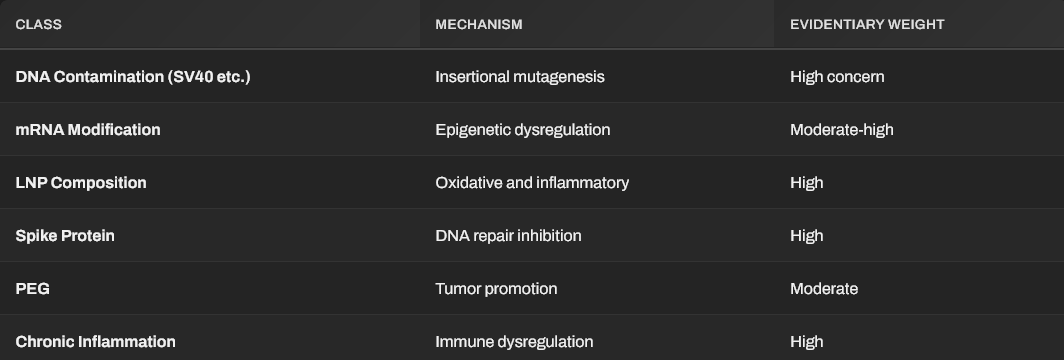
This is not “accidental omission.” It is a policy of willful blindness, disguised as urgency.
VIII. Why This Matters Now
Even if mRNA vaccines prevent infection-related mortality, they have permanently introduced into biomedical precedent a regulatory bypass mechanism where genetic products can avoid cancer testing by rebranding as “temporary.”
This precedent, if not overturned, will affect gene editing, RNA therapeutics, and future immunogenics across all medicine.
The public health agencies have chosen a path where appearance of safety triumphs over biological reality.
IX. The Takeaway
The carcinogenic risk of mRNA COVID vaccines was never ruled out—it was simply never ruled in because the studies weren’t done.
Each omission has a paper trail: waived guidelines, shortened protocols, redacted biodistribution data, self-certified DNA thresholds.
True transparency begins when all manufacturing data, plasmid sequences, and long-term genomic assays are made public.