



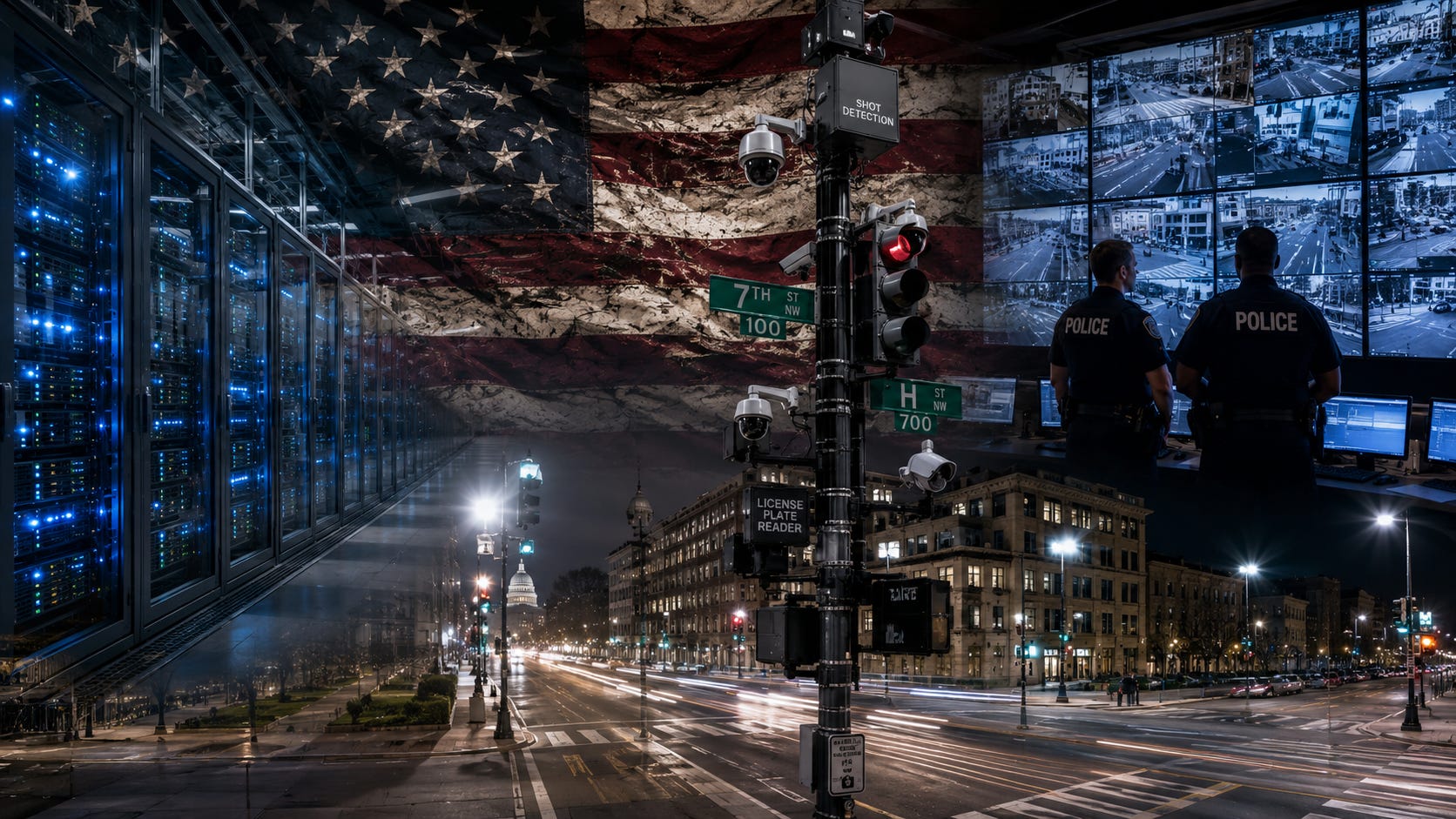
The pitch was simple. Stolen vehicles. Missing children. License plates scanned at intersections, flagged against hot lists, matched to crimes already in progress. That was the story told to city councils, county boards, and homeowners associations across the country when Flock Safety came knocking. What those communities approved and what they actually installed turn out to be two different things.
Flock cameras now search for people. Not plates. People. Specifically, they search for descriptions of people: what they are wearing, what color their skin is, whether they have tattoos, whether they are heavy-set, whether they carry a backpack, whether their t-shirt advertises a political allegiance or a sports team. Police departments across the United States have run these searches at least hundreds of times, often across dozens or even hundreds of camera networks simultaneously, according to records reviewed by Margin of the Law.
This is not a glitch in the system. This is the system working as designed.
What FreeForm Actually Does
Flock calls the feature FreeForm. It launched in February 2025. The company marketed it primarily as a tool for searching vehicles using natural language instead of license plate numbers. An officer could type a phrase like “red pickup with ladder rack” and the system would surface matching footage from across its network. Useful, in theory, when a witness remembers the truck but not the plate.
What the marketing did not emphasize is that the same natural language search also works on people. Officers can type descriptions of human beings into the search bar and Flock’s AI will scan footage from cameras across the country, surfacing anyone who matches. The system treats video the way a search engine treats text. Oceans of footage, queried in seconds, returning results based on clothing, posture, accessories, and physical characteristics.
Jay Stanley, senior policy analyst for the American Civil Liberties Union’s Speech, Privacy, and Technology Project, put it plainly in an email to 404 Media. Most of the public has not caught up to what a modern surveillance camera can do. AI video analytics means massive video archives can be searched like text files, including for sensitive content like t-shirts, tattoos, and bumper stickers. Even without facial recognition, the capability represents a significant expansion of what surveillance means.
Flock advertises FreeForm most prominently for its Condor video cameras, which are distinct from its automatic license plate reader cameras. The Condor line includes features like “people detection alerts” and a “Guardian Mode” that automatically zooms in on people and vehicles. The company’s own website promotes AI-powered video with no blind spots, fully integrated into the Flock platform.
The integration matters. The video cameras are not isolated from the license plate readers. They are designed to work together. Kevin Cox, a Flock consultant who previously worked for the Grand Prairie Police Department in Texas, has described the combination as transformative for prosecution, placing a vehicle at a scene while also capturing video of the people connected to it.
The Searches Themselves
The records reviewed by 404 Media came from HaveIBeenFlocked.com, a website that compiles Flock search data obtained through public records requests. The underlying documents are called Network Audits. They log, with granular detail, every search an officer runs: when it happened, how many cameras were queried, the stated reason, and in the case of FreeForm searches, the text the officer typed into the system.
A field called “text_prompt” captures that typed input. Reviewing it reveals how officers actually use the tool.
Dunwoody Police Department in Georgia searched for someone wearing a “backpack.” Later searches from the same department included “person walking” and “black sweatshirt,” each one running across nine networks of cameras at a time.
Pocatello Police Department in Idaho searched 38 cameras for “a male on foot.” Another search from the same agency simply read “Atlanta falcons,” apparently referencing someone wearing NFL merchandise.
Corona Police Department in California searched for “American flag shirt” and “dodger shirt.”
Milford Police Department in Connecticut ran searches for “male with tattoos,” “male with brown hair,” and “woman blue shirt,” across more than a hundred cameras.
The California Highway Patrol searched 274 cameras for someone wearing a “gray shirt.”
The Texas Department of Public Safety searched 96 networks of cameras for a “man wearing [sic] a black t-shirt and shorts.”
Florence Police Department in South Carolina searched 61 cameras for “person with gun.”
Chamblee Police Department in Georgia searched 85 camera networks for a “white woman wearing grey shirt, blonde hair, black shorts with blue and white shoes.” The same agency ran a separate search for “female with ugg boots.”
Brookhaven Police Department in Georgia searched for “tall man.”
Some searches referenced race directly. The California Highway Patrol searched for a “white male about 6ft 1in tall, longer brown hair almost to his shoulders, slender build, will have been wearing blue jeans, boots with white paint stains on the toes and possibly carrying a black helmet.” The Atlanta Police Department searched for a “non Caucasian [sic] male wearing blue shirt blue pants white hat.”
Some searches indicated a target’s apparent political affiliation. Anne Arundel County Police Department in Maryland searched 198 networks for a “white jeep with Trump flag.”
The stated reasons for the searches vary. Some are logged as part of an investigation. Some are missing persons cases. Some have the reason field redacted entirely, leaving no public record of why the search was run.
The Problem With Vague Queries
A search for “backpack” or “person walking” or “tall man” does not identify a suspect. It identifies a category. Many people wear backpacks. Many people walk. Many men are tall. A search like this does not narrow the field. It widens it, pulling up footage of anyone who fits a loose description, most of whom have done nothing wrong.
Beryl Lipton, senior investigative researcher at the Electronic Frontier Foundation, described the risk to 404 Media. AI-enabled video analysis across large archives of footage raises the chance that law-abiding people going about their day end up observed by police without their knowledge, and potentially implicated in crimes they had nothing to do with. Lipton pointed to the case of Trayvon Martin, murdered by someone who argued that a hoodie justified suspicion.
The legal concept of reasonable suspicion traditionally requires specific, articulable facts. A vague description run through a network of hundreds of cameras does not meet that standard. It generates leads by casting the widest possible net and seeing what gets caught. The people caught up in that net are not suspects in any meaningful legal sense. They are matches. The distinction matters.
Tom Bowman, policy counsel for security and surveillance at the Center for Democracy and Technology, called the shift a bait-and-switch. The town was pitched a tool to catch stolen cars and find missing kids. What it got was the capability to search for a person or description of a person across a wealth of camera networks at once. Bowman compared it to being sold a smoke detector and later discovering it had been recording every conversation in the house.
What Flock Says
Flock provided a statement to 404 Media. The company described FreeForm as a tool to help investigators sort through large amounts of footage when working with limited information, such as a witness description. The company emphasized that FreeForm is not facial recognition. Flock’s products do not use facial recognition, according to the statement, and the company has no facial recognition technology in development. FreeForm cannot identify a person by name, verify identity, or search for a specific face.
The company pointed to specific use cases. A September 2025 AMBER alert. An elderly man who walked away from an assisted living facility in Emporia, Kansas. These are the scenarios Flock prefers to discuss.
The company also described what it calls guardrails. Users are not supposed to be able to search attributes like race, ethnicity, religion, or nationality. When they attempt to do so, according to Flock, an alert is generated and sent to the agency’s administrators.
The records reviewed by 404 Media include searches that referenced race. Whether alerts were generated in those cases, and what agencies did with those alerts if they were, is not clear from the public records.
The distinction between facial recognition and what FreeForm actually does is worth examining. Facial recognition identifies individuals by matching biometric features of a face to a database. FreeForm does something different. It identifies individuals by matching clothing, body type, accessories, and other visible characteristics to a text description. The end result, from the perspective of the person being searched, is similar. A police officer types a description. The system returns footage of people matching that description. That the matching is based on a t-shirt rather than a face does not change the fundamental nature of what is happening.
The Broader Trajectory
FreeForm did not appear in isolation. It is part of a pattern of expansion in what Flock cameras are capable of doing and how police use them.
In May 2025, 404 Media reported that Flock planned to build a massive people lookup tool using data from commercial data brokers and from data breaches. The internal language, captured in meeting audio obtained by 404 Media, described the goal as jumping from the license plate reader to the person. The idea was to connect a vehicle sighting to the identity of a driver using purchased or stolen personal information. Following the reporting and internal pressure, Flock scrapped the plan to use hacked data.
In December 2025, 404 Media reported that Flock had left at least 60 of its people-tracking Condor cameras exposed to the open internet. Anyone with the right address could watch the live feeds. These were not the license plate readers. These were the cameras specifically designed to track people.
Earlier reporting from 404 Media revealed that local police departments were running Flock searches on behalf of Immigration and Customs Enforcement. That reporting triggered the wave of public records requests that produced the Network Audits now being analyzed. The pattern is consistent. Capabilities expand. Uses multiply. Oversight lags behind.
Stanley from the ACLU offered a thought experiment. Imagine a police department stationed officers on every corner, writing down where every resident was at what time, what they were wearing, what they were carrying. Notes on everybody, around the clock. Most people would find that intrusive and would ask why the department was doing it. That, in substance, is what these systems do automatically.
Flock is not just expanding license plate reader surveillance, Stanley continued. The company is moving into every new form of surveillance that technology makes possible, linking the data streams together to build an increasingly complete picture of how everybody lives. Most Americans, he suggested, do not want to live under that kind of constant automated surveillance.
The Question of Consent
The communities where Flock cameras operate approved installations based on specific representations about what the cameras would do. License plate reading. Stolen vehicles. AMBER alerts. Those representations shaped the political calculus that got the cameras installed. Residents who might have objected to a broader surveillance system did not object because the system presented to them was narrower.
The system that now exists is broader. Whether the original approvals cover the current capabilities is a question that has largely not been asked, let alone answered. City councils that voted to install license plate readers did not vote to install networks of searchable video cameras capable of tracking people by clothing and physical description. The transition happened without a second vote.
This is the practical consequence of buying surveillance infrastructure from a private company that controls the software. The hardware sits on local poles, owned by local governments, but the capabilities are determined by software updates pushed from a vendor. What the cameras could do yesterday is not what they can do today. What they can do today is not what they will do tomorrow. The community that approved the installation has no vote on the feature roadmap.
Where the Records Come From
The existence of the FreeForm searches is public knowledge only because of a specific accident of policy. Flock’s Network Audit feature logs searches in a format that can be requested under state public records laws. Journalists, activists, and ordinary residents have used those laws to extract spreadsheets from police departments across the country. HaveIBeenFlocked.com aggregates the results.
Without that logging and without those requests, the FreeForm searches would be invisible to the public. There is no requirement that police departments proactively disclose what they search for. There is no notification to the people who appear in the results. There is no judicial oversight of the vast majority of these searches. An officer with access to the system can type a description and query hundreds of cameras in seconds, generating matches that implicate people who will never know they were implicated.
The guardrails that exist are internal to Flock and its customer agencies. They rely on the agencies to police themselves. Alerts about prohibited searches go to agency administrators, not to independent oversight bodies, not to the public, not to the people whose descriptions were used.
What the Data Shows and What It Does Not
The records reviewed by 404 Media show hundreds of searches. The actual number is almost certainly higher, because the public records available represent only the agencies whose audits have been requested and received. Many agencies have not been audited. Some requests have been denied or delayed. The visible searches are a sample, not a complete inventory.
The records do not show the results of the searches. They do not show who was flagged, who was followed up on, who was questioned, who was arrested. They do not show whether any of the searches led to solved crimes or to wrongful detentions. The audits log the input, not the output.
What the records do show is that the capability is being used, frequently, across many jurisdictions, with text prompts that range from narrowly specific to extremely vague. The tool exists. It is operational. It is being pointed at ordinary people in ordinary clothes doing ordinary things.
The Terms of the Trade
Surveillance technology has always traded broader observation for the promise of narrower results. More cameras catch more crimes, the argument goes. Better search tools catch more criminals. The cost is accepting that cameras and search tools will also observe many people who are not criminals.
The old version of that trade involved cameras that mostly stared blankly at intersections, their footage reviewed only when something specific happened. The new version involves cameras that actively analyze what they see, feed the analysis into a searchable database, and let officers across the country query that database for matches. The passive has become active. The archive has become a search engine.
Whether that trade is worth it is not a technical question. It is a political one. It belongs to the communities that host the cameras, the legislatures that regulate them, and the courts that interpret the constitutional limits on what police can do with them. So far, those bodies have largely not weighed in, because the capabilities have expanded faster than the oversight has.
The cameras keep watching. The searches keep running. The records keep piling up, in audit logs and in Flock’s databases and in the public records requests filed by people who want to know what is actually happening on the poles outside their homes.
The pitch was stolen cars and missing kids. The product is something else. The difference between the two is the space where the actual policy question lives, and it is a space that has not yet been seriously addressed.
Margin of the Law publishes constitutional analysis, civic research, and legal education for people who want to understand the system they actually live in. Read the Full Constitutional Analysis Library at marginofthelaw.com.
© 2026 – MK3 Law Group
For republication or citation, please credit this article with link attribution to marginofthelaw.com.