


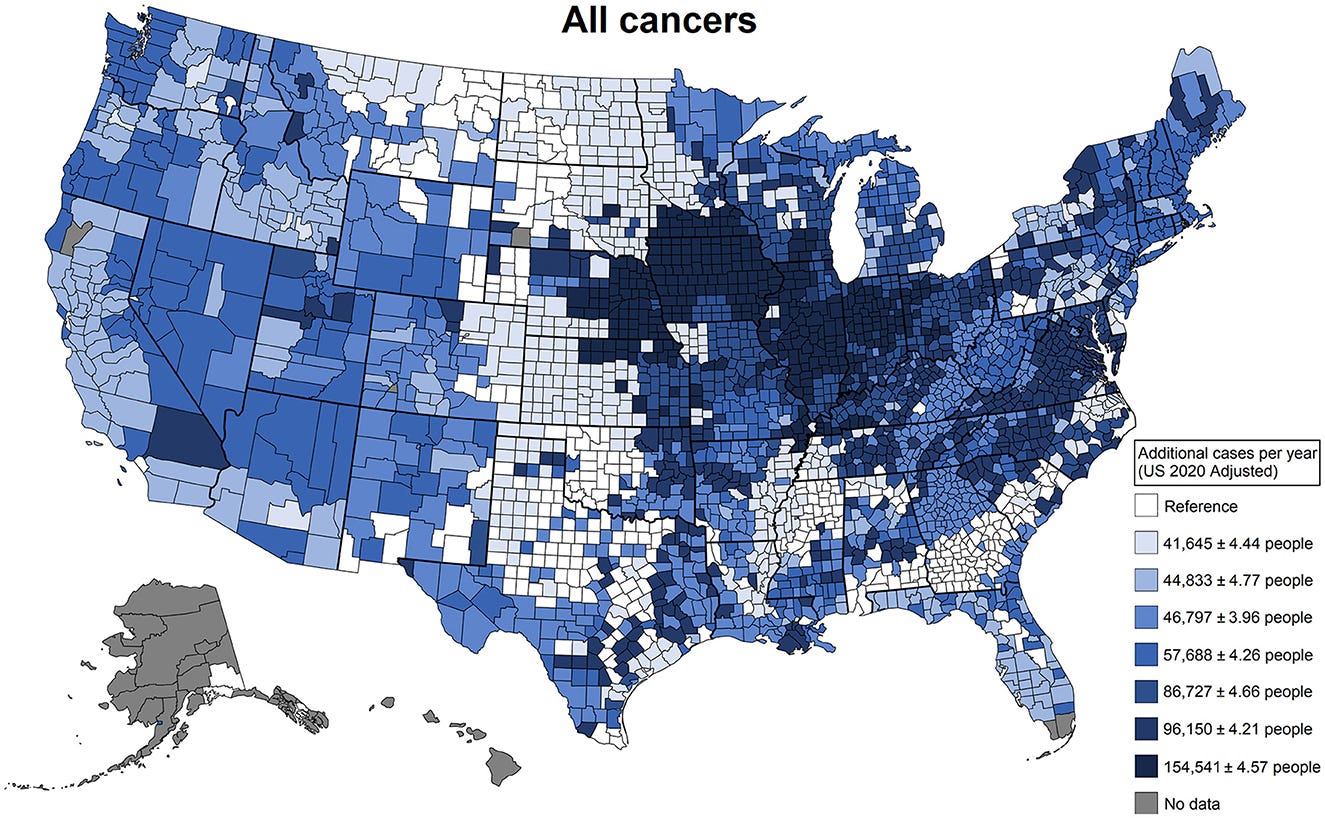
The statistics are stark and undeniable. Nearly 40% of Americans will develop cancer during their lifetime. Over 2 million new cases will be diagnosed in 2025. More than 600,000 Americans will die from cancer this year alone. These aren’t abstract numbers, they represent a systemic breakdown that demands examination.
The data comes from the National Cancer Institute’s Surveillance, Epidemiology, and End Results (SEER) database, which tracks cancer incidence and mortality across the United States. What emerges from this data is a pattern that raises uncomfortable questions about the forces shaping American health, questions that remain largely unasked in public discourse.
The Scope of the Problem
Cancer has become America’s second-leading cause of death, claiming one in six lives. The lifetime risk numbers paint a sobering picture: 39.9% of men and 39.0% of women will face a cancer diagnosis. These percentages translate to real odds—roughly 1 in 3 Americans will battle this disease.
The most common cancers tell their own story. Prostate cancer affects 1 in 8 men. Breast cancer strikes 1 in 8 women. Lung cancer—strongly linked to smoking and environmental toxins—affects 1 in 17 men and 1 in 18 women. Colorectal cancer, increasingly connected to dietary and lifestyle factors, hits 1 in 24 men and 1 in 26 women.
These numbers reflect current conditions, not historical data. The risk calculations are based on incidence data from 2018, 2019, and 2021, with 2020 excluded due to COVID-19 disruptions. Mortality data spans 2019-2023, representing the most recent comprehensive picture available.
Geographic and Demographic Patterns
The cancer burden isn’t distributed equally. Non-Hispanic Black men face the highest mortality rates at 203.6 per 100,000, while non-Hispanic Asian/Pacific Islander women have the lowest at 83.1 per 100,000. These disparities reflect complex interactions between genetic factors, environmental exposures, healthcare access, and socioeconomic conditions.
Cancer rates are generally highest in countries with the longest life expectancy and highest standard of living—a pattern that suggests lifestyle and environmental factors play significant roles. The United States, with its high cancer rates, fits this global trend, raising questions about what aspects of modern American life contribute to cancer development.
The Economic Burden
The financial impact is staggering. Cancer care expenditures in the United States reached $208.9 billion in 2020. These costs are projected to rise as the population ages and new treatments are developed. The American Cancer Society estimates that costs will continue climbing as more expensive therapies become standard care.
This economic burden extends beyond direct medical costs. Cancer affects productivity, family finances, and healthcare system capacity. The 18.1 million cancer survivors living in America as of 2022—a number projected to reach 26 million by 2040—represent both a success story of improved treatment and an ongoing demand on healthcare resources.
Trends and Trajectories
Some progress has been made. Overall cancer death rates have declined since the early 1990s, with recent data showing decreases of 1.7% per year among men and 1.3% per year among women from 2018 to 2022. These improvements reflect advances in early detection, treatment protocols, and surgical techniques.
However, these overall improvements mask concerning trends for specific cancers. While death rates for many individual cancers have declined, others have remained static or even increased. The decline in smoking rates has contributed to reduced lung cancer deaths, but rising obesity rates may be driving increases in other cancer types.
Environmental and Lifestyle Factors
The data reveals patterns that point to environmental and lifestyle influences on cancer development. The geographic clustering of certain cancers, the differences between demographic groups, and the correlation between cancer rates and economic development suggest that factors beyond genetics are at work.
American dietary patterns, exposure to industrial chemicals, electromagnetic radiation, processed foods, and sedentary lifestyles all potentially contribute to cancer risk. The food industry’s use of preservatives, artificial additives, and processing methods has expanded dramatically over the decades when cancer rates were rising.
Manufacturing and industrial activities have introduced thousands of chemicals into the environment, many with limited testing for long-term health effects. Agricultural practices involving pesticides and herbicides create exposure pathways that didn’t exist for previous generations.
The Information Landscape
The response to these trends reveals institutional priorities. Government agencies collect and report statistics but rarely pursue aggressive investigation into environmental causes. The medical establishment focuses on treatment rather than prevention of underlying causes. Industry groups fund research that tends to minimize connections between their products and cancer risk.
This dynamic creates an information environment where certain questions are not pursued with the same rigor as others. Studies that might implicate profitable industries or established practices face funding challenges and publication barriers. Meanwhile, treatment-focused research receives substantial support because it aligns with profitable business models.
Regulatory Patterns
The regulatory framework governing cancer-causing substances reflects these priorities. Chemicals are typically approved for use based on limited testing, with longer-term health effects discovered only after years or decades of exposure. The burden of proof falls on demonstrating harm rather than ensuring safety.
Food additives, industrial chemicals, pharmaceutical products, and consumer goods enter the market through approval processes that prioritize economic factors over precautionary health principles. When health concerns emerge, regulatory responses tend to be slow and incremental, often requiring overwhelming evidence before action is taken.
The Missing Conversations
Public discourse about cancer typically focuses on fundraising for research, awareness campaigns, and support for patients and families. These efforts, while valuable, don’t address the systemic factors that may be driving cancer rates.
Discussions about environmental causes, industrial influences, or regulatory failures rarely achieve mainstream attention. When they do surface, they’re often dismissed as conspiracy theories or anti-progress sentiment. This pattern ensures that fundamental questions about cancer causation remain on the margins of public conversation.
The media landscape reinforces this dynamic. Cancer stories typically focus on individual battles, medical breakthroughs, and fundraising events. Investigative reporting into potential environmental or industrial causes occurs infrequently and faces resistance from powerful interests.
Data Limitations and Gaps
Even the comprehensive SEER database has limitations that affect our understanding of cancer trends. The program covers approximately 48% of the U.S. population, potentially missing regional patterns or exposures. Data collection focuses on incidence and mortality rather than detailed exposure histories or environmental factors.
Cancer registries track disease occurrence but don’t systematically investigate potential causes. This creates a situation where extensive data exists about cancer patterns but limited information is available about the factors driving those patterns.
International Comparisons
Global cancer statistics provide context for American trends. Cancer rates vary significantly between countries, even those with similar economic development levels. These variations suggest that specific national policies, environmental conditions, or lifestyle patterns influence cancer risk.
Countries with stricter chemical regulations, different agricultural practices, or alternative food systems sometimes show different cancer profiles. These comparisons could inform policy discussions, but they rarely receive attention in American policy debates.
The Path Forward
Addressing America’s cancer crisis requires confronting uncomfortable realities about institutional priorities and economic interests. The current approach—focusing on treatment while largely ignoring potential environmental and lifestyle causes—serves certain interests while failing to address root causes.
Real progress would require systematic investigation of environmental factors, aggressive regulation of potentially harmful substances, and public discourse that prioritizes health over economic interests. This approach would challenge established industries and regulatory patterns, explaining why it faces resistance.
The Question of Accountability
The statistics document a public health crisis affecting nearly half the population. The economic costs are enormous. The human suffering is immeasurable. Yet public discourse rarely focuses on accountability for these outcomes.
This absence of accountability reflects power dynamics that keep certain questions off the table. Industries that profit from the current system have resources to influence research priorities, regulatory decisions, and media coverage. Public health advocates and affected communities typically lack equivalent resources.
Conclusion
The cancer statistics tell a clear story: America faces a crisis that affects millions of lives and costs hundreds of billions of dollars annually. The data reveals patterns that suggest environmental and lifestyle factors play significant roles in cancer development.
Yet public discourse avoids the systemic questions these patterns raise. Instead of investigating potential causes, attention focuses on treatment and individual responsibility. This dynamic serves established interests while leaving fundamental problems unaddressed.
The numbers demand better questions. Why do cancer rates vary so dramatically between countries and demographic groups? What environmental factors contribute to cancer development? How do industrial practices and regulatory policies affect cancer risk? Which institutions benefit from maintaining current approaches rather than pursuing prevention?
These questions don’t require conspiracy theories or radical politics—they require the same rigor applied to cancer treatment being directed toward cancer prevention. The statistics provide the foundation for this investigation. What remains is the will to ask uncomfortable questions and challenge established interests.
Until that happens, the numbers will continue documenting a crisis that could be prevented rather than just treated. The data is clear. The patterns are evident. The questions remain unasked.
Resources:
https://www.cancer.gov/about-cancer/understanding/statistics
https://www.cancer.org/cancer/risk-prevention/understanding-cancer-risk/lifetime-probability-of-developing-or-dying-from-cancer.html