


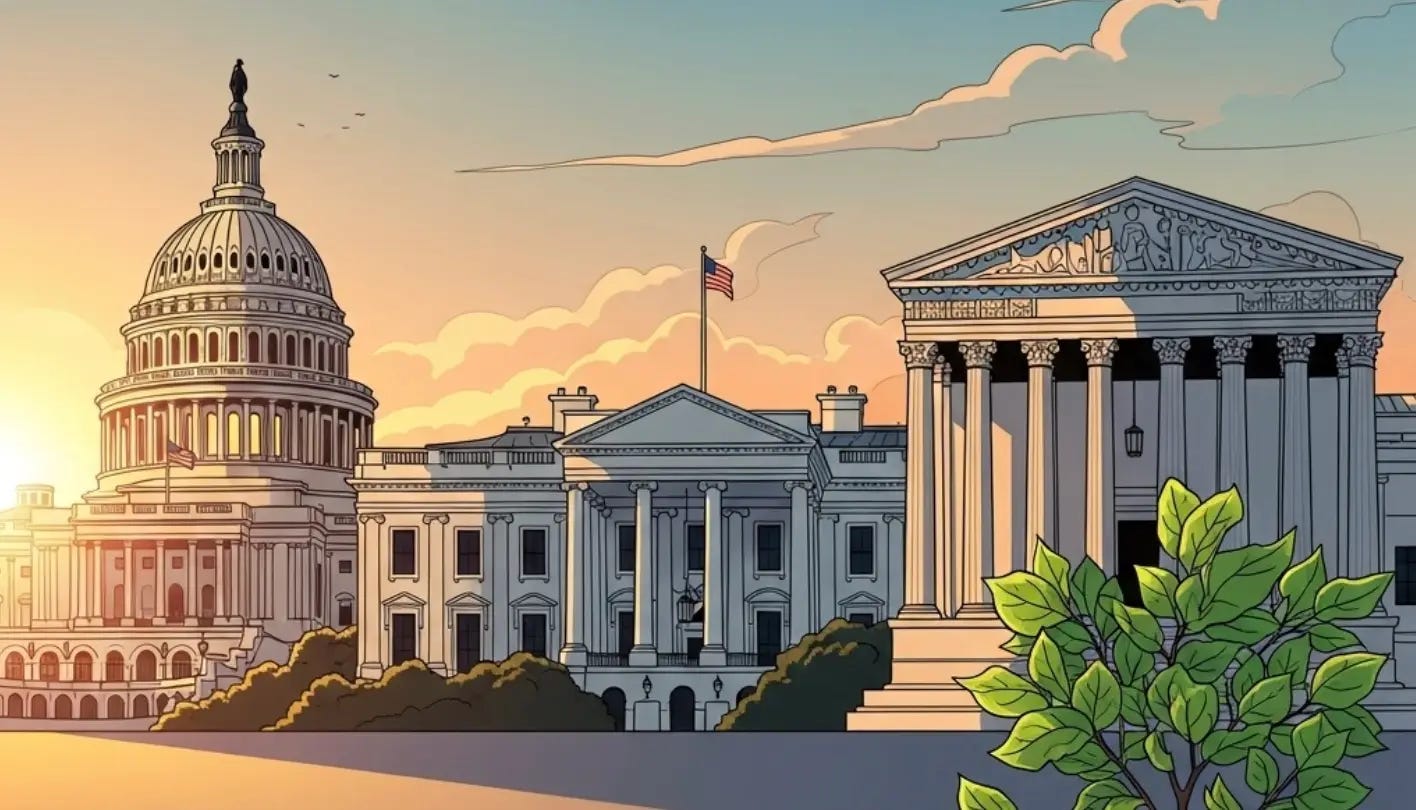
The modern American administrative state represents one of the most significant structural developments in governance since the Constitution was ratified. Article I vests all legislative power in Congress. In practice, that power is distributed across a network of federal agencies that write rules, enforce statutes, and adjudicate disputes. This examination explores the constitutional foundations, historical development, operational mechanics, and implications of that system. The purpose is not academic completeness but clarity about how power is actually exercised and why it operates largely invisible to most citizens.
The Disconnect Between Theory And Practice
The civics class model of American government presents a clean structure. Congress writes laws. The Executive enforces them. Courts interpret them. This model is not incorrect. It is incomplete in ways that fundamentally affect how governance actually operates.
The agencies governing daily American life do not fit cleanly into this framework. The Environmental Protection Agency, the Federal Communications Commission, the Food and Drug Administration, the Securities and Exchange Commission, and dozens of other federal bodies do far more than enforce congressional statutes. They write rules that carry the force of law. They investigate violations of those rules. They prosecute cases. They adjudicate disputes through internal tribunals. They impose financial penalties and compliance requirements. All of this occurs within single institutional structures, most of it without substantial public visibility.
Consider the practical scope. In any given year, federal agencies produce regulatory text that substantially exceeds the volume of legislation Congress enacts. An environmental regulation from the EPA affects how manufacturers operate factories, how farmers manage land, and how municipalities treat water. A telecommunications rule from the FCC shapes internet infrastructure and service provision. An FDA approval decision determines whether a new medication reaches patients and under what conditions. These regulatory determinations carry real consequences for millions of people, yet they emerge from administrative processes that most citizens do not understand and have limited capacity to influence.
This is not a minor technical issue. It is the defining structural characteristic of how the country actually runs. Citizens cannot vote out agency administrators. They have limited practical access to the rulemaking process. They often learn about regulations after they take effect. Understanding the administrative state is therefore not optional for anyone seeking genuine comprehension of American governance.
Constitutional Design And The Delegation Problem
The Constitution is explicit about legislative authority. Article I states: “All legislative Powers herein granted shall be vested in a Congress of the United States.” This language codifies the nondelegation principle. Congress holds legislative authority and cannot simply transfer it to another body. The Constitution provides for three branches, not four.
Yet Congress does precisely that, routinely and across most sectors of governance. Modern statutes routinely grant agencies broad mandates to act in ways Congress deems “reasonable,” “appropriate,” or “in the public interest.” The agencies then determine what those terms mean in practice, issuing regulations that govern entire industries and sectors. The gap between what the Constitution says and what actually happens is not a minor discrepancy. It is the foundational tension of modern American governance.
The standard defense of this arrangement invokes practical necessity. Modern governance is technically complex. Environmental regulation, financial oversight, telecommunications policy, and healthcare management all demand specialized expertise that no legislature can realistically maintain across all domains. Congress sets policy direction. Agencies apply expertise to fill operational details. The arrangement represents a compromise between constitutional design and governing reality.
This argument reflects genuine structural necessity. A legislature cannot maintain specialized expertise in hundreds of regulatory domains. It cannot respond quickly enough to changing conditions. It cannot manage the technical details of governing a complex, industrial economy. Yet the compromise comes with substantial costs. Significant governing authority is exercised by institutions that citizens did not elect and cannot easily hold to account.
The Supreme Court established the operative standard in J.W. Hampton, Jr. and Co. v. United States. Delegation is permissible when Congress provides an “intelligible principle” to guide agency action. In practice, this standard has proven remarkably permissive. Courts have rarely struck down statutes as unconstitutional delegations, even when grants of discretionary authority are exceptionally broad. The intelligible principle standard functions less as a meaningful constraint on delegation and more as a mechanism for accommodating it.
Historical Evolution Of Administrative Authority
The administrative state took recognizable form in the late 19th century. The Interstate Commerce Commission, created in 1887, represented the first significant federal regulatory agency. The driving context was the emergence of industrial-scale economic activity that overwhelmed existing regulatory capacity. National railroads, massive corporate trusts, and integrated markets created coordination problems that individual states could not address and that Congress lacked the technical expertise to manage directly.
These early agencies were conceived as expert bodies positioned between political pressure and technical necessity. The Interstate Commerce Commission would regulate railroads based on rational analysis rather than political whim. That framing, the idea of agencies as repositories of specialized expertise insulated from ordinary politics, has persisted through every subsequent expansion of the administrative state.
The decisive structural shift occurred during the New Deal. Facing economic collapse, the Roosevelt administration moved to assert federal authority across broad swaths of economic life. Congress responded by creating numerous agencies with expansive regulatory mandates. The National Industrial Recovery Administration, the Securities and Exchange Commission, the National Labor Relations Board, and other bodies were established with broad authority to shape economic activity.
The Supreme Court initially resisted this expansion. It struck down key New Deal legislation on constitutional grounds. By 1937, however, the Court fundamentally shifted course. The resistance dissolved. The administrative state moved from an institutional experiment to an established feature of American governance.
Congress codified this arrangement through the Administrative Procedure Act of 1946. The APA standardized procedures governing rulemaking, adjudication, and judicial review across the federal administrative apparatus. It created a framework that acknowledged the administrative state as a permanent feature of governance while establishing mechanisms for procedural regularity and oversight. The APA remains the central statutory framework defining how administrative power operates.
How Delegation Functions In Modern Governance
Modern statutes delegate authority through deliberately general language. Agencies receive directives to protect public health, issue rules in the public interest, or take actions they find appropriate under the circumstances. This generality is not accidental. It reflects a deliberate legislative strategy. Congress establishes broad policy objectives while transferring implementation authority to specialized agencies. Those agencies then determine what policy objectives require in practice through regulations carrying legal force equivalent to statutes.
The case for delegation rests on three foundations. First, technical expertise. Agencies accumulate specialized knowledge in their regulatory domains that Congress cannot match across every sector. An FDA scientist understands pharmacology in ways general legislators cannot. An SEC official understands securities markets and trading mechanics. Second, operational flexibility. Agencies can adjust regulatory requirements as conditions change without requiring new legislation. When scientific evidence evolves, when markets shift, or when technological innovation creates new problems, agencies can adapt faster than Congress can legislate. Third, practical efficiency. Modern governance in an industrial economy cannot be managed through traditional legislative processes alone. Congress produces dozens of laws per year. Federal agencies produce thousands of regulations.
These arguments reflect genuine structural realities. They also are frequently deployed to shield agency authority from meaningful scrutiny.
The critique of delegation is equally substantive. Broad delegation undermines democratic accountability. When Congress transfers lawmaking authority to agencies, the connection between public preferences expressed through elections and the legal requirements governing behavior becomes attenuated. Citizens can vote members of Congress out of office. They cannot vote out agency administrators. The accountability mechanism is indirect, delayed, and often ineffective.
Delegation also creates conditions for regulatory overreach. Agencies with broad mandates and ambiguous statutory guidance possess significant latitude to expand authority beyond what Congress originally contemplated. Enforcement becomes inconsistent. The boundary between statutory interpretation and policy creation blurs. An agency can reinterpret an ambiguous statute in a way that substantially changes its reach without Congress taking any action.
These concerns are not merely academic. They address the fundamental question of who governs and through what mechanisms.
Rulemaking: The Primary Mechanism Of Agency Lawmaking
The primary mechanism through which agencies create binding regulations is notice-and-comment rulemaking under the Administrative Procedure Act. The process follows a defined sequence. An agency publishes a proposed rule in the Federal Register with an explanation of its basis and purpose. A public comment period follows, typically sixty to ninety days. The agency reviews all submitted comments, considers objections and suggestions, and issues a final rule. That final rule carries the force of law. It governs behavior in the same way a statute does, with enforcement consequences for non-compliance.
The practical significance of this authority is difficult to overstate. The volume of regulatory text produced by federal agencies substantially exceeds the volume of legislation enacted by Congress in any given year. In 2022, for example, federal agencies issued approximately 2,700 rules. Congress enacted 284 laws. Rules govern air and water quality standards, workplace safety requirements, financial disclosure obligations, telecommunications infrastructure, and healthcare provider compliance. For most businesses and many individuals, agency rules constitute the operational law. Congressional statutes set the framework and policy direction. Agency regulations determine what compliance actually requires.
Notice-and-comment rulemaking is technically open to public participation. In practice, the process is not accessible in ways that produce meaningful democratic engagement. The comment process is dominated by industry stakeholders, trade associations, and organized interest groups with the legal and technical resources to engage effectively. A large pharmaceutical company can afford to hire lawyers and scientists to submit detailed technical comments on FDA regulations. An individual patient cannot match that level of engagement. The gap between formal openness and practical accessibility is a structural feature of the system, not an anomaly or aberration.
Enforcement And Adjudication: Consolidated Power
Federal agencies hold substantial investigative powers. Subpoena authority allows agencies to compel production of documents and testimony. Inspection authority permits physical examination of facilities and records. Data collection requirements generate ongoing streams of compliance information. These powers operate largely outside the judicial process. Agencies gather evidence, assess compliance, and make initial determinations of violation through internal processes without involvement of courts or outside parties.
Agencies can impose significant penalties without initiating proceedings in federal court. Fines, license revocations, cease-and-desist orders, and mandatory compliance measures are all available through administrative action. The procedural protections available in traditional court proceedings, including right to trial, rules of evidence, and the requirement that the government prove its case beyond reasonable doubt, are not uniformly present in administrative enforcement.
The defining structural characteristic of administrative governance is the consolidation of functions within single institutions. The agency investigates potential violations. The same agency prosecutes the case against the alleged violator. The same agency adjudicates the dispute through an internal tribunal overseen by an administrative law judge. In most cases, that judge is an employee of the same agency.
This consolidation is efficient. Agency staff can move cases through investigation, prosecution, and adjudication without the delays inherent in the court system. The process is faster and less expensive than traditional litigation. It is also in direct tension with the separation of powers principles that structure American governance. When investigator, prosecutor, and judge operate within a single institutional structure, the structural conditions for institutional bias are present. The agency has incentive to sustain its own enforcement decisions. The judge answering to that agency faces institutional pressure to validate agency action.
Judicial Oversight And Deference Doctrine
The Supreme Court established the governing framework for judicial review of agency interpretations in Chevron U.S.A., Inc. v. Natural Resources Defense Council, Inc. Under the Chevron doctrine, courts defer to agency interpretations of ambiguous statutory language as long as the interpretation is reasonable. The practical effect is significant. When Congress uses general or ambiguous language, the agency administering that statute gains authority to determine what it means. Courts review that interpretation for reasonableness rather than correctness. The agency’s reading of its statutory mandate is presumptively valid.
Chevron deference extended the delegation principle beyond the legislative domain into the interpretive one. Agencies gained authority not only to implement congressional mandates but to define their scope. An agency could reasonably interpret an ambiguous statute in a way that expanded its own authority. Courts would defer to that interpretation unless it was unreasonable.
The Supreme Court’s posture toward administrative deference has shifted materially in recent years. Kisor v. Wilkie narrowed the scope of deference to agency interpretations of their own regulations. The Court’s subsequent decisions have applied heightened scrutiny to assertions of broad agency authority, particularly in areas with significant economic or political consequence. The Court struck down an agency action in West Virginia v. Environmental Protection Agency, stating that agencies cannot claim major authority without clear congressional delegation.
The direction of travel is clear. The Court is less willing to accept expansive agency authority claims than it was during the decades following Chevron. Whether that shift produces durable doctrinal change remains to be determined. The administrative state has proven institutionally durable through decades of evolution. Resistance from the courts has not dissolved it.
Democratic Accountability And Its Limits
Federal agency heads are appointed, not elected. Career agency staff are civil servants insulated from direct political accountability by design. Removal protections exist for many lower-level employees. The oversight mechanisms that constrain agency action, including congressional review, judicial challenge, and executive supervision, are real but indirect and reactive rather than continuous and prospective.
The result is a governing system in which substantial authority is exercised by institutions that are formally accountable but practically difficult to hold to account through ordinary democratic means. Congressional oversight of agency activity is episodic rather than continuous. Committees hold hearings. Confirmation processes create accountability moments. The Congressional Review Act provides a mechanism for disapproving agency rules through a legislative veto, though this tool is rarely used effectively. These oversight mechanisms constrain agency behavior at the margins. They do not provide continuous democratic oversight of the rulemaking, enforcement, and adjudication functions that constitute the bulk of administrative activity.
Executive control, exercised by the President through agency heads and the Office of Management and Budget, provides another accountability mechanism. The President can set policy direction through executive orders and can remove agency heads who resist presidential priorities. Yet this authority also exists in tension with the independence many agencies require to function effectively. An FDA that responded purely to presidential preferences could approve dangerous drugs to benefit political allies. An EPA that reflected purely executive priorities could eliminate environmental protection when it conflicts with administration interests.
The administrative state therefore exists in a genuine tension. It requires some insulation from political pressure to function effectively. Complete insulation from accountability contradicts democratic principle. The balance between these requirements remains perpetually unsettled.
Contemporary Challenges And Future Directions
The Supreme Court has signaled skepticism toward expansive agency authority claims. Recent decisions have constrained agency power in several domains. The trajectory of these decisions suggests continued pressure on broad delegation doctrine, wide deference standards, and the consolidation of functions within agencies. The long-term doctrinal consequences are not yet fully apparent.
Proposals for legislative reform have circulated for years. Narrowing delegation authority, requiring congressional approval of major agency rules, strengthening transparency requirements, and expanding judicial review are all regularly discussed in policy circles. None has produced comprehensive legislative action. The administrative state has proven institutionally durable against reform efforts.
The integration of data analytics and algorithmic decision-making into agency operations is generating new accountability problems. When enforcement priorities, compliance assessments, and regulatory decisions are shaped by automated systems, the transparency and oversight challenges that already exist in administrative governance become more acute. If an algorithm determines which companies receive inspections or which loan applications receive scrutiny, how are citizens to know the criteria being applied? How are agencies to explain and defend algorithmic decisions? These questions are not yet settled.
The Reality Of American Governance
The administrative state is not a deviation from American governance. It is the operational core of it. The formal constitutional structure remains in place. Congress still passes legislation. The President still nominates judges. The formal mechanisms of constitutional government persist. Beneath that formal structure, however, a governing apparatus that exercises legislative, executive, and judicial functions operates with substantial insulation from direct democratic accountability.
That is not an argument for dismantling the administrative state. Modern governance in an industrial society of 330 million people cannot be managed through the mechanisms the founders designed for a pre-industrial republic of three million. The structural compromise that produced the administrative state reflects genuine necessity. Technical complexity, geographic scale, and economic interdependence all require administrative capacity the founders did not contemplate.
It is, however, an argument for clear-eyed understanding. The gap between the constitutional model taught in civics classes and the operational reality of governance is significant. The consolidation of investigative, prosecutorial, and judicial functions within administrative agencies raises legitimate questions about separation of powers. The insulation of agency authority from direct democratic accountability is a structural feature, not an accident or aberration.
Citizens who want to understand where power in America actually resides need to understand the administrative state. The formal mechanisms of electoral accountability and legislative authority do not tell the complete story. The agencies that exercise vast regulatory authority over economic activity, environmental protection, financial markets, and public health do not appear on civics class diagrams. Yet those agencies determine more about daily life for most Americans than Congress does.
That recognition is the starting point for genuine understanding of American governance as it actually exists.
Margin of the Law publishes constitutional analysis, civic research, and legal education for people who want to understand the system they actually live in. Read the Full Constitutional Analysis Library at marginofthelaw.com.
© 2026 – MK3 Law Group
For republication or citation, please credit this article with link attribution to marginofthelaw.com.