


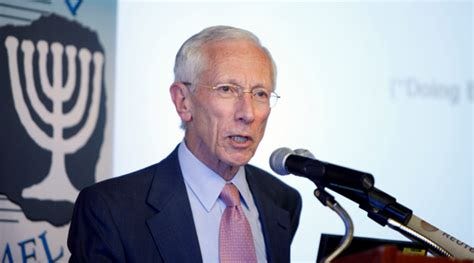
Stanley Fischer is particularly notable; Israeli citizen, former Governor of the Bank of Israel, mentor to Ben Bernanke and Mario Draghi, and arguably the most influential central banking technocrat of his generation. His protégés run central banks across the Western world.-MK3
Stanley Fischer died on May 31, 2025, in Lexington, Massachusetts. He was 81. The cause was Alzheimer's disease. The obituaries called him a towering figure, a giant of macroeconomics, a public servant of extraordinary distinction. MIT issued a statement. The Fed issued a statement. The IMF issued a statement.
What none of those statements explained is what Fischer actually built, how he built it, and what it cost the people who never got to vote on any of it.
This is that story.
The Beginning: Rhodesia to Cambridge
Stanley Fischer was born on October 15, 1943, in Mazabuka, Northern Rhodesia, now Zambia. His Hebrew name was Shlomo Ben Pesach Hacohen. His parents were Jewish emigrants from Latvia and Lithuania who ran a general store. They lived in the house directly behind it. No running water. Hurricane lamps for light.
His father, Philip Fischer, born "Petja" in Latvia, had arrived in Northern Rhodesia in 1926 at age 19, following two older half-brothers already settled there. His mother, Ann Kopelowitz, was from Cape Town, her own parents having emigrated from Lithuania in the 1890s. This is the background that produced one of the most powerful financial technocrats of the twentieth century. Not inherited wealth. Not connected families. A general store in southern Africa.
When Fischer was 13, the family relocated to Bulawayo, Southern Rhodesia, now Zimbabwe. There he joined Habonim, a Labor Zionist youth movement. He met his future wife, Rhoda Keet, through that same organization. In 1960, he traveled to Israel on a youth leadership program and spent time studying Hebrew at Kibbutz Ma'agan Michael. People who were there recalled that even as a teenager, Fischer stood apart. He was not just intelligent. He was precise in a way most people never become.
He encountered Keynes' General Theory and won a scholarship to the London School of Economics. On the way to London, he stopped in Israel for six months to study Hebrew on a kibbutz. He earned his BSc in 1965 and his MSc shortly after. He married Rhoda in December 1965. Then he headed to MIT for his doctorate, which he completed in 1969 under Franklin M. Fisher. His dissertation examined general equilibrium theory under uncertainty. The title was Essays on Assets and Contingent Commodities. Rigorous, abstract, and exactly the kind of work that opens doors to institutions that prefer their power obscured behind mathematics.
He spent a brief period as an assistant professor at the University of Chicago, which in the late 1960s and early 1970s was the center of gravity for monetarist economics and rational expectations theory. Then he returned to MIT in 1973, became a full professor in 1977, and stayed for the bulk of his academic career.
The Factory: MIT and the Central Banking Priesthood
Understanding what happened at MIT requires understanding what MIT economics was during Fischer's tenure. It was not simply a prestigious department producing excellent researchers. It was the primary training ground for the people who would go on to govern monetary policy across the Western world.
Fischer's doctoral students include:
Ben Bernanke, who served as Chair of the Federal Reserve from 2006 to 2014 and presided over the 2008 crisis response and the full deployment of quantitative easing.
Mario Draghi, who served as President of the European Central Bank from 2011 to 2019 and became famous for his "whatever it takes" declaration, committing the ECB to unlimited bond purchases to hold the Eurozone together.
Greg Mankiw, who served as Chairman of the Council of Economic Advisers under President George W. Bush and remains one of the most widely read economics textbook authors in the world.
Olivier Blanchard, who served as Chief Economist at the IMF from 2008 to 2015.
Ken Rogoff, who also served as Chief Economist at the IMF and became influential for his research on sovereign debt and financial crises.
Paul Krugman, who won the Nobel Prize in Economics in 2008 and became one of the most read economic commentators in the country.
Christina Romer, who served as Chair of the Council of Economic Advisers under President Obama.
Lawrence Summers, who served as Treasury Secretary under President Clinton, as President of Harvard University, and as Director of the National Economic Council under Obama.
This is not a list of people who happened to study at the same institution. This is a generation of monetary policymakers produced by a single academic program, shaped by a single intellectual framework, and trained to see economic problems through the same analytical lens. When critics point to groupthink in central banking, this is the specific mechanism they are describing. Not a conspiracy. A curriculum. A set of assumptions so deeply embedded that the people who hold them do not notice they are assumptions at all.
The Intellectual Architecture
Fischer's core academic contribution was a synthesis. On one side sat the Chicago School's insistence on rational expectations and efficient markets. On the other sat the MIT Keynesian tradition, which emphasized price stickiness, nominal rigidities, and the real effects of monetary policy on output and employment. These two frameworks were in tension. Fischer bridged them.
His 1977 paper, "Long-Term Contracts, Rational Expectations, and the Optimal Money Supply Rule," demonstrated that money could have real effects on the economy even when agents form expectations rationally. The mechanism was straightforward: because wages and prices are set in staggered contracts that cannot all be renegotiated simultaneously, monetary policy can affect real output even when everyone knows what the central bank is doing.
This was consequential for a specific reason. The rational expectations revolution, associated with Robert Lucas and the Chicago School, had challenged the theoretical basis for active monetary stabilization policy. If people anticipate policy, the argument went, policy loses its effect. Fischer's paper provided a counterargument within the rational expectations framework itself. He showed that institutional features of real economies, specifically the staggering of contracts, preserved space for effective monetary intervention.
The dynamic stochastic general equilibrium models now used by every major central bank in the world to evaluate policy options are direct descendants of this synthesis. The Bank of England uses them. The Federal Reserve uses them. The ECB uses them. The models differ in their details, but they share the foundational assumptions that Fischer's work helped cement. When you read that the Fed's economic staff ran models suggesting a particular interest rate path, those models trace their lineage to the MIT department of the 1970s and 1980s.
The Institutional Carousel: Following the Revolving Door
Fischer left MIT for the first time in 1988 to become Chief Economist at the World Bank. He stayed two years, long enough to absorb the institutional culture and acquire relationships. Then he returned briefly to academia before taking the position that would define his institutional legacy.
In 1994, Fischer became First Deputy Managing Director of the IMF. This was the number two position at the institution responsible for managing sovereign debt crises and providing emergency lending to governments facing currency collapses. He held this role until 2001. Seven years. Four major crises.
The Mexican Peso Crisis of 1994 and 1995 was the first. The IMF, with Fischer in a central role, organized a bailout of approximately $50 billion. The package stabilized the peso but came with conditions: fiscal adjustment, structural reforms, liberalization of capital flows. Mexico entered a severe recession. Unemployment rose sharply. Real wages fell. The macroeconomic numbers eventually improved. The people who lost jobs and income during the adjustment period were not represented at the negotiating table.
The Asian Financial Crisis of 1997 and 1998 was larger and more damaging. Thailand, Indonesia, South Korea, Malaysia, and the Philippines all experienced severe currency collapses. The IMF's response, directed in significant part by Fischer, has been studied and criticized extensively since. The core criticism is this: the IMF prescribed contractionary policies for economies already in contraction. It demanded higher interest rates to defend exchange rates, which deepened recessions. It demanded fiscal austerity, which further reduced demand in collapsing economies. And it pushed for rapid financial liberalization that had contributed to the vulnerability in the first place.
In 1996, Fischer had co-authored a Brookings Institution paper arguing that East Asian countries had pursued sound macroeconomic policies and that the risk of a major economic disruption was small. The crisis began the following year. Fischer later acknowledged that the IMF had been too slow to recognize the severity of the situation and that some of the prescriptions had been wrong. That acknowledgment came after the fact. The suffering that resulted from the policies came in real time.
The Russian default of 1998 added another data point. The IMF, again with Fischer centrally involved, had extended significant credit to Russia in an attempt to prevent default. Russia defaulted anyway. The episode raised serious questions about whether the IMF lending during that period had primarily served to allow Western financial institutions to exit Russian debt positions before the collapse, with the eventual costs borne by Russian citizens and the IMF's member country shareholders.
Fischer also oversaw the IMF's aggressive push for capital account liberalization during this period. Liberalizing capital accounts means removing restrictions on the movement of money across borders. The theoretical argument for this policy was that it would allow capital to flow to where it could be used most productively. The empirical evidence supporting this claim was thin at the time. Fischer and the IMF pushed it anyway. When the Asian crisis hit, the ease with which capital could leave these countries was a primary driver of the currency collapses. The IMF's own researchers later produced papers questioning whether capital account liberalization in developing countries without strong institutional infrastructure had been beneficial.
From the IMF to Citigroup
In 2002, Fischer became Vice Chairman of Citigroup, President of Citigroup International, and Head of the Public Sector Client Group. He held these positions until 2005.
This transition is worth stating plainly. A man who had spent seven years at the top of the institution responsible for imposing financial discipline on developing nations moved directly to a position at one of the largest banks in the world, a bank that had business interests throughout every country where the IMF had operated. The Public Sector Client Group at Citigroup existed to develop business relationships with governments and public institutions. Fischer had spent seven years cultivating the most extensive network of government relationships in global finance.
Citigroup would go on to require a $45 billion direct capital injection from the US government during the 2008 financial crisis, along with guarantees covering approximately $300 billion in troubled assets, and more than $2 trillion in below-market-rate emergency lending from the Federal Reserve. It was one of the largest bailouts of a single financial institution in American history.
The Wall Street on Parade investigation into Fischer's background also noted connections between Fischer and Citigroup's extensive operations in the Cayman Islands, the offshore jurisdiction used extensively for tax minimization and regulatory arbitrage. This received essentially no attention during his Federal Reserve confirmation process.
The Bank of Israel: The Israeli Citizenship Question
In 2005, Fischer was appointed Governor of the Bank of Israel by Prime Minister Ariel Sharon and Finance Minister Benjamin Netanyahu. To take the position, he became an Israeli citizen. He did not renounce his American citizenship.
He served as Governor of the Bank of Israel from 2005 to 2013. The period included the global financial crisis of 2008 and 2009, during which Israel's economy performed relatively well compared to other developed nations. Fischer received significant credit for this outcome. He was praised extensively in international financial media for his steady stewardship.
Jesse Colombo, writing in Forbes during this period, offered a dissenting analysis. Colombo argued that Fischer had responded to the global crisis by dramatically expanding Israel's money supply, cutting interest rates aggressively, and maintaining loose monetary conditions well after the immediate crisis had passed. In Colombo's view, this had inflated a credit bubble in Israeli real estate and financial assets that made Israel look prosperous during the expansion phase while storing up risks for the future. The praise for Fischer's management of the Israeli economy, in this reading, was premature because it was evaluating a bubble during the inflation phase rather than at resolution.
This critique is structurally identical to the criticism that would later be made of Alan Greenspan's management of the Federal Reserve in the 1990s and early 2000s. Greenspan was celebrated for presiding over the longest peacetime expansion in American history. The expansion was driven in significant part by loose monetary conditions that inflated the dot-com bubble and then the housing bubble. The celebration came before the reckoning.
The Federal Reserve Vice Chairmanship
In 2014, President Obama nominated Fischer to serve as Vice Chairman of the Federal Reserve. The Vice Chair is the second-most powerful monetary position in the United States and, given the dollar's role as the world's reserve currency, one of the most consequential economic roles on earth.
Fischer was, at the time of his nomination, a citizen of Israel. He was a former Governor of the Bank of Israel. There is no other instance in the recorded history of the Federal Reserve of someone moving directly from serving as the head of a foreign nation's central bank to the Vice Chairmanship of the Federal Reserve.
His Senate confirmation hearing produced one memorable exchange. Elizabeth Warren, then a junior senator from Massachusetts, noted that three of the four most recent Democratic Treasury Secretaries had Citigroup connections. The fourth had been offered but declined the CEO position. Fischer himself had been President of Citigroup International. Warren expressed concern about what she described as a pattern of a single institution exercising disproportionate influence over economic policy.
Chuck Schumer responded at the same hearing by delivering what amounted to an extended tribute to Fischer's career. He asked no difficult questions.
Fischer was confirmed and served as Vice Chair from 2014 to 2017. He resigned in October 2017, eight months before his term was scheduled to expire. The stated reason was personal. He was later reported to have been experiencing the early effects of Alzheimer's disease.
The Doctrine: Why It Matters That They All Thought Alike
To understand why Fischer's role as a trainer of central bankers matters, you need to understand what those central bankers actually did when they held power.
Bernanke at the Fed, Draghi at the ECB, and Fischer himself at the Bank of Israel and then the Fed all deployed variations of the same set of tools in response to the 2008 financial crisis and its aftermath. The tools were: near-zero or negative interest rates held for extended periods, large-scale asset purchases financed by central bank money creation (quantitative easing), explicit guidance committing central banks to maintain loose conditions, and backstopping of financial asset prices through various lending facilities.
The results of these policies were uneven in their distribution. Financial asset prices recovered rapidly and then significantly exceeded pre-crisis levels. The owners of financial assets, concentrated at the upper end of the wealth distribution, saw their balance sheets expand substantially. Workers whose primary economic resource is their labor saw slower wage growth and, in many cases, reduced purchasing power relative to asset prices. The gap between financial wealth and wage income widened in every major economy that deployed these policies.
This is not a criticism that can be directed at any single central banker. It is an observation about a shared doctrine deployed simultaneously across different institutional contexts. The fact that Fischer's students ran the ECB, the Fed, and multiple other institutions while Fischer himself ran the Bank of Israel and then sat as Vice Chair of the Fed means that the relevant policy decisions across the Western world were made by people who shared not just a general economic education but a specific intellectual genealogy. They were trained by the same person, in the same department, using the same models, during the same years.
The Blackrock Coda
After leaving the Federal Reserve in 2017, Fischer became a senior advisor at BlackRock, the world's largest asset management firm. BlackRock managed approximately $6 trillion in assets at the time he joined and has grown substantially since. During the COVID crisis of 2020, the Federal Reserve hired BlackRock to manage several of its emergency asset purchase programs. The firm responsible for managing a significant portion of the Fed's emergency interventions was the same firm that employed former Fed Vice Chair Stanley Fischer.
Fischer also maintained active involvement with the Council on Foreign Relations and held membership in the Group of Thirty, the Washington-based advisory body that includes current and former central bankers, finance ministers, and senior private sector financial executives. The Group of Thirty has faced criticism for the opacity of its deliberations and the concentration of influence it represents, since its members simultaneously advise governments, run financial institutions, and consult with each other in a private setting.
The Asymmetry of Accountability
Fischer's career demonstrates something specific about how power operates in modern financial governance. Democratic accountability in the Constitutional Republic assumes that the people who make consequential decisions about public resources and economic conditions are answerable to the public through elections, legislative oversight, or transparent administrative processes.
Central banks occupy a space designed to be outside this accountability structure. They are formally independent from elected government. Their governors are appointed, not elected. Their deliberations are partially shielded from real-time public scrutiny. This independence is justified on the grounds that monetary policy requires technical expertise and that central banks must be insulated from short-term political pressure to maintain price stability.
The critique this arrangement generates is not that technical expertise is irrelevant. It is that technical expertise concentrated in a small, interconnected network of people who share intellectual training, institutional relationships, and career interests is not the same as independent expert judgment. Fischer trained Bernanke. Bernanke ran the Fed. Fischer ran the Bank of Israel. Fischer then joined Bernanke's Fed as Vice Chair. Draghi, trained by Fischer, ran the ECB. They all deployed the same toolkit. They all moved between central bank positions and private sector firms that directly benefited from central bank policy.
When the IMF pushed capital account liberalization policies that served Wall Street interests, Fischer was at the IMF. When Citigroup was building its international public sector business, Fischer was at Citigroup. When the Fed deployed policies that inflated financial asset prices, Fischer was at the Fed. When BlackRock was hired by the Fed to manage emergency programs, Fischer was at BlackRock.
None of this proves coordinated intent. It does not need to. The point is structural. A network this tight, with intellectual formation this uniform, circulating through institutions with this much financial interconnection, will produce consistent outcomes regardless of whether any individual actor is consciously pursuing a particular interest. The outcomes are built into the architecture.
What the Obituaries Left Out
The obituaries that ran following Fischer's death on May 31, 2025 were uniformly respectful. They described his intellectual contributions accurately. They noted his students' achievements. They acknowledged his central role in crisis management. They mentioned his leadership of the Bank of Israel and the Federal Reserve.
They did not examine in any depth whether the IMF policies he directed during the Asian financial crisis had been correct or what the human cost of those policies had been. They did not examine the transition from IMF to Citigroup and what it represented about the relationship between international financial institutions and the private banking sector. They did not examine the question of what it means that the same person governed the central bank of Israel, became an Israeli citizen without renouncing American citizenship, and then became Vice Chair of the Federal Reserve. They did not examine the consistency between Fischer's career trajectory and the careers of his students, or ask whether that consistency tells you something about whose interests monetary policy actually serves.
This is not because the journalists who wrote those obituaries were incompetent or dishonest. It is because the obituary form gravitates toward institutional affirmation, and because the people best positioned to evaluate Fischer's career are the people who trained under him, work alongside his former students, or operate within the same institutional networks he occupied throughout his life.
The most consequential figures in any system of governance are the ones who operate at the level where institutional assumptions are formed rather than where individual decisions are made. Fischer operated at that level for fifty years. He shaped the models, trained the governors, built the consensus around which all subsequent debate was organized.
He was born behind a general store in Rhodesia with hurricane lamps and no running water. He ended his career as a senior advisor to the world's largest asset manager, having trained the people who ran the Federal Reserve, the European Central Bank, and the International Monetary Fund.
Understanding how that happened, and what it produced, is more useful than any tribute.
Margin of the Law publishes constitutional analysis, civic research, and legal education for people who want to understand the system they actually live in. Read the Full Constitutional Analysis Library at marginofthelaw.com.
© 2026 – MK3 Law Group
For republication or citation, please credit this article with link attribution to marginofthelaw.com.
Thank you for providing this new piece of the massive puzzle that is the globalist empirical structure and putting this into the context of Ivy League schools like Cambridge or MIT where we know that many suspect ideas have originated from. I also appreciate the important detail you provide on Benjamin Netanyahu. I had a few years ago run across a video put out by George Hunt in the early 1990s trying to raise awareness about what was devised with the UNCED Earth Summit that produced Agenda 21. George H.W. Bush who signed us onto that agreement and where we had Nancy Pelosi telling us in a speech how this would roll out. That speech is hard to come by, but she tells it all: how it would be done by way of Banking, Committees, NGO's, philanthropy, public private partnerships, the State Department/Intelligence/USAID, etc.
This is deeply embedded now in all our systems and with help from the Maxwell family and Epstein it would appear. I wonder if this man is maybe one of the architects, or was it perhaps Edmond de Rothschild whose family speaks and those words become marching orders. In this George Hunt video still in circulation, Edmond de Rothschild speaks on the topic of what Maurice Strong credits Rothschild with inventing Conservation Banking. This was part of the World Wilderness banking concept to tokenize everything in our environment, as we are seeing roll out with the C40 15 Minute Smart Cities being tied to this system. It is important as well that we show this involved U.N.'s Maurice Strong an oil man like Rockefeller and others like them were also oil men and linked to the military industrial complex, to the U.N. and WHO that as we know they may claim they care about the environment, but do they really? Or, is it more likely that this is used as the cover for the green washing land grabs? This of course links to programs like the NSSM 200, to the Global 2000 Report, and to the Club of Rome's Limits to Growth.
UN UNCED Earth Summit 1992 by George Hunt https://youtu.be/r8c-NKjOOA0?si=pDM4ACd5XxYIXCSb
Nancy Pelosi speaking about HCON RES 353 Agenda 21 https://youtu.be/mwijFpapccA?si=XX3KhJgnGW0ytXDC
https://janasutoova.substack.com/p/warning-israel-set-to-recognize-global
https://authordanielpdouglas.substack.com/p/operation-garden-plot
https://www.globalresearch.ca/the-911-plan-cheney-rumsfeld-and-the-continuity-of-government/5320879
https://www.globalresearch.ca/rex-84-fema-s-blueprint-for-martial-law-in-america/3010
https://mailchi.mp/arccopy/forced-relocation-into-femas-designated-kill-zones
https://newspaste.substack.com/p/the-kissinger-continuum-b1b?utm_source=substack&utm_medium=email
https://covertactionmagazine.com/2023/06/16/new-house-judiciary-select-subcommittee-should-pursue-the-unfinished-business-of-the-september-1992-inslaw-affair-investigation/
https://lakotalaw.org/news/2023-09-01/lahaina-was-burning-long-before-the-fireFEMA - Martial Law - Oliver North Questioned on Continuity of Government https://youtu.be/tXJKNIQ51Xw?si=03HJzj1ucAPQyAam
Jewish National Fund Canada’s Charitable Status Revoked! https://youtu.be/peUf3d2FcR4?si=26Yic6yIrHqcD7nr
https://perfectunion.us/how-this-billionaire-couple-stole-californias-water-supply/
https://israel365news.com/419001/first-international-congress-of-noahides-set-for-jerusalem-this-november/
https://www.noahideacademy.org/post/have-the-noahide-laws-been-recognized-by-any-government
https://israel365news.com/313462/sanhedrin-blesses-trump-calls-president-uphold-seven-noahide-laws/
https://thewinepress.substack.com/p/it-begins-israel-to-host-worlds-first
https://wordandway.org/2026/04/10/hegseths-removal-of-top-army-chaplain-raises-troubling-questions-from-black-denomination/
https://noahideworldcenter.org/pages/congress
https://www.chabad.org/therebbe/article_cdo/aid/816460/jewish/Education-is-the-Cornerstone-of-Humanity.htm
https://www.chabad.org/news/article_cdo/aid/3985364/jewish/Thinking-About-Our-Children-Education-Day-USA-Turns-40.htm
https://israel365news.com/419919/a-second-red-heifer-is-born-in-the-golan-heights-god-is-pressing-us-to-accelerate-the-path-toward-building-the-temple/
https://israel365news.com/419800/obadiah-promised-spains-exiles-would-return-a-sanhedrin-ruling-just-tested-that-promise/