

The Speech That Changed Everything
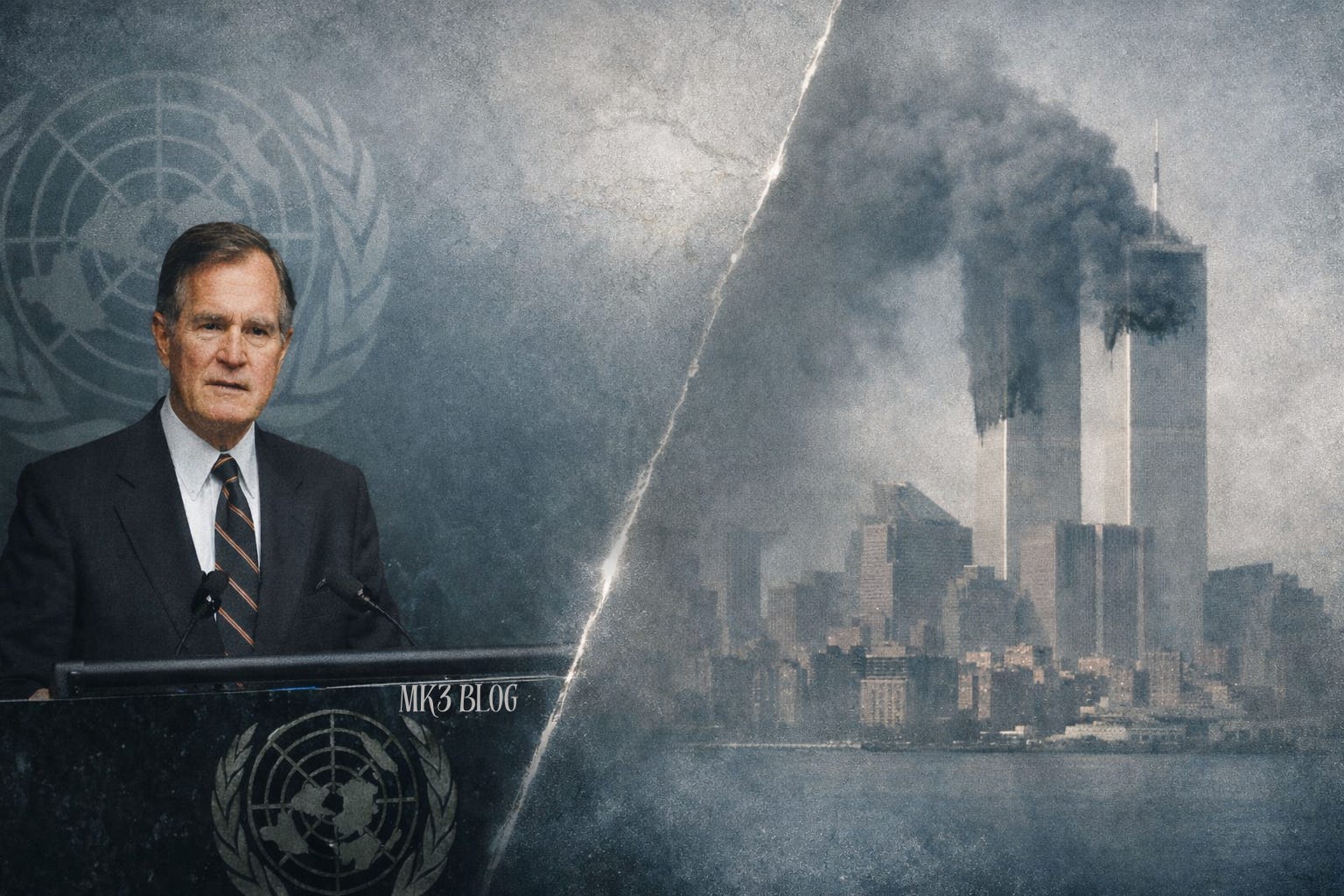
September 11, 1990. George Herbert Walker Bush stood before Congress and delivered a speech that would reshape American foreign policy for generations. The address was not merely a wartime briefing. It was a declaration of intent — a blueprint for American dominance in a world where the old rules no longer applied.
“We gather tonight, witness to events in the Persian Gulf as significant as they are tragic,” Bush began. He described how Iraqi dictator Saddam Hussein had broken promises and sent his military machine across the border into Kuwait on August 2, 1990. But the speech went far beyond the immediate crisis. Bush invoked something larger — a “new world order” where American power would serve as the organizing principle of global affairs.
“At this very moment, they serve together with Arabs, Europeans, Asians and Africans in defense of principle and the dream of a new world order,” Bush declared, speaking of American troops deployed to the Persian Gulf. “That’s why they sweat and toil in the sand and the heat and the sun.”
This was not a throwaway phrase. Bush would repeat the term “new world order” in subsequent speeches throughout the period — in his Oval Office address announcing the bombing campaign on January 16, 1991, and again in his State of the Union on January 29. The repetition was deliberate. The message was clear. American foreign policy had entered a new phase, and there would be no return to the old constraints.
Thirty-four years later, the wars that began with that speech have never truly ended. What Bush launched that September evening has become the defining feature of American foreign policy — a permanent state of military engagement across the Middle East and beyond.
The Geopolitical Landscape of 1990
Understanding what happened requires understanding the world as it existed in 1990. For forty-five years following World War II, global politics operated on a simple binary: the “free world” led by the United States versus the “communist world” led by the Soviet Union. This international duopoly created a tense equilibrium maintained by nuclear weapons. The doctrine of Mutually Assured Destruction — appropriately abbreviated MAD — prevented direct military conflict between the superpowers. Small wars erupted across the globe, but the big one never came. This was the Cold War.
Then the wall came down.
November 9, 1989 — less than a year before Saddam Hussein’s tanks rolled into Kuwait — the Berlin Wall fell. East and West Germans flooded through checkpoints that had divided their city for nearly three decades. The Soviet empire was crumbling. The Cold War was ending. And the United States suddenly found itself as the world’s sole superpower.
This created both opportunity and uncertainty. The military-industrial complex that President Eisenhower had warned about in 1961 faced an existential question: without the Soviet threat, what justification remained for massive defense spending? The answer would come from the Persian Gulf.
The Iraq-Iran War and American Double-Dealing
The roots of the 1990 crisis reach back to the Iran-Iraq War of 1980-1988. This eight-year bloodbath killed approximately two million people and devastated both nations. Iraq initiated the conflict, but the Reagan administration found it convenient to ensure neither side achieved decisive victory.
American allies supplied weapons to Iraq. Simultaneously, the Reagan administration ran an illegal operation — later known as Iran-Contra — that provided arms to Iran in exchange for hostages held in Lebanon. The United States was literally arming both sides of the conflict, keeping the bloodshed going while weakening the military capabilities of both nations. This was realpolitik at its most cynical.
When the war finally ended in 1988, Iraq found itself in financial ruin. The country owed massive debts to Saudi Arabia and Kuwait, which had provided financial support during the conflict. Iraq requested debt forgiveness to prevent national bankruptcy. Kuwait refused.
The situation grew more complicated. Kuwait used slant drilling techniques to access oil reserves from disputed fields along the Iraq-Kuwait border. From Iraq’s perspective, Kuwait was stealing Iraqi oil while demanding repayment of war debts. Iraq complained to the United States about Kuwait’s actions. The American response was ambiguous at best.
April Glaspie, the U.S. Ambassador to Iraq, met with Saddam Hussein on July 25, 1990 — just eight days before the invasion. According to Iraqi transcripts of the meeting, Glaspie told Saddam: “We have no opinion on your Arab-Arab conflicts, such as your dispute with Kuwait.” Whether this constituted a green light for invasion or merely diplomatic ineptitude remains debated. What is not debated is what happened next.
On August 2, 1990, Iraqi forces invaded Kuwait. Rather than simply seizing the disputed border territory and oil fields, Saddam Hussein took the entire country. Whatever legitimate grievances Iraq may have had against Kuwait, this overreach transformed Saddam from aggrieved party to international aggressor.
Manufacturing Consent: The Incubator Baby Hoax
Wars require public support. Public support requires moral clarity. And moral clarity sometimes requires fabrication.
Immediately following the invasion, the Kuwaiti ambassador to the United Nations produced a numbered list of Iraqi atrocities. Items 19 and 20 described Iraqi soldiers robbing hospitals of medicines and clearing them of patients. Over the following weeks, these allegations evolved into something more visceral — claims that Iraqi soldiers were removing premature babies from incubators and leaving them to die on hospital floors.
On October 10, 1990, a fifteen-year-old girl identified only as “Nayirah” appeared before the Congressional Human Rights Caucus. She delivered tearful testimony about witnessing Iraqi soldiers take babies from incubators at Al-Addan Hospital in Kuwait City. Her identity was kept secret, supposedly for her protection.
The testimony was devastating. It was also a complete fabrication.
Nayirah was actually Nayirah al-Sabah, daughter of Saud al-Sabah, the Kuwaiti ambassador to the United States, and a member of Kuwait’s ruling family. Her testimony had been arranged by Hill & Knowlton, one of the world’s largest public relations firms, working on behalf of Citizens for a Free Kuwait — a front organization funded by the Kuwaiti government.
Representative Tom Lantos, co-chairman of the Congressional Human Rights Caucus, knew Nayirah’s true identity but concealed it from the public and even from his fellow co-chairman, Representative John Porter of Illinois. The Congressional Human Rights Foundation, which Lantos headed, rented office space in Hill & Knowlton’s Washington headquarters at a reduced rate. Citizens for a Free Kuwait donated $50,000 to the foundation after Iraq’s invasion. The foundation also financed congressional travel, including trips by Lantos and his wife.
Human Rights Watch conducted its own exhaustive investigation following Kuwait’s liberation. Their findings were unambiguous: “Middle East Watch concludes that it has found no basis to the allegation that Iraqi troops took babies from incubators in Kuwaiti hospitals, causing them to die. Testimony taken by Middle East Watch after the liberation of Kuwait, from Kuwaiti doctors, nurses and administrators is clear and consistent in refuting the charge. Careful examination of hospital and cemetery records produced the same results.”
The incubator baby story was war propaganda — professionally produced, congressionally endorsed, and completely false. Yet it served its purpose: building American public support for military intervention.
Building the Coalition
With Iraq cast as the aggressor, the United Nations moved quickly. The UN Security Council — composed of five permanent members with veto power and ten rotating members — passed Resolution 660 on August 2 with fourteen votes condemning the invasion and demanding Iraq’s immediate and unconditional withdrawal from Kuwait.
Secretary of State James Baker took the lead in assembling a military coalition. This proved challenging. Many nations viewed the conflict as an internal Arab matter. Others worried about expanding American influence in the oil-rich Gulf region. The solution was straightforward: money.
Baker ultimately assembled forces from thirty-four nations: Afghanistan, Argentina, Australia, Bahrain, Bangladesh, Canada, Czechoslovakia, Denmark, Egypt, France, Germany, Greece, Hungary, Honduras, Italy, Kuwait, Morocco, the Netherlands, Niger, Norway, Oman, Pakistan, Poland, Portugal, Qatar, Saudi Arabia, Senegal, South Korea, Spain, Syria, Turkey, the United Arab Emirates, the United Kingdom, and the United States. American troops constituted seventy-four percent of the 660,000 soldiers deployed to the theater.
The price of participation varied by country. Egypt received forgiveness of twenty billion dollars in debt — “partly in thanks for the support it gave” in the Gulf War, as the New York Times reported. Syria, despite decades as an American adversary, suddenly became a fast friend, receiving $2.5 billion in assistance from Gulf states and Japan.
The diplomatic maneuvering revealed the selective application of international principles. Just days before the Iraq deadline, Soviet forces moved into Lithuania. The Baltic nation had been independent in 1940 when the Soviets marched in and annexed it. With the Cold War ending, Lithuania had reasserted its independence. Now Soviet tanks were threatening that independence again.
George Bush declared there was “no justification” for the Soviet action and warned it “could not help but affect our relationship.” Then he offered only his “thoughts and prayers.” There was no talk of protecting Lithuania from Soviet aggression, despite fifty years of official American policy recognizing Lithuanian independence. The reason was simple: the Soviet Union was supporting the Iraq deadline. Principle yielded to pragmatism.
The Bush administration also claimed Iraqi troops were massing at the Saudi Arabian border, preparing to invade and seize the oil fields. Pentagon officials, citing classified satellite imagery, estimated 250,000 Iraqi troops and 1,500 tanks positioned for attack. This claim justified the massive American military buildup in Saudi Arabia.
There was one problem. The claim appears to have been false. Soviet satellite photographs obtained by the St. Petersburg Times showed no such buildup. Neither the CIA nor the Pentagon’s Defense Intelligence Agency considered an Iraqi attack on Saudi Arabia probable. But the threat served its purpose, providing justification for American forces to deploy to Saudi soil.
On November 29, 1990, the UN Security Council passed Resolution 678 with twelve of fifteen votes. The resolution authorized member states “to use all necessary means” to enforce previous resolutions if Iraq did not fully withdraw from Kuwait by January 15, 1991. The legal framework for war was in place.
Congress followed on January 12, 1991. Democrats controlled both houses — the Senate 56-44 and the House 270-164 plus one independent, Bernie Sanders. The Authorization to Use Military Force Against Iraq Resolution passed the Senate by a slim 52-47 margin, with forty-one Republicans joined by ten Democrats. The House approved it more decisively, 250-183, with 164 Republicans and 86 Democrats voting in favor.
Operation Desert Storm
The January 15 deadline passed. On January 16, 1991, bombing began. Operation Desert Storm had commenced.
That night, George Bush appeared on television from the Oval Office to announce the campaign. He invoked the “new world order” again. In his January 29 State of the Union address, he expanded on the theme: “What is at stake is more than one small country. It is a big idea — a new world order, where diverse nations are drawn together in common cause to achieve the universal aspirations of mankind — peace and security, freedom, and the rule of law.”
The decision to use force appears to have been made months earlier by a small group within the administration. On October 25, 1990, CIA Director William Webster told the National Council on World Affairs Organization that sanctions were working effectively, cutting off ninety-eight percent of Iraq’s oil exports and approximately ninety-five percent of its imports. Outside the administration, substantial military and civilian opinion opposed the military option.
Author Theodore Draper’s analysis identified the principal advocates for war: President Bush himself, Secretary of Defense Dick Cheney, Vice President Dan Quayle, and National Security Adviser Brent Scowcroft. “It was a peculiarly presidential war,” Draper wrote, “whose political effect depended largely on whether it could be fought speedily and with minimal casualties on the American side.”
The State Department’s official history confirms the timeline: “By October 30, the Bush administration made a decision to push Iraq out of Kuwait by force if necessary.”
The air campaign was overwhelming. Pentagon reports estimate 1,200 American aircraft participated, flying 69,406 sorties over nearly forty days. Strikes targeted Iraqi military infrastructure, defenses, missile sites, electrical grids, water systems, and sewage facilities. Approximately 60,830 Air Force personnel participated in the operation.
On February 24, 1991, the ground war began. Coalition forces swept around Kuwait’s fortified defenses through the open desert — the same territory where Iraq was supposedly massing troops for an invasion of Saudi Arabia. The advance destroyed what had been called the “fourth largest army in the world.” Iraqi forces fleeing north were decimated on what became known as the “Highway of Death.” In just one hundred hours, the ground campaign was over.
Victory was declared on April 6, 1991. Retreating Iraqi forces had set oil wells ablaze and created massive spills, but the military outcome was decisive. Official American casualties were reported as 145 battle deaths, 147 non-battle deaths, and 467 wounded in action. George Bush declared an end to “Vietnam syndrome” in a March speech to the American Legislative Exchange Council.
His approval rating reached ninety percent — the highest in polling history.
The War That Never Ended
The official UN mission was complete. Kuwait was liberated. But the war continued.
Saddam Hussein remained in power. UN sanctions against Iraq remained in place. The United States, Britain, and France established two large “no-fly zones” over northern and southern Iraq — ongoing military operations not specifically authorized by the UN Security Council. American and coalition aircraft would patrol these zones and conduct strikes for the next twelve years.
The human cost of sanctions was staggering. A subsequent report indicated that over 500,000 Iraqi children died as a result of the war and sanctions. When asked about this figure in a 1996 interview, Secretary of State Madeleine Albright said “the price was worth it.”
American casualties were also higher than initially reported. The Department of Veterans Affairs later determined that over 8,000 U.S. service members died by 2002 as a result of service in the Iraq theater. Gulf War Syndrome — a constellation of chronic symptoms affecting veterans — remained poorly understood and inadequately treated.
Former U.S. Attorney General Ramsey Clark convened the International War Crimes Tribunal, which assembled evidence supporting eleven charges against the United States, including allegations of “a pattern of conduct intended to lead Iraq into provocations” before the Kuwait invasion. The tribunal presented its findings in New York City in early 1992. Nothing came of it.
The 1992 Election and Its Aftermath
The American economy had entered a “jobless recovery.” Bush’s approval rating collapsed from ninety percent to twenty-nine percent. Arkansas Governor Bill Clinton ran on domestic issues with the campaign slogan, “It’s the economy, stupid.” Independent billionaire Ross Perot channeled public frustration with both major parties.
Perot received nineteen percent of the vote — the strongest independent showing since Theodore Roosevelt’s Bull Moose campaign in 1912. The political establishment quickly constructed a narrative that Perot had “spoiled” the election for Bush. This claim, repeated endlessly in subsequent years, served to discourage third-party challenges. The actual evidence for this spoiler effect is questionable at best.
Before leaving office, Bush left two significant legacies for the incoming administration.
First, a Defense Planning Guidance document drafted in spring 1992 declared that the United States would serve as the world’s sole superpower handling global military needs. The document explicitly endorsed preemptive wars to eliminate weapons of mass destruction. “The U.S. may be faced with the question of whether to take military steps to prevent the development or use of weapons of mass destruction,” the document stated, including “pre-empting an impending attack” or “punishing the attackers.”
Second, during the lame-duck period following the election, Bush ordered an intervention in Somalia with no exit strategy. The Clinton administration inherited this operation, which ended in humiliation — memorialized in the film “Black Hawk Down.”
The Clinton Years: Continuity Over Change
By summer 1993, the Clinton administration was bombing Iraq. The stated justification was retaliation for an alleged Iraqi conspiracy to assassinate former President Bush during a visit to Kuwait. The legal basis was questionable. The pattern was established.
Throughout Clinton’s eight years, the Iraq war continued in slow motion. Sanctions remained in force. The no-fly zones remained active. UN weapons inspectors searched for weapons of mass destruction that, it would later be confirmed, did not exist in any significant quantity.
The absurdity of the WMD claims should have been apparent. Iraq had not used such weapons during the 1991 campaign despite facing total military defeat. The subsequent inspections and bombing campaigns made development or concealment of such weapons effectively impossible. Yet the specter of Iraqi WMDs became a permanent fixture of American political discourse.
George Bush, meanwhile, joined the Carlyle Group — a private investment firm specializing in defense contracts. The firm had been founded by Reagan’s Secretary of Defense Frank Carlucci and included Bush’s Secretary of State James Baker as a partner. The revolving door between government service and defense industry profit spun smoothly.
In October 1998, Clinton signed the Iraq Liberation Act, a Republican-introduced bill that funded efforts for “regime change” in Iraq. This law would later be cited by George W. Bush to justify the 2003 invasion.
December 1998 brought the most intensive military action of the Clinton years. Operation Desert Fox — a four-day bombing campaign — launched on December 16, three days before the House voted to impeach Clinton over his affair with Monica Lewinsky. The timing was widely noted.
Clinton also deployed American military power elsewhere — in Haiti, across the former Yugoslav territories, in Afghanistan, and in Sudan. The 1999 Kosovo intervention marked the first combat operations in NATO’s history, conducted without UN Security Council authorization. The “new world order” Bush had proclaimed was taking shape, with American military force as its primary instrument.
The 2000 Election and the Path to September 11, 2001
George W. Bush — son of the former president — ran for the presidency in 2000 against Vice President Al Gore. For those paying attention, the younger Bush’s intentions toward Iraq were clear.
His campaign was populated by members of the Project for a New American Century, a neoconservative think tank. In September 2000, PNAC released a major policy paper titled “Rebuilding America’s Defenses.” The document expanded on the 1992 Defense Planning Guidance and called for increased military spending sufficient to fight three major wars simultaneously. Iraq was specifically identified as a target.
Election night produced chaos. News networks first called the race for Gore, then for Bush, then retracted both calls. The outcome hinged on Florida, where Bush’s brother Jeb served as governor. The margin was impossibly thin.
Florida’s Secretary of State, Katherine Harris — a Republican who had served as co-chair of Bush’s Florida campaign — certified Bush as the winner before recounts could be completed. Legal challenges wound through state and federal courts. On December 12, 2000, the U.S. Supreme Court issued its ruling in Bush v. Gore. By a 5-4 vote along partisan lines, the Court stopped the recount and effectively declared George W. Bush the winner.
Bush’s inauguration on January 20, 2001, was marked by large protests. The crowd of demonstrators rivaled the crowd of supporters. Television cameras could not avoid capturing the dissent.
The new administration filled its ranks with PNAC members and began implementing tax cuts that primarily benefited the wealthy. The economy softened. Critics warned of coming disaster, both economic and geopolitical.
Then came September 11, 2001 — eleven years to the day after George H.W. Bush first proclaimed his “new world order” before Congress.
Blowback
The attacks of September 11, 2001, were not random. They emerged from a specific historical context that American foreign policy had helped create.
In 1996, Osama bin Laden — a Saudi national who had worked with the CIA against Soviet forces in Afghanistan during the 1980s — issued a declaration of war against the United States. His grievances were specific: American troops stationed in Saudi Arabia, the holy land of Islam, and the ongoing sanctions against Iraq.
“Your brothers in land of the two holiest sites and Palestine are calling upon you for help and asking you to take part in fighting against the enemy, your enemy; the Israelis and Americans,” bin Laden wrote. “They are asking you to do whatever you can within one’s own means and ability, to expel the humiliate and defeat the enemy out of the sanctities of Islam.”
The presence of American troops in Saudi Arabia — deployed during the 1990-1991 Gulf War and never fully withdrawn — was a direct consequence of George Bush’s “new world order.” The sanctions that starved Iraqi children were a continuation of that same policy. The war that began on September 11, 1990, created the conditions for the attacks of September 11, 2001.
The Permanent War State
The pattern established by George H.W. Bush in 1990 has continued for more than three decades. Wars begin. Wars continue. Wars do not end. They simply transform — new names, new justifications, new theaters — but the fundamental reality remains unchanged.
The Authorization for Use of Military Force passed after September 11, 2001, remains in effect. It has been used to justify military operations across the globe, in countries that had nothing to do with the attacks. The 2003 invasion of Iraq — justified by fabricated claims about weapons of mass destruction — removed Saddam Hussein but created conditions for the rise of ISIS. The war in Afghanistan lasted twenty years and ended exactly as critics predicted it would.
The “new world order” George Bush proclaimed in 1990 was not a plan for peace. It was a plan for permanent American military dominance, enforced through force or the threat of force, sustained by a defense industry that profits from endless conflict, justified by manufactured threats and compliant media.
The troops who sweated and toiled in the sand in 1990 were told they were building a better world. Their children and grandchildren have deployed to the same region for the same stated purposes. The mission has not been accomplished. The mission was never designed to be accomplished. The mission is the mission.
September 11, 1990, marked the beginning of something that has no planned ending. George Bush stood before Congress and described a world where American power would impose order. What he built instead was a machine for generating chaos — and profit.
The documents are clear. The speeches are on record. The consequences are measured in trillions of dollars and millions of lives. This is what happened. This is what continues to happen.
The new world order is here. It looks exactly like the old world order, only with better marketing and bigger bombs. Anyone who expected otherwise was not paying attention to what George Bush actually said on September 11, 1990.