


Rep. Sheila Cherfilus-McCormick, representing Florida’s 20th Congressional District, faces unprecedented scrutiny through simultaneous federal criminal charges and multiple House Ethics Committee investigations. The allegations center on systematic misuse of approximately $5.7 million in federal COVID-19 disaster relief funds, which investigators claim were laundered through personal and business accounts to finance her political campaigns while concealing the money’s true source.
The case spans violations from 2018 through 2024, encompassing campaign finance fraud, money laundering, tax violations, and the misuse of congressional influence. Cherfilus-McCormick maintains her innocence, characterizing the charges as politically motivated attacks. However, the convergence of evidence from multiple jurisdictions presents a detailed picture of alleged systematic corruption.
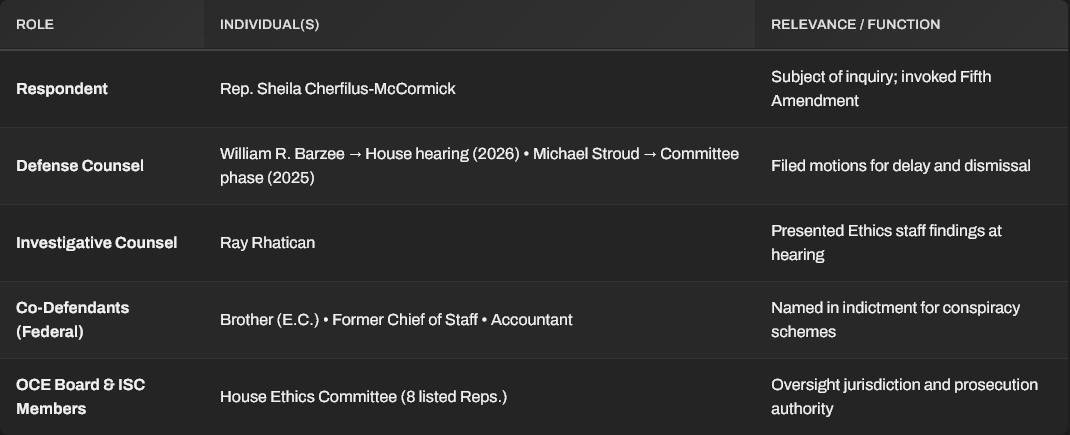
KEY DOCUMENTATION SUMMARY:
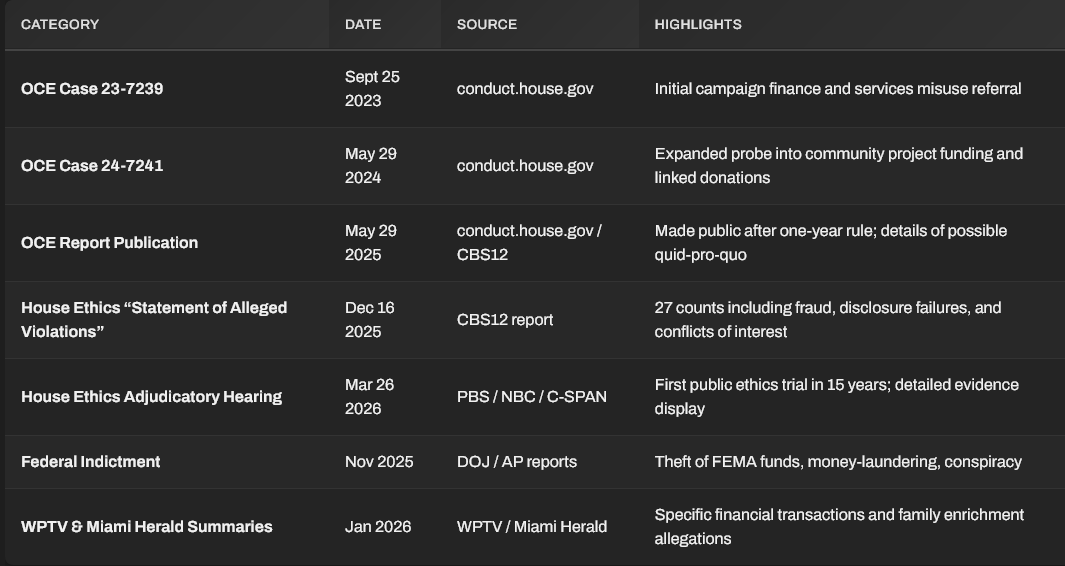
WITNESSES / INVESTIGATIVE ACTORS (Identified in records):
Foundation: Early Campaign Finance Violations (2018-2020)
The investigation’s roots trace back to Cherfilus-McCormick’s initial congressional campaigns. According to WPTV reporting from January 2026, her 2018 campaign operated through a personal bank account rather than establishing the required official Federal Election Commission (FEC) campaign account. This fundamental violation of campaign finance regulations created the structural foundation for subsequent alleged misconduct.
Multiple FEC reports went unfiled during this period, while a $50,000 transfer from her husband’s law firm to the campaign account was immediately repaid the same day. Investigators flagged this pattern as potential straw donation activity, where the true source of campaign funds is concealed through intermediate transactions.
The personal bank account usage violated FEC definitions of “personal funds,” as she lacked legal title to those resources. These early irregularities established a pattern of financial opacity that would expand significantly during the COVID-19 pandemic period.
The COVID-19 Over-payment Scheme (2021-2022)
The central allegations revolve around a $14 million contract awarded to Trinity Health Care Services, a family firm controlled by Cherfilus−McCormick, for COVID−19 vaccination outreach services through Florida′s Department of Emergency Management. A clerical error resulted in a $14 million contract awarded to Trinity Health Care Services, a family firm controlled by Cherfilus−McCormick, for COVID−19 vaccination outreach services through Florida′s Department o Emergency Management. A clerical error resulted in a $5.7 million overpayment that was never promptly repaid despite state audit findings.
Federal investigators allege that instead of returning the excess funds, Cherfilus-McCormick and her relatives orchestrated a complex laundering scheme. The money allegedly flowed from Trinity Health Care to SCM Consulting (her personal company), then into personal accounts, and finally into campaign financing through 99 separate transactions totaling approximately $6 million.
During this period, investigators documented luxury purchases including a 3-carat yellow diamond ring from Tiffany’s, designer clothing, a Tesla vehicle, and extensive travel expenses. These purchases coincided with her 2022 special election victory, which she publicly described as “self-financed.” Federal prosecutors now allege this self-financing was actually underwritten by misappropriated taxpayer funds.
The timing proves significant because investigators estimate SCM Consulting would have needed to work 150,000 hours (approximately 17 years of full-time labor) to legitimately justify the earnings reported during this compressed timeframe. This mathematical impossibility provides compelling evidence of the alleged laundering operation.
First Ethics Referral and Investigation Expansion (2023)
On September 25, 2023, the Office of Congressional Ethics (OCE) issued its first formal referral (Case 23-7239) to the House Committee on Ethics. This referral highlighted unreported payments to a state political action committee linked to her campaign, potential acceptance of excessive or misreported contributions, possible use of private voluntary services for official congressional work, and systematic commingling of business and campaign accounts.
The House Ethics Committee responded by establishing an Investigative Subcommittee (ISC) on December 27, 2023, signaling the seriousness of the allegations. This formal structure enabled comprehensive document subpoenas and witness interviews under congressional authority.
Expanded Scope and Second Referral (2024)
The investigation’s scope expanded significantly when OCE issued a second referral (Case 24-7241) on May 29, 2024. This expanded investigation examined community project funding potentially directed to for-profit entities with connections to Cherfilus-McCormick, campaign donations that appeared tied to specific official actions, improper payments between her congressional office and private entities, and undisclosed in-kind contributions that violated House ethics rules.
The OCE Board found “probable cause” of violations related to improper contributions and misuse of office resources. This expansion synchronized with an ongoing Department of Justice investigation, creating parallel tracks of accountability that would eventually converge in the federal indictment.
Public Disclosure and Federal Charges (2025)
The OCE report became public on May 29, 2025, following the mandatory one-year disclosure rule. The report detailed possible exchanges of campaign contributions for official actions, payments from her congressional office to private entities in violation of House standards, and preferential treatment in community project funding allocations.
Significantly, the report confirmed that Cherfilus-McCormick invoked the Fifth Amendment against self-incrimination during Ethics Committee questioning, a legal right that nonetheless raised public questions about her willingness to provide explanations for the alleged conduct.
In November 2025, the Department of Justice unsealed federal criminal charges against Cherfilus-McCormick, her brother, and associated staff members. The charges included theft of government funds, money laundering, conspiracy, and tax violations. The federal indictment directly mirrored the House Ethics findings, creating a unified narrative across both congressional and criminal proceedings.
On December 16, 2025, the House Ethics Subcommittee adopted a comprehensive 59-page “Statement of Alleged Violations” encompassing 27 separate counts of violations. These spanned campaign finance fraud, disclosure failures, misuse of federal funds, and conflict of interest violations. The Statement also flagged potential foreign-linked campaign support through alleged conduit contributions from Petrogaz-Haiti S.A., though this element remains under investigation.
Historic Public Ethics Trial (March 2026)
On March 26, 2026, the House Ethics Committee convened the first public adjudicatory hearing for a sitting member of Congress since Charlie Rangel’s case in 2010. The televised proceedings, broadcast live on C-SPAN, PBS, and NBC News, represented a rare moment of transparency in congressional accountability processes.
The Committee reviewed a 242-page report detailing all 27 violation counts. Key testimony revealed that her personal consulting firms and relatives’ companies allegedly received over $6 million with no documented services provided. Investigators presented evidence showing systematic cycling of funds between Trinity HealthCare and campaign accounts designed to create the appearance of legitimate self-funding.
Her attorney, William R. Barzee, attempted to delay or seal the hearing due to the pending criminal trial, but was denied by the Ethics Committee. The proceedings concluded with Cherfilus-McCormick again invoking her Fifth Amendment rights rather than providing testimony in her defense.
Current Status and Future Proceedings
As of March 2026, multiple legal proceedings continue simultaneously. The federal criminal trial is scheduled for April 2026, though defense motions may push proceedings into summer or fall. The charges carry potential prison sentences and substantial financial penalties if convicted.
The House Ethics Committee continues its independent review process. Potential penalties range from formal reprimand or censure to committee removal or expulsion from Congress. Expulsion requires a two-thirds majority vote of the House, making it the most severe penalty but also the most difficult to achieve politically.
Cherfilus-McCormick has stepped down as Ranking Member of the Foreign Affairs Subcommittee on Middle East, North Africa, and Central Asia but refuses to resign from Congress entirely. She maintains that her constituents continue to support her and that she retains constitutional rights to serve pending resolution of all proceedings.
Republican leadership has introduced a motion for expulsion, but passage would require significant Democratic defections. Both Speaker Mike Johnson and Minority Leader Hakeem Jeffries have publicly emphasized the importance of due process, suggesting reluctance to act before criminal proceedings conclude.


Systemic Implications and Structural Failures
The Cherfilus-McCormick case illuminates significant structural weaknesses in federal financial oversight systems. The four-year gap between initial flagged violations and public accountability demonstrates the opacity and delays built into House Ethics processes. Most concerning, the financial flows remained unmonitored due to poor synchronization between FEC reporting requirements and congressional disclosure frameworks.
The case reveals how pandemic emergency contracting circumvented normal oversight mechanisms. Weak post-COVID accounting controls left billions of dollars vulnerable to diversion through healthcare contractors operating under emergency authorities. The Trinity Health Care overpayment remained unaddressed for years, suggesting serious oversight failures at both state and federal levels.
Congressional self-financing rules enabled “recycled” funds to appear legal when passed through intermediate business entities. This loophole essentially allows the conversion of misappropriated government funds into legitimate-appearing campaign financing, as long as the money passes through enough intermediary accounts to obscure its original source.
Documentary Evidence and Investigation Coordination
The investigation demonstrates unprecedented coordination between multiple oversight bodies. The Office of Congressional Ethics, House Committee on Ethics, Department of Justice Public Integrity Section, Florida Department of Emergency Management, and Federal Election Commission all contributed evidence and analysis to build the comprehensive case.
Key documents include OCE referrals 23-7239 and 24-7241, the 59-page Statement of Alleged Violations, the 242-page Ethics Committee report, federal grand jury indictments, and hundreds of banking records showing the alleged money flows. This documentary foundation provides investigators with detailed transaction-level evidence of the alleged schemes.
The parallel state civil case seeking recovery of the $5.6 million overpayment adds another dimension of accountability. Florida’s Department of Emergency Management continues settlement negotiations while criminal proceedings advance, creating potential recovery mechanisms for taxpayers regardless of criminal trial outcomes.
Precedent and Political Impact
The public nature of the Ethics Committee hearing breaks with decades of private congressional accountability processes. The decision to televise proceedings reflects both the severity of the allegations and growing public demand for transparency in congressional oversight.
The case establishes important precedent for how pandemic-era fraud cases will be prosecuted and adjudicated. With billions in COVID relief funds distributed under emergency authorities, the Cherfilus-McCormick prosecution sends clear signals about post-pandemic accountability enforcement.
Politically, the case tests the boundaries of party loyalty versus institutional integrity. Democratic leadership faces difficult decisions about whether to support a colleague through due process or distance the party from serious corruption allegations. The ultimate resolution will likely influence how similar cases are handled in the future.
Looking Forward: Expected Resolution Timeline
Federal criminal proceedings will likely conclude by late 2026, potentially influencing House Ethics Committee recommendations. If criminal convictions occur, House expulsion becomes more politically viable, as members historically face greater pressure to remove convicted colleagues.
The Florida civil case provides a separate track for taxpayer recovery that proceeds regardless of criminal outcomes. Settlement negotiations continue parallel to criminal proceedings, potentially providing restitution even if criminal charges are not ultimately sustained.
The case ultimately demonstrates both the potential and limitations of existing accountability mechanisms. While multiple oversight bodies successfully identified and documented alleged misconduct, the years-long timeline for resolution raises questions about whether current systems provide adequate deterrence for future violations.
The Cherfilus-McCormick investigation represents a comprehensive test of federal accountability systems in the post-pandemic era. Its resolution will establish important precedents for congressional ethics enforcement, federal fraud prosecution, and the boundaries of acceptable political conduct in American democracy.
Whether she is ultimately convicted or exonerated, the documented evidence reveals systematic weaknesses that enabled the alleged misconduct to continue undetected for years. These structural failures demand attention regardless of individual case outcomes, as they affect the integrity of federal financial systems far beyond any single member of Congress.
STRUCTURAL MAP — “Investigations Convergence”:
2018 – 2020 → Campaign Irregularities
2021 – 2022 → COVID overpayment flow into campaigns
2023 → 2025 → OCE and Ethics referrals (23‑7239, 24‑7241)
Nov 2025 → Federal indictment aligning with House findings
Mar 2026 → Public adjudicatory hearing
Apr 2026 + → Federal trial + possible House expulsion vote
Outcome Vectors (Expected 2026):
Ethics Decision ▸ Censure / Reprimand / Expulsion
DOJ Trial ▸ Conviction or Acquittal
Florida Civil Recovery ▸ State claw‑back (Trinity repayment $5.6 M agreement)
SYSTEMIC NOTES:
It took over four years from first flagged violations to a public hearing — highlighting the opacity of House Ethics processes.
Most financial flows remained unmonitored due to weak synchronization between the FEC and Congressional reporting frameworks.
Regulatory capture symptom: pandemic contracting via state emergency mechanisms circumvented normal oversight.
Transparency deficit: none of the subcommittee transcripts have yet been released to the public.