

The source for this article: The Journal of Historical Review
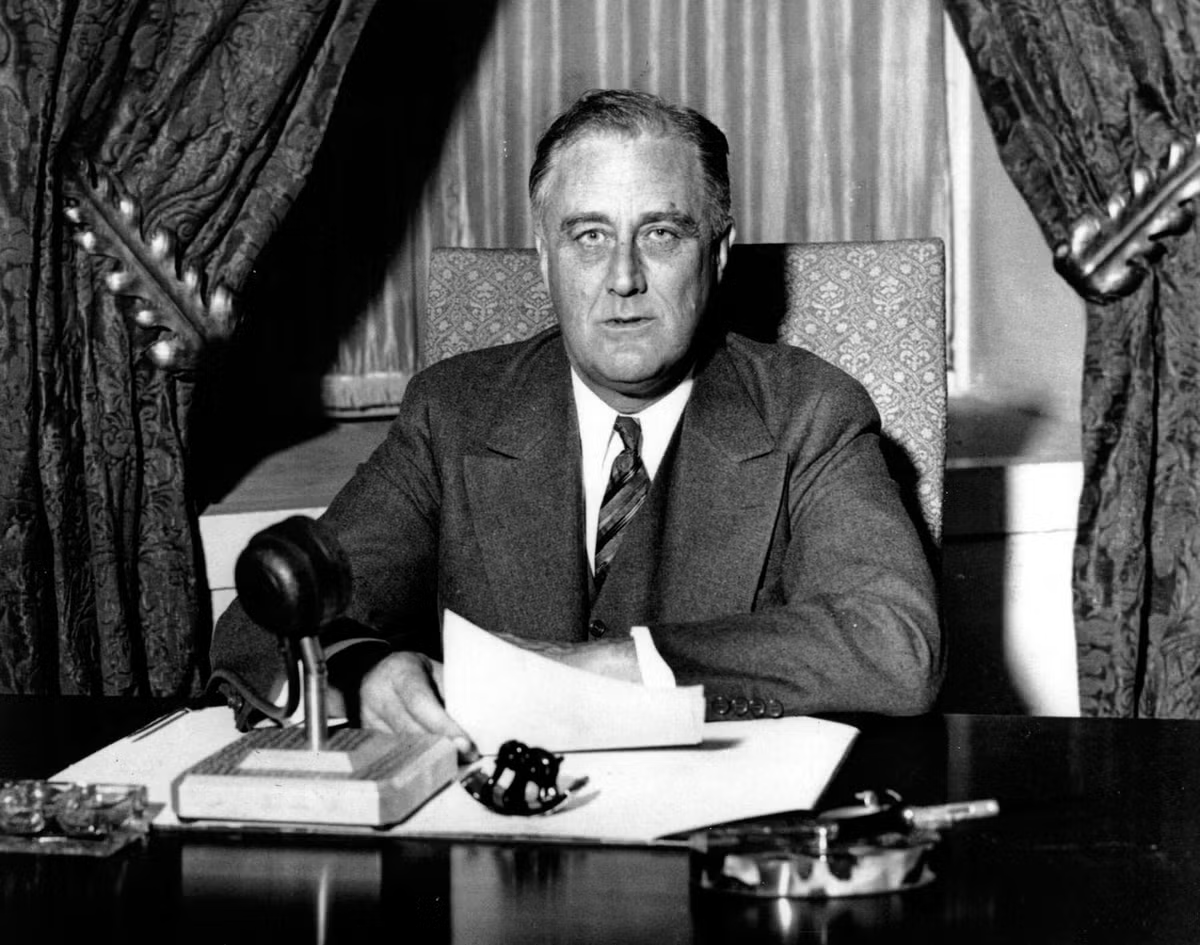
Franklin D. Roosevelt’s role in the events that led to the Second World War has received far less scrutiny than the scale of his actions would suggest. Public attention has centered on the Pearl Harbor attack and America’s later entry into the conflict. Yet a body of evidence shows that Roosevelt conducted a sustained campaign, beginning well before September 1939, to push Britain, France, and Poland into war with Germany.
In 1982 and 1983, ceremonies marked the centenary of Roosevelt’s birth and the fiftieth anniversary of his first inauguration. Political leaders from both parties and most major media outlets presented a uniformly favorable portrait. President Reagan joined the tributes. Within a short time, however, additional records surfaced that contradicted the prevailing narrative. These records had been captured by German forces when they took Warsaw in late September 1939. They consist of confidential reports sent to the Polish Foreign Ministry by its ambassadors in Washington, Paris, and London. The documents detail conversations with senior American officials, above all William C. Bullitt, Roosevelt’s personal envoy in Europe, and to a lesser extent Joseph P. Kennedy, the ambassador in London.
The German government published a selection of the documents in March 1940 under the title Polnische Dokumente zur Vorgeschichte des Krieges. An English edition appeared in New York the same year, though the translation contained numerous omissions and errors. The Polish originals were examined by foreign journalists in Berlin at the time of release. Later, Polish diplomats who had authored some of the reports confirmed their authenticity in published memoirs and diaries. Historians Charles C. Tansill and Harry Elmer Barnes each stated that the documents were genuine. Edward Raczynski, Polish ambassador in London from 1934 to 1945, wrote in his diary on 20 June 1940 that the facsimiles matched originals he had seen. Juliusz Lukasiewicz, ambassador in Paris, included several of the same texts in his postwar papers. Tyler Kent, a U.S. embassy official in London, reported that copies of American messages in the files corroborated the Polish accounts.
The reports describe a consistent policy. Roosevelt viewed Germany’s recovery and its demand for revision of the post-1919 territorial settlement as a threat that required active opposition. He instructed his representatives to discourage any negotiated settlement that would leave Germany stronger. Bullitt, who enjoyed direct telephone access to the president and often bypassed Secretary of State Cordell Hull, conveyed these instructions to the French and Polish governments. In conversations recorded by Polish ambassadors, Bullitt stated that the United States would ultimately join Britain and France if they went to war with Germany, though it would not enter at the outset. He urged both countries to refuse any territorial concessions and to accelerate rearmament. He indicated that American material support would be available once hostilities began.
Polish Ambassador Jerzy Potocki reported from Washington on 9 February 1938 that Jewish organizations were exerting strong pressure on the administration to adopt a confrontational stance toward Germany. He noted that this pressure was shaping public information through radio, film, and the press. In a longer report dated 12 January 1939, Potocki described the domestic political setting in detail. He observed that Roosevelt faced mounting labor unrest and persistent unemployment. The president, according to Potocki, sought to shift attention outward by emphasizing foreign dangers. The same report recorded that prominent Jewish figures close to Roosevelt supported this approach. Potocki concluded that the administration was using the European crisis to justify large increases in military spending and to prepare public opinion for eventual involvement.
Bullitt’s statements to Polish diplomats became more explicit as the crisis deepened. On 21 November 1938 he told Potocki that Britain, France, and the United States needed roughly two more years to complete rearmament. In the interim, he said, Germany should be allowed or encouraged to move eastward. Once Germany was engaged with the Soviet Union, the Western powers could intervene from a position of strength. On 16 January 1939 Bullitt repeated to Potocki that the United States would place its resources at the disposal of Britain and France once war began. On 29 March 1939 Lukasiewicz reported that Bullitt had assured him of full American backing for Poland’s refusal to negotiate over Danzig or the Corridor.
These exchanges occurred against a background of specific diplomatic moves. After the Munich agreement of September 1938, Roosevelt publicly criticized the settlement and privately pressed Britain and France to adopt a firmer line. In March 1939, following the German occupation of Bohemia and Moravia, he sent a message to Prime Minister Neville Chamberlain warning that continued cooperation with Germany would cost Britain American support. Chamberlain altered course within days. On 31 March 1939 Britain extended a guarantee to Poland. The guarantee contained no provision for negotiation and no requirement that Poland first attempt to settle its disputes with Germany. Polish leaders interpreted the pledge as unconditional backing. They therefore declined German offers to discuss Danzig and the Corridor.
Roosevelt also rejected opportunities to encourage direct talks. In September 1938 he did not respond to French requests that the United States consider arbitration of the Sudeten question. In August 1939, after Britain had committed itself to Poland, Chamberlain asked Roosevelt through Ambassador Kennedy to urge the Poles to open negotiations. Roosevelt declined. On 11 September 1939, after war had started, Kennedy again cabled that the president might still act to limit the conflict. Roosevelt replied that no American peace initiative was possible.
The Polish documents make clear that the ambassadors understood the gap between American public opinion and the administration’s private commitments. Potocki noted repeatedly that the majority of Americans opposed involvement in another European war. He recorded that Roosevelt therefore avoided explicit pledges in public while authorizing Bullitt to convey firmer assurances in private. The same pattern appears in Roosevelt’s 23 October 1940 campaign speech, in which he denied the existence of any secret understanding that would draw the United States into war.
Additional contemporary records support the Polish reports. British Ambassador Sir Ronald Lindsay’s confidential dispatch of 19 September 1938 describes a White House meeting in which Roosevelt outlined a plan for Britain and France to impose a blockade on Germany without a formal declaration of war. The president argued that this approach would allow him to maintain the appearance of American neutrality while supplying material aid. U.S. Ambassador William Phillips later wrote that by late 1938 he had concluded that American entry on the Allied side was only a matter of timing. Swiss diplomat Carl J. Burckhardt recorded a December 1938 conversation with Ambassador Anthony Drexel Biddle in which Biddle expressed confidence that Poland would fight over Danzig and that American opinion would support intervention.
After the war, former Ambassador Joseph Kennedy told Secretary of Defense James Forrestal that neither Britain nor France would have guaranteed Poland without sustained pressure from Washington. Kennedy stated that Bullitt had repeatedly assured Roosevelt that Germany would not fight and that Chamberlain had complained that American and Jewish influence had forced Britain into the conflict. French Foreign Minister Georges Bonnet wrote in 1971 that Bullitt had done everything possible in 1939 to bring France into war.
The documents also record Polish perceptions of the interests at work. Potocki and Lukasiewicz observed that certain financial and political groups in the United States stood to gain from increased arms production and from loans to Britain. They noted that these groups operated through organizations such as the Committee to Defend America by Aiding the Allies, which received support from major banking houses and from individuals with holdings in war-related industries. The Polish envoys distinguished between these organized pressures and the broader American public, which they described as largely unaware of the administration’s private diplomacy.
Roosevelt’s domestic political situation supplied an additional motive. Potocki reported in January 1939 that the president faced growing criticism over unemployment and labor conflict. By directing attention to foreign threats, Roosevelt could justify new expenditures and rally support. The same report observed that the administration carefully avoided linking the Soviet Union with the totalitarian states in its public statements, thereby preserving the possibility of later cooperation with Moscow.
The Polish ambassadors themselves were not sympathetic to Germany. They reported what they heard and saw without endorsement. Their accounts are consistent with one another and with independent records. They show that Roosevelt’s representatives conveyed, well before September 1939, a clear message: the United States would support Britain and France if they resisted German demands, and it would eventually join them in war. The message was delivered to governments that were already inclined to resist. The result was the British guarantee to Poland, Poland’s refusal to negotiate, and the subsequent declarations of war by Britain and France after the German attack on 1 September 1939.
The captured documents were dismissed at the time by American officials as fabrications. Secretary Hull stated that no such conversations had occurred. Bullitt denied making the statements attributed to him. In 1940 most Americans still placed confidence in official denials. Later releases of records and the testimony of participants have removed the basis for that confidence. The documents stand as a primary record of the private diplomacy that preceded the public outbreak of war in Europe.
Margin of the Law publishes constitutional analysis, civic research, and legal education for people who want to understand the system they actually live in. Read the Full Constitutional Analysis Library at marginofthelaw.com.
© 2026 – MK3 Law Group
For republication or citation, please credit this article with link attribution to marginofthelaw.com.