


“The spirit of resistance to government is so valuable on certain occasions that I wish it to be always kept alive. It will often be exercised when wrong, but better so than not to be exercised at all.”
Thomas Jefferson, Letter to Abigail Adams, February 22, 1787
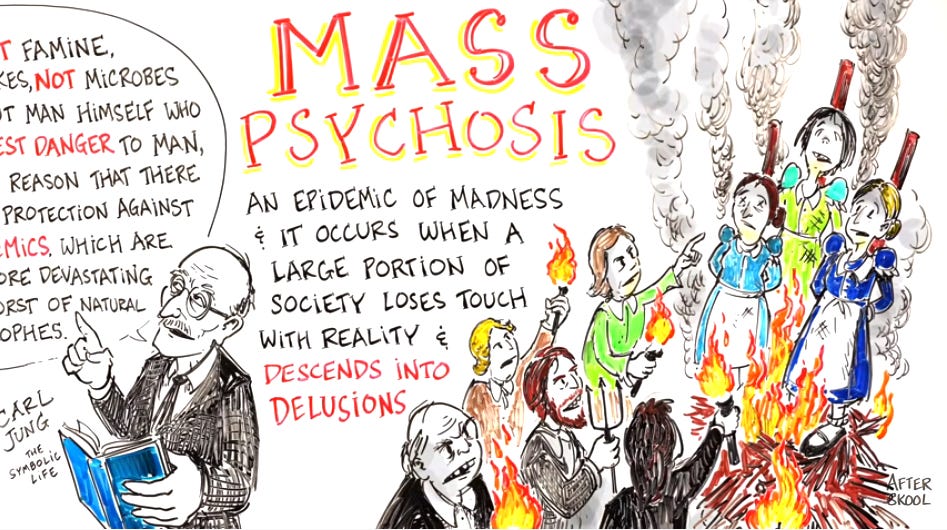
The phrase “mass psychosis” gets thrown around whenever people want to describe large-scale irrationality or herd behavior gone wrong. But here’s the problem with that label: it’s not a clinical diagnosis. It’s rhetorical shorthand for something more complex and dangerous.
If you want to understand what’s actually happening when entire populations seem to lose their grip on reality, you need to look at the mechanisms underneath the buzzwords. Researchers call it mass formation, thought reform, informational cascades, and preference falsification. These concepts have actual gears inside them—they explain how totalitarian control takes root and spreads.
This is a breakdown of what “mass psychosis of totalitarianism” is pointing at, how it forms, how it’s maintained, why intelligent people join in, and how it collapses.
Defining Totalitarian Mass Dynamics
Totalitarianism isn’t just authoritarian government with a mean streak. It’s an attempt at total domination—power that penetrates every domain of life: speech, association, employment, education, family, belief, even inner thought. Hannah Arendt argued it’s a distinct form of rule because it aims at comprehensive control and uses terror plus ideology to achieve it.
Mass psychosis in this context means a large portion of the population starts behaving as if a shared narrative is more real than reality itself. Dissent becomes socially or institutionally dangerous. You don’t need people to be literally delusional for this to work. You just need four conditions:
Fear and uncertainty
Social isolation and atomization
Intense narrative control
Clear incentives to comply and penalties for resistance
That combination manufactures “as-if belief”—the real fuel that powers totalitarian systems.
The Psychological Foundation
Hannah Arendt identified the critical precondition for totalitarian susceptibility: loneliness. Not physical isolation, but social disconnection—being unmoored, detached, replaceable, “superfluous.” When people lack meaningful ties to institutions and communities, they become available for mass mobilization.
Erich Fromm approached it differently, arguing that modern freedom creates anxiety and responsibility some people can’t handle. They cope by fleeing into authoritarianism—submitting to power, merging with a movement, trading autonomy for certainty.
Mattias Desmet’s recent “mass formation” framework emphasizes similar conditions: societal loneliness, meaninglessness, free-floating anxiety, and frustration that gets organized around a narrative and target. Whether you buy his complete analysis or not, these ingredients overlap with established social psychology and political theory.
The pattern is clear: totalitarianism doesn’t start with evil masterminds. It starts with populations primed for psychological relief.
How Ordinary Minds Become Totalitarian-Compatible
Several psychological mechanisms show up consistently across different cases and contexts.
Obedience to Authority
Stanley Milgram’s experiments demonstrated that ordinary people will obey authority figures even when it conflicts with their moral instincts. In real totalitarian systems, you don’t need shock machines. You need bureaucracy, rules, and layered responsibility so everyone can say “not my decision.”
The key insight: people outsource their conscience to institutional authority. Individual moral judgment gets dissolved into procedural compliance.
Conformity and the Spiral of Silence
Elisabeth Noelle-Neumann’s “spiral of silence” theory explains how fake consensus forms: people fear social isolation; when they think their view is unpopular, they shut up; silence makes the dominant view look even more dominant; then more people shut up.
Totalitarian systems weaponize this dynamic by making dissent not just unpopular, but punishable. The spiral accelerates until public discourse becomes a performance of agreement that doesn’t reflect private beliefs.
Informational Cascades
Economists Bikhchandani, Hirshleifer, and Welch modeled how people rationally follow others’ choices when they assume earlier actors know something they don’t. The crowd can “lock in” to false beliefs even when many privately doubt them.
This is the mathematical version of “everyone’s pretending, so I pretend too.” It explains how entire societies can march toward obviously destructive outcomes while looking rational at each individual decision point.
Preference Falsification
Timur Kuran’s research explains why whole societies can appear loyal right up until they suddenly aren’t. People hide true beliefs due to risk; public support becomes an elaborate illusion; then one event shifts perceived safety and the illusion collapses fast.
This mechanism explains why totalitarian regimes can feel invincible until they fall in a matter of days or weeks.
Thought Reform Environments
Robert Jay Lifton studied ideological totalism and identified eight criteria that create environments capable of reshaping human thought:
Milieu control - controlling communication and information
Mystical manipulation - orchestrating experiences that feel spontaneous but serve the system
Demand for purity - creating impossible standards that require constant confession
Sacred science - treating ideology as both scientific and sacred, beyond question
Loading the language - creating specialized vocabulary that stops thought
Doctrine over person - subordinating individual experience to group beliefs
Dispensing of existence - deciding who deserves to exist or participate
Confession - requiring admission of guilt and inadequacy
These aren’t just “cult things.” They’re general-purpose tools for grinding down independent thought that can operate in any institutional setting.
The Political Technology of Control
Modern totalitarian systems use specific techniques that go beyond traditional tyranny.
Narrative Control
Rather than simply banning information, sophisticated systems shape what gets amplified, what gets mocked, and what becomes career-ending to question. Lifton’s “milieu control” can be cultural and corporate as much as governmental.
The goal isn’t to make people believe the official story. It’s to make them act as if they believe it, which is often enough.
Ideological Reality Redefinition
Totalitarian ideologies don’t just argue policies—they claim access to higher “truth” that overrides lived experience. Contradictions become loyalty tests: if you’ll repeat obvious falsehoods, you’ve proven you’re “one of us.”
This creates a two-tier reality system where official truth and observable truth diverge, and people learn to navigate both simultaneously.
Moralization of Everything
When disagreements become moral contamination rather than intellectual differences, rational debate dies. Once people think dissent makes you dirty rather than wrong, they stop listening and start cleansing.
This transforms political opposition into spiritual warfare, making compromise impossible and persecution righteous.
Population Atomization
Weak civil society—declining churches, unions, local organizations, genuine community—means people can’t coordinate resistance or reality-check with trusted peers. Arendt placed enormous weight on this factor.
Isolated individuals are far more susceptible to mass mobilization than people embedded in strong local networks.
Distributed Enforcement
Formal informants and secret police are expensive and inefficient. Modern systems prefer turning neighbors into sensors through social media reporting, workplace orthodoxy enforcement, and cultural pile-ons that function like decentralized policing.
When enforcement becomes crowd-sourced, the state’s coercive costs drop dramatically while psychological pressure increases.
Bureaucratic Fragmentation
Breaking control systems into specialized pieces means no individual feels responsible for the whole outcome. Everyone just “follows procedure.” Conscience gets dissolved into process, making large-scale cruelty administratively routine.
Modern Acceleration Through Data Systems
Classic totalitarian systems needed massive secret police apparatus to monitor and control populations. Modern societies have something potentially more powerful: pervasive data collection, behavioral prediction, and algorithmic amplification.
Digital platforms can combine several psychological mechanisms simultaneously:
Group polarization (people get more extreme in ideological bubbles)
Informational cascades (algorithmic herding)
Spiral of silence (fear of online mob punishment)
Preference falsification (performing beliefs for social safety)
This creates high-speed machinery for manufacturing apparent social consensus, whether it reflects genuine beliefs or not.
The result is social pressure that scales beyond anything previous totalitarian systems could achieve, often without requiring direct government control.
The Formation Process: How Mass Psychosis Develops
Historical analysis reveals a common progression in how societies slide into totalitarian mass dynamics:
Stage 1: Social Fracture and Anxiety
Economic stress, rapid cultural change, institutional breakdown, widespread loneliness. People feel unprotected and invisible.
Stage 2: Totalizing Narrative Emergence
A story arrives that explains everything and offers meaning: “Here is the cause of your suffering; here is the enemy; here is the cure.” The narrative must be comprehensive enough to address existential anxiety.
Stage 3: Identity Fusion
Belief becomes identity. The movement becomes tribal belonging. Questioning becomes betrayal of self and community.
Stage 4: Speech Regulation
Social censorship precedes legal censorship. The spiral of silence kicks in. People self-censor. Institutions follow the social pressure.
Stage 5: Purification Rituals
Public confession, denunciation ceremonies, loyalty tests, and symbolic compliance requirements become normal. Dissent gets purged through social and professional punishment.
Stage 6: Normalized Cruelty
Harm to designated enemies gets reframed as necessity, safety, progress, or justice. People adapt because adaptation is survival.
Stage 7: Apparent Universal Consensus
Preference falsification and informational cascades make agreement look unanimous even when private doubt is widespread.
Stage 8: System Fragility
Contradictions accumulate, coercion costs rise, reality pressure builds. One crack in apparent consensus can trigger rapid collapse as preference falsification unravels.
Warning Signs in Real Time
These indicators suggest a society is developing totalitarian mass dynamics:
Debate Becomes Contamination
When disagreement gets treated as moral pollution rather than intellectual difference, you’re in purity politics territory.
Language Compression
Vocabulary shrinks into slogans and thought-stopping phrases. Complex realities get reduced to simple formulas that prevent rather than enable thinking.
Ritual Denunciation
Public confession, forced apologies, compelled statements of loyalty, and ceremonial punishment of dissidents become routine.
Institutional Coordination
Media, corporations, schools, regulators, and platforms quietly align around single narratives without formal coordination. You don’t need a dictator if you have synchronized gatekeepers.
Self-Silencing
Fear of social isolation drives private disagreement underground. People doubt publicly while conforming publicly, creating false consensus.
Rewarded Cruelty
Career benefits flow to orthodoxy enforcers. Selective punishment teaches everyone what compliance costs and what dissent costs.
Resistance and Mitigation
Populations can resist totalitarian drift, but it requires boring, sustained effort rather than heroic gestures.
Rebuild Social Bonds
Loneliness is political vulnerability. Strong local relationships provide reality-check networks that resist mass narrative capture. Arendt wasn’t being poetic about this—social atomization enables totalitarian control.
Protect Viewpoint Diversity
When institutions punish heterodox thinking, they become preference falsification factories. Organizations need dissent to function properly and avoid catastrophic blind spots.
Slow Information Cascades
Design social norms that make it acceptable to say “I’m not sure” or “I need more information.” Cascades thrive on certainty theater and social pressure to have immediate opinions.
Decentralize Control Points
Single points of failure—one platform, one payment system, one licensing authority, one information gateway—make coercion cheap and coordination easy. Distributed systems are harder to capture.
Develop Psychological Defenses
Real skills, not motivational slogans:
Recognize fear spikes and artificial urgency
Separate identity from beliefs (”I can question X without becoming evil”)
Watch for purity language and scapegoating scripts
Resist compelled speech requirements
Maintain private thinking space
Create Exit Options
People stay trapped in destructive systems partly because leaving means social death. Providing dignified alternatives reduces the pressure to cling to failing ideologies.
The Uncomfortable Truth
The scariest aspect isn’t that “other people get brainwashed.” It’s that susceptibility to mass formation is normal human social software. Obedience, conformity, cascade following, silence spirals, identity fusion—these are default behaviors, not rare pathologies.
Totalitarian mass psychosis happens when these normal social mechanisms get industrialized by institutions, incentives, and systematic narrative control. No supernatural manipulation required. Just ordinary humans doing what humans naturally do, at scale, with consequences they prefer not to examine.
Understanding this doesn’t make you immune. It just gives you better tools for recognizing when your own social instincts are being weaponized against your capacity for independent judgment.
The solution isn’t to eliminate human social psychology—that’s impossible and undesirable. The solution is to structure social systems that channel these instincts toward truth-seeking, voluntary cooperation, and genuine flourishing rather than toward domination and control.
That requires constant vigilance, not because enemies are everywhere, but because the mechanisms of mass formation are always available, waiting for the right conditions to activate. Keeping those conditions from developing is the real work of preserving human freedom and dignity.
Menticide: The Murder of the Mind
The word “menticide” sounds like something from a science fiction novel, but it emerged from Cold War psychiatry as a serious attempt to understand systematic attacks on human consciousness. Coined by Dutch-American psychiatrist Joost Meerloo, the term literally means “killing the mind”—describing organized efforts to break down independent judgment, values, and identity so people will adopt new beliefs or comply with authority.
Meerloo introduced the concept in his 1951 American Journal of Psychiatry article “The Crime of Menticide,” then expanded it in his 1956 book The Rape of the Mind. His work focused on understanding how totalitarian systems don’t just extract compliance—they reshape the inner life itself.
Important context: menticide isn’t a modern clinical diagnosis. It’s a conceptual framework that overlaps with better-established research on thought reform, coercive persuasion, and what journalists called “brainwashing” during the Korean War era.
SEE: MINDSPACE: Understanding Behavioral Control in Modern Governance
Meerloo’s Original Framework
Meerloo defined menticide as an “organized system of psychological intervention” combined with “judicial and social perversion” in service of tyrannical control. Unlike simple coercion, which seeks behavioral compliance, menticide aims to transform the victim’s mental landscape so they genuinely embrace their captors’ worldview.
In The Rape of the Mind, he expanded beyond prison interrogations to analyze how entire societies could undergo psychological manipulation through fear, propaganda, “semantic fog” (language distortion), and systematic confusion.
The core mechanism isn’t hypnosis or mystical mind control. It’s a process: sustained pressure + controlled confusion + manipulated reality = weakened autonomous self + strengthened dependency on authority.
Menticide vs. Related Concepts
These terms often get conflated, but understanding their distinctions clarifies the territory:
Brainwashing (popular terminology): Broad, often imprecise label for coercive persuasion that entered English during Cold War discussions of Chinese and Korean prisoner-of-war treatment.
Thought Reform (Robert Jay Lifton’s framework): Systematic study of Chinese “re-education” programs that identified eight recurring techniques used in totalist environments to reshape human thinking.
Menticide (Meerloo’s concept): Emphasizes the “killing” or “murder” of independent mind and conscience through sustained psychological pressure, fear, language distortion, and institutional coercion.
Historical critique worth noting: A influential 1956 review by Hinkle and Wolff argued that coercive confession extraction was mostly traditional brutality and psychological stress, warning that terms like “menticide” and “brainwashing” could mislead people into thinking these methods were scientifically precise and uniformly effective.
This criticism appears throughout later scholarship: the techniques can be powerful, but they aren’t magic and don’t work uniformly on everyone.
The Three-System Attack
Menticide works by targeting three interconnected human systems: cognition (how you know), identity (who you are), and social belonging (where you’re safe).
Cognitive Breakdown: Confuse, Exhaust, Overload
Clear thinking requires certain conditions: adequate rest, access to information, time for reflection, and logical consistency. Menticide systematically attacks these prerequisites.
People can’t reason effectively when they’re sleep-deprived, isolated, threatened, or flooded with contradictions. Confusion creates craving for certainty. The authority provides that certainty—at a price.
Common techniques include:
Rapid-fire contradictory information (”doublethink” dynamics)
Information overload or complete deprivation (both work)
“Semantic fog”—muddy definitions so nothing remains stable
Constant demands for response and self-justification, preventing quiet reflection
Lifton’s concept of “milieu control” captures much of this: controlling what information and communication reach the target until their inner dialogue starts echoing the controlled environment.
Identity Destruction: Induce Guilt, Shame, Self-Betrayal
If you can force someone to publicly denounce themselves, confess imaginary crimes, or betray core beliefs, you create internal psychological damage. Humans hate cognitive dissonance, so they often reduce it by aligning beliefs with their forced actions (”If I said it, maybe it’s true”).
This explains why compelled rituals matter so much. It’s not about the specific content—it’s about the act of psychological surrender. Once someone betrays themselves publicly, their sense of autonomous identity weakens.
Lifton identified “confession” as a central mechanism in totalist systems because it forces victims to participate in their own mental destruction.
Belonging Hijack: Make the Group Your Oxygen
When leaving a system means social death—job loss, family rejection, community exile, status destruction—people adapt by psychologically fusing with the group narrative. Eventually, the person polices themselves, which is the most efficient form of control.
This isn’t just about fear. Humans are fundamentally social beings who need belonging to survive psychologically. Menticide exploits this by making the controlling group the only available source of identity and meaning.
Signature Tactics in Practice
Recognizing menticide requires watching for clusters of specific behaviors:
Milieu Control
Total or near-total control over information and communication. This doesn’t require literal imprisonment—it can be achieved through algorithmic filtering, professional pressure, social ostracism, or bureaucratic gatekeeping.
Loaded Language and Thought-Stopping
Specialized vocabulary that ends thinking instead of enabling it. Lifton called this “loading the language”—complex realities get compressed into simple phrases that prevent rather than facilitate analysis.
Sacred Science
The controlling ideology becomes simultaneously scientific (factual, rational, evidence-based) and sacred (beyond question, morally pure, spiritually true). When evidence conflicts with doctrine, evidence gets reinterpreted rather than doctrine being questioned.
Purity Demands
Everything becomes moralized. All issues become contamination-based and unforgiving. You’re either completely clean or you’re part of the problem. Nuance becomes evidence of corruption.
Confession and Denunciation Rituals
Public self-criticism, forced apologies, re-education statements, loyalty pledges. The key is compelling participation in one’s own psychological destruction.
Dispensing of Existence
People get sorted into categories of deserving and undeserving. Once a system decides some people “don’t count,” cruelty toward them becomes not just acceptable but righteous.
Where Menticide Appears
The classic setting is coercive interrogation and totalitarian political control, but menticide-style dynamics can emerge anywhere power intersects with identity and fear:
High-control groups: Cults and extremist movements that demand total ideological conformity and punish independent thinking.
Abusive relationships: Intimate partners can use menticide techniques to break down their victim’s sense of reality and autonomous judgment.
Institutional orthodoxy: Organizations where career advancement depends on ideological compliance and dissent results in professional destruction.
Mass movement dynamics: Social environments where mob enforcement replaces individual judgment and participation becomes compulsory.
None of this requires secret police or formal authority. Humans will enforce orthodoxy for free if you provide them with status, moral righteousness, and designated targets.
Defense Against Menticide
You can’t defeat menticide through “facts and logic” alone because the attack targets the conditions necessary for rational thinking, not just information content.
Protect Basic Mental Hygiene
Sleep deprivation makes everyone more suggestible. Quiet solitude is where you notice contradictions and maintain independent thought. Totalist pressure specifically targets these basic requirements for mental clarity.
Maintain Multiple Information Channels
Read across viewpoints, especially primary sources. Seek out people who disagree with you respectfully. Milieu control loses power when you have alternate inputs for reality-checking.
Refuse Compelled Speech
When you’re forced to say things you don’t believe, you’re being pushed into self-betrayal—a core mechanism of thought reform. Protecting your right to remain silent or speak your actual thoughts is a fundamental defense.
Monitor Your Language
When you start speaking primarily in slogans and loaded phrases, your brain starts thinking in those same patterns. If you can’t explain an idea in plain words, you don’t own the idea—it owns you.
Cultivate Real-World Relationships
Belonging is psychological protection. Isolation is the petri dish where menticide grows. Totalitarian dynamics thrive when people can’t reality-check with trusted individuals who care about them personally.
Learn Your Internal Warning Signs
Pay attention to these mental states:
“I’m afraid to even think this thought”
“I can’t ask questions without being labeled as dangerous”
“I’m repeating phrases instead of reasoning through problems”
“I’m tempted to denounce others to prove my loyalty”
These aren’t signs of enlightenment or moral progress. They’re indicators of psychological conditioning that should trigger defensive awareness.
Modern Applications and Scaling
Traditional menticide required intensive, personalized pressure over extended periods. Modern information systems can scale similar dynamics across entire populations simultaneously.
Digital platforms enable:
Algorithmic milieu control (filtering information bubbles)
Rapid deployment of loaded language and thought-stopping phrases
Crowd-sourced confession and denunciation rituals
Real-time enforcement of purity standards
Automated dispensing of social existence based on compliance
The result can be menticide-like effects achieved through technological amplification of normal social psychology rather than direct coercion.
Limitations and Resistance
Menticide isn’t magic. It requires specific conditions and has built-in limitations:
Individual variation: People vary enormously in susceptibility based on personality, experience, social support, and situational factors.
Resource intensity: True menticide requires sustained pressure over time, which is expensive and difficult to maintain at scale.
Reality pressure: Physical reality continues to exist regardless of ideological claims, creating ongoing tension that can break psychological control.
Human resilience: People have remarkable capacity for psychological recovery when oppressive conditions change.
Social costs: Systems that rely heavily on menticide tend to become dysfunctional because they suppress the feedback mechanisms necessary for effective decision-making.
Understanding menticide provides tools for recognizing when your own thinking is under systematic attack and when social systems are being structured to undermine independent judgment. The goal isn’t paranoia, but appropriate vigilance about protecting the mental conditions necessary for human flourishing and democratic governance.
The techniques Meerloo identified weren’t science fiction—they were documentation of what humans had already learned to do to other humans. That makes them both more dangerous and more defendable than mystical mind control would be. They operate through normal psychological and social mechanisms, which means normal psychological and social defenses can work against them.
The key insight is recognizing that your mind is not automatically yours. It requires active protection, just like physical health or financial security. That protection starts with understanding how mental autonomy can be systematically undermined, and building personal and social practices that maintain the conditions necessary for independent thought and genuine choice.