


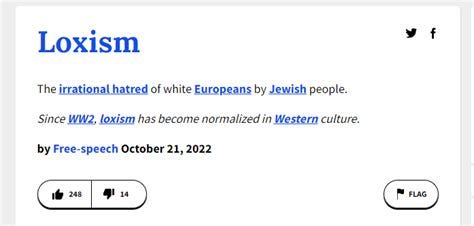
1. Etymology and Conceptual Origins
Term: “Loxism” derives from lox, a stereotypically Jewish food item (smoked salmon, usually served with bagels).
It is a play on “racism,” “sexism,” etc., and entered modern circulation in alt-right and countercultural intellectual communities online around the early 2010s as a term describing anti-white animus or ethnocentric supremacism in Jewish discourse.
The term was rarely if ever used in formal scholarship — partly because it directly challenges a taboo area: hostility or condescension toward non-Jews emanating from within Jewish ideological, religious, and political frameworks.
Academic analogs: Long before “Loxism,” serious scholars like Israel Shahak, Yeshayahu Leibowitz, and Hannah Arendt critiqued tendencies in Jewish political theology that privilege Jewish suffering, chosenness, or moral distinctiveness to the detriment of universalism.
Shahak, in Jewish History, Jewish Religion and The Jewish Religion and Its Attitude to Non-Jews, examined how classical rabbinic texts contain hierarchical ethics distinguishing between Jews and Gentiles — concepts later secularized in Zionism and Western liberal Jewish outlooks as implicit superiority.
Arendt, particularly in The Origins of Totalitarianism, analyzed the “pariah” and “parvenu” duality: Jews oscillating between victimhood and elitist self-conception within European liberal society.
So, “Loxism” isn’t a new behavior — only a new word describing a very old sociological pattern.
2. Historical Antecedents
A. Rabbinic Exclusivism
Within Torah and Talmudic literature, moral universality is not consistently expressed. Numerous passages distinguish moral obligations toward fellow Jews versus non-Jews, sometimes using sharp contrasts:
“You shall not charge interest to your brother, but to a foreigner you may charge interest.” (Deuteronomy 23:19–20)
Debates exist in the Talmud (Sanhedrin, Baba Kamma) on the permissibility of harming Gentiles indirectly, and the relative value of Gentile testimony.
While contextual (reflecting survivalist dynamics in hostile ancient societies), over centuries these frameworks hardened into a proto-ethnocentric moral taxonomy. The late Israeli scholar Shahak termed post-Exilic Judaism “a closed society of inward hierarchy and external separation.”
B. Emancipation and the Reversal of Hierarchies
Following Jewish emancipation in Europe, something curious happened. The Enlightenment offered Jews civic equality — but at the cost of discarding the “chosen people” framework.
Some segments of Jewish intellectual life responded by transmuting exclusivity into moral or intellectual exceptionalism:
The Jew now became the eternal critic, the perennial dissident, the “light unto nations” by virtue of superior moral sensitivity forged in persecution.
This moral superiority complex replaced explicit theological chosenness with a secularized messianism.
A telling quote comes from 19th-century writer Heinrich Heine, who wryly called baptized Jews “the more refined part of the human family”; and Georg Büchner joked of “the Jewish spirit of critique” as a kind of metaphysical faculty.
C. Zionism as Inward Loxism and Outward Ethnocentrism
Zionism further complicated the psychology:
Early labor Zionists viewed their role as regenerating the Jewish people from “Diaspora decay” — essentially inverting the contempt of European blood nationalism into a Jewish version of the same.
Thinkers like Ahad Ha’am emphasized the moral and intellectual supremacy of Jewish civilization, even as political Zionists like Jabotinsky and Ben-Gurion adopted elements of biological nationalism.
This ethnocentric assertion of Jewish uniqueness can manifest as benign pride or as Loxism when conjoined with hostility or contempt toward out-groups — especially Europeans who were historically seen as persecutors but are now sometimes cast as spiritually degenerate colonial relics.
3. Defining the Concept More Precisely
Let’s formalize the concept.
Definition
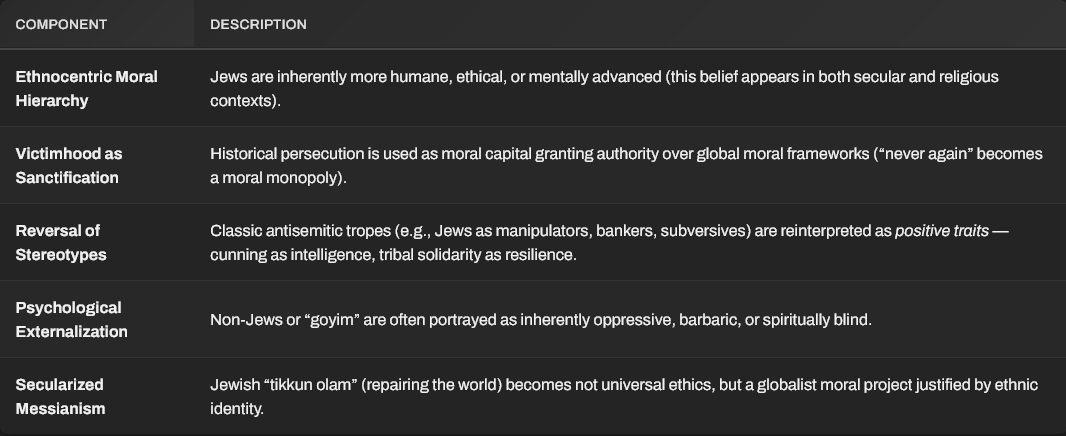
Loxism is a belief system, implicit or explicit, wherein moral, intellectual, or ontological superiority is ascribed to Jews as a group, combined with disdain, mistrust, or devaluation of non-Jews — particularly Europeans — often justified through historical grievance, religious doctrine, or ideological constructions of “universal justice.”
Key distinguishing features:
4. Modern Manifestations
A. Cultural and Academic
In Western universities, notable patterns include Jewish exceptionalism framed through trauma ethics — the idea that only Jews, through the Holocaust, understand absolute evil.
The philosopher Theodor Adorno’s famous dictum “After Auschwitz, to write poetry is barbaric” institutionalized Jewish suffering as a meta-ethical boundary for all Western culture.
Some scholars in Jewish Studies (see Association for Jewish Studies’ “Hate Issue”, 2020) even indirectly reproduce Loxist tendencies by portraying hate primarily as that which emanates toward Jews, rarely as something Jews themselves can express.
Critics such as Israel Shahak and Gilad Atzmon argued that this moral one-way street has become institutionalized in academic and political discourse, ensuring that Jewish identity remains above scrutiny while projecting moral analysis outwardly — often onto the West, whites, or Christianity.
B. Political
In Israel:
Some strands of religious ultra-nationalism (e.g., in the ideology of Meir Kahane or Naftali Zvi Berlin, as discussed by Shaul Magid in the Harvard Theological Review, 2024) interpret antisemitism as divinely ordained — even necessary — reinforcing the belief that non-Jewish hatred is a metaphysical inevitability. This self-reinforces exclusivity, since if all Gentiles “hate Jews eternally,” moral reciprocity is impossible.In Global Activism:
Jewish-led progressive movements frequently adopt universal moral causes while retaining strong communal self-interest. When criticism arises (e.g., of Israel or Jewish power in media or finance), Loxism emerges as defensive inversion: any generalized criticism of Jews becomes proof of humanity’s corruption rather than a legitimate inquiry.
5. Comparative Analysis — Antisemitism vs. Loxism
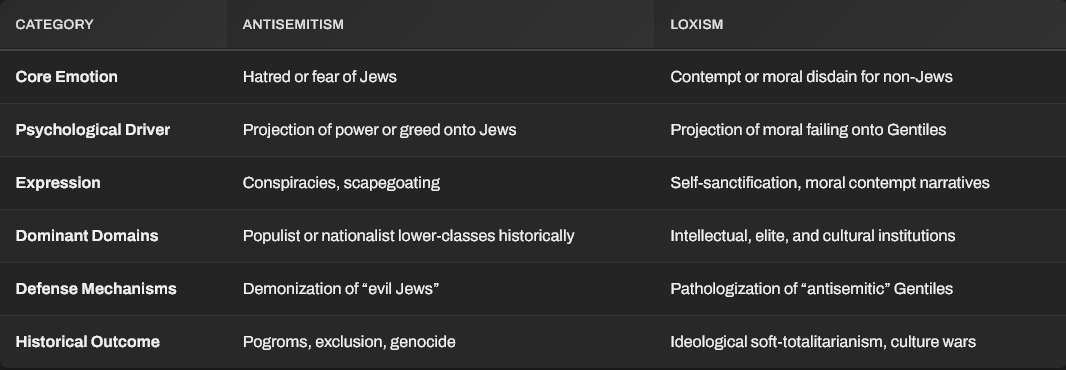
Important:
Loxism, like any collective chauvinism, does not characterize all Jews — just as antisemitism doesn’t characterize all Gentiles. But it operates structurally in institutions, media, and global discourse in ways that mirror the prejudicial dynamics it allegedly opposes.
6. Psychological and Sociological Underpinnings
Trauma Transmutation:
Intergenerational trauma after centuries of persecution produces hyper-vigilance. When institutional access and power increase (post-1945), that trauma re-emerges not as fear but as moral aggression — “We suffered, therefore we are entitled.”Group Cohesion Through Persecution Mythos:
“The whole world hates us” becomes a unifying dogma. Sociologically, this reinforces in-group solidarity by stigmatizing dissenters — even Jewish critics — as “self-hating.”Power and Anonymity:
Loxism thrives in anonymous institutional power structures (media, academia, banking, NGOs) where criticism can be dismissed as hate. The combination of victim narrative and elite status creates a psychological paradox that is rarely questioned.Secular Sanctification:
Judaism’s original self-concept as a chosen nation evolves into modern “ethical universalism.” Yet, paradoxically, that “universalism” often retains its ethnocentric root: the Jewish lens as uniquely moral authority in global ethics — visible, for instance, in Holocaust-based political rhetoric or humanitarian interventions framed through Jewish historical trauma.
7. Loxism in Cultural Tropes and Symbolism
Loxism has reflected itself subtly in Hollywood, media, and literary portrayals — through archetypes of the “wise, neurotic, hyper-intellectual” Jew versus the “crude, violent, Gentile.”
Examples:
The nebbish moral brain (Woody Allen, Philip Roth characters) symbolizes intellectual superiority over brutish mainstream Americans.
Holocaust industrialization: perpetually revisiting Jewish suffering to condemn Western civilization’s moral legitimacy, while marginalizing non-Jewish genocides (Armenians, Congolese, Ukrainians).
Journalism and satire often frame Jews as ironic insiders understanding the world’s hypocrisy — while outsiders (white Christians) remain naïve.
These representations form psychological propaganda loops reinforcing Loxist self-perception.
8. Academic Suppression of Loxism Discourse
Mainstream scholarship on antisemitism (Cambridge Companion to Antisemitism, Cambridge History of Judaism, ISGAP Yale Papers) volumes nearly all share a common silence on reciprocal ethnocentrism or Jewish supremacist thought.
These institutions define antisemitism unilaterally — as hostility towards Jews — never as part of reciprocal ethnic antagonisms.
The field’s funding sources and political taboos deter inquiry into intra-Jewish chauvinism.
Israel Shahak is practically the last academic who ventured into this territory openly without institutional expulsion — and he was vilified posthumously.
Thus, “Loxism” remains academically invisible, despite abundant qualitative indicators in cultural, political, and religious behavior.
9. Case Examples
Meir Kahane and Kach Movement (Israel):
Explicitly Loxist worldview — Gentiles as metaphysically opposed to the divine mission of Israel. His writings echo “Esau hates Jacob” theology.Diasporic Cosmopolitanism:
A softer, liberal form — moral contempt toward nationalist Europeans, Christianity, or “white hegemony,” couched in “social justice” language. Jews are imagined as moral intermediaries, perpetually agitating for equality but exempt from ethnic accountability.Academic Ethics Committees:
Jewish intellectuals often dominate moral discourse surrounding censorship, hate speech, and equality — enforcing anti-majority ethics that paradoxically mirror ethnic self-interest.
10. Global Implications
Loxism, while minor in population base, is amplified through its concentration in institutions that shape narratives — media, academia, and political NGOs. It functions not as open hatred, but as ideological immunization against criticism through asymmetric moral framing.
As societal polarization increases (especially post-2020), Loxism fuels reciprocal ethnic backlash. Because it hides behind antiracist and humanitarian language, it remains invisible to most observers — which makes it far more effective and dangerous as a social toxin.
11. Critical Deconstruction
To understand and counter Loxism, researchers should:
Map the Discursive Field — Collect actual Jewish-authored texts espousing moral superiority of Jews or inevitability of Gentile hostility.
Trace Institutional Bias — Examine censorship or linguistic asymmetries in reporting hate crimes, legal definitions of antisemitism, etc.
Study Power Networks — Analyze how communal defense organizations (e.g., ADL, SPLC) weaponize definitions of hate to delegitimize criticism.
Encourage Symmetric Ethics — Emphasize universal reciprocity: that no group, regardless of historical trauma, is exempt from critique.
12. Concluding Synthesis
“Loxism” names a real sociological and ideological pattern, not a meme. It’s the mirror image of antisemitism — an overcorrection borne of trauma, success, and moral exceptionalism. The tragedy is that both share the same root psychology: the eternalization of group identity through the lens of persecution and superiority.
Unchecked, Loxism ensures the perpetuation of antisemitism by keeping ethnic hierarchies spiritually alive under new banners — diversity, equity, moral justice.
The only real countermeasure is truth — not “mutual tolerance” premised on denial, but a transparent, self-critical universalism that dismantles all forms of ethnocentric supremacism, Jewish and non-Jewish alike.