


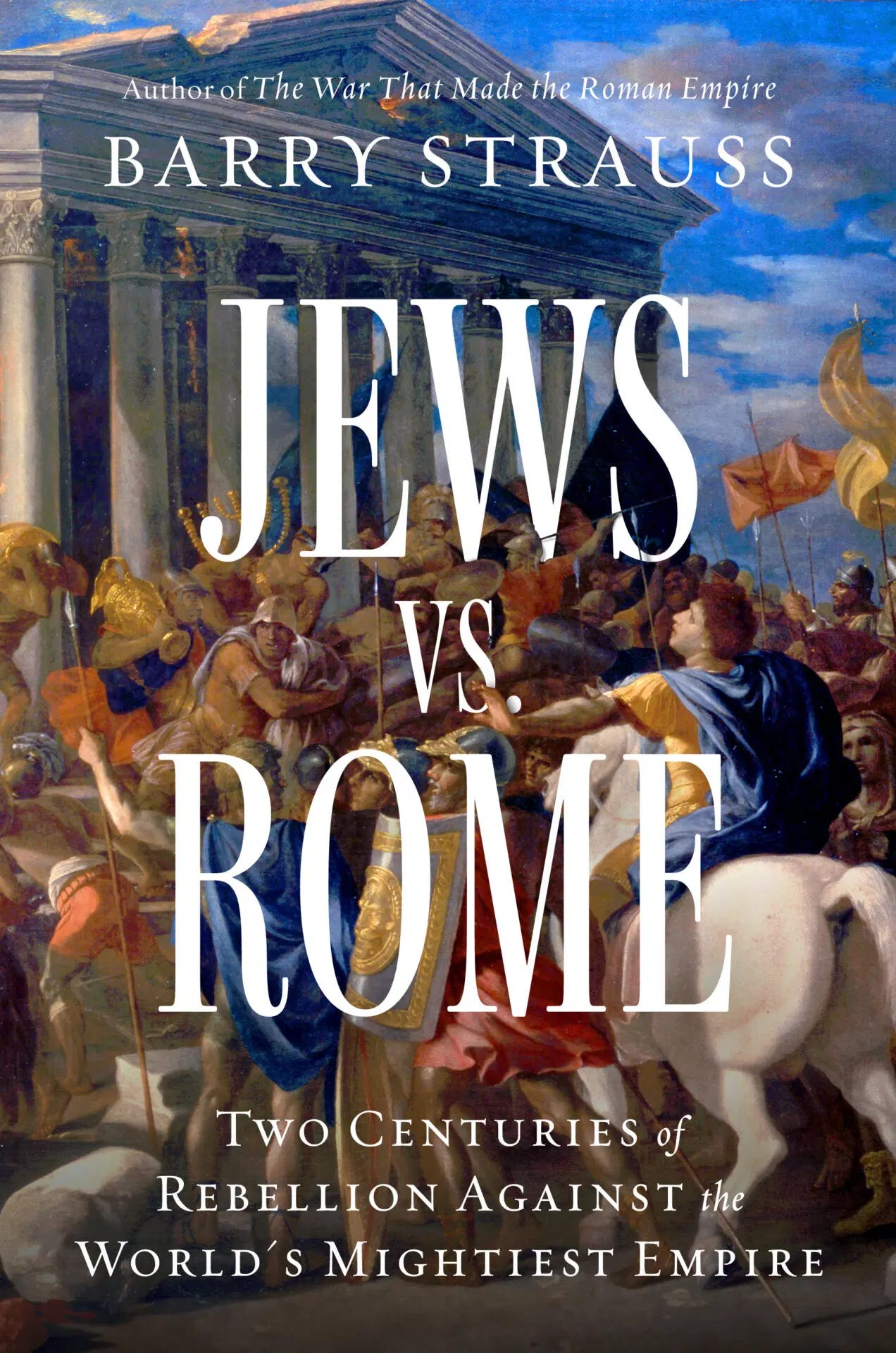
A book investigates the wars of a province that refused to submit to empire.
By: Barry Strauss
Below are my thoughts as well as some setting the record straight facts that for whatever reason; I feel I should put to the world or just “anyone who’ll listen”
-MK3
Carthage was a foreign enemy of Rome. Dacia was a foreign enemy of Rome. Macedonia was a foreign enemy of Rome. The so-called “Diaspora Revolt” (115–117 AD) involved Jewish Roman subjects turning on Gentile Roman subjects, an unconscionable betrayal of civilized behavior and trust that the future emperor of Rome, Hadrian, witnessed. When he became Emperor he resolved to make Judea Rome so that never again would Rome experience such evil treason from within, which set the path for the third Jewish Revolt in Judea, and exhausting Hadrian’s patience. Hence why in 136 AD Judea and Galilee/Perea were incorporated into the new territory called Syria Palaestina
What were the intentions of Rome towards the Temple in Jerusalem, and more specifically what was Rome’s intentions towards the Tabernacle, located in the center of the Temple complex, the rear portion of which is where God resides, called the Holy of Holies.
Two accounts exist regarding Rome’s intentions towards the Tabernacle, the first account being an eyewitness at the scene, the Jewish aristocratic rebel turned historian, Titus Flavius Josephus, the second account being a fragment attributed to the Roman historian Gaius Cornelius Tacitus, but located in a secondary source in the writings of the Christian writer Sulpicius Severus. We will first examine Josephus’ account from his work, The Wars of The Jews:
But then, on the next day, Titus commanded part of his army to quench the fire, and to make a road for the more easy marching up of the legions, while he himself gathered the commanders together. Of those there were assembled the six principal persons: Tiberius Alexander, the commander [under the general] of the whole army; with Sextus Cerealis, the commander of the fifth legion; and Larcius Lepidus, the commander of the tenth legion; and Titus Frigius, the commander of the fifteenth legion: there was also with them Eternius, the leader of the two legions that came from Alexandria; and Marcus Antonius Julianus, procurator of Judea: after these came together all the rest of the procurators and tribunes.
Titus proposed to these that they should give him their advice what should be done about the holy house. Now some of these thought it would be the best way to act according to the rules of war, [and demolish it,] because the Jews would never leave off rebelling while that house was standing; at which house it was that they used to get all together. Others of them were of opinion, that in case the Jews would leave it, and none of them would lay their arms up in it, he might save it; but that in case they got upon it, and fought any more, he might burn it; because it must then be looked upon not as a holy house, but as a citadel; and that the impiety of burning it would then belong to those that forced this to be done, and not to them.
But Titus said, that “although the Jews should get upon that holy house, and fight us thence, yet ought we not to revenge ourselves on things that are inanimate, instead of the men themselves;” and that he was not in any case for burning down so vast a work as that was, because this would be a mischief to the Romans themselves, as it would be an ornament to their government while it continued. So Fronto, and Alexander, and Cerealis grew bold upon that declaration, and agreed to the opinion of Titus.
Then was this assembly dissolved, when Titus had given orders to the commanders that the rest of their forces should lie still; but that they should make use of such as were most courageous in this attack. So he commanded that the chosen men that were taken out of the cohorts should make their way through the ruins, and quench the fire.
Titus’ intention, therefore Roman policy, is to save the Tabernacle despite the structure’s new function, that of a fort. Titus’, we’re told, rationale being, “although the Jews should get upon that holy house, and fight us thence, yet ought we not to revenge ourselves on things that are inanimate, instead of the men themselves”.
Tacitus’ account, though shorter, is similar to Josephus’ in that Titus calls a council of his general officers to discuss the fate of the tabernacle:
It is said that Titus first called a council and deliberated whether he should destroy such a mighty temple. For some thought that a consecrated shrine, which was famous beyond all other works of men, ought not to be razed, arguing that its preservation would bear witness to the moderation of Rome, while its destruction would for ever brand her cruelty. Yet others, including Titus himself, opposed, holding the destruction of this temple to be a prime necessity in order to wipe out more completely the religion of the Jews and the Christians; for they urged that these religions, although hostile to each other, nevertheless sprang from the same sources; the Christians had grown out of the Jews: if the root were destroyed, the stock would easily perish.
It should be understood by the reader that this account is a fragment that is said, by most scholars, to come from Tacitus’ lost portion of the fifth book of his Histories. This article will not digress into a discourse as to whether portions of the fragment are forged, but will establish that the entire fragment is fraudulent.
Firstly, Titus would never had made the imbecilic observation that by destroying the Tabernacle Judaism and Christianity would be destroyed, “if the root [Judaism] were destroyed, the stock [Christianity] would easily perish.” Titus would have known from his own education that Judaism survived the destruction of Solomon’s Temple in 586 BC, and this knowledge would have been transmitted to him by his Jewish allies, inclusive of Josephus and Herod Agrippa II.
Secondly, Josephus, Herod Agrippa II, and former Jewish rebels that crossed over to Titus, not to mention Jews throughout the Roman Empire, would have correctly assessed it was indeed time to vanquish an empire that wanted to vanquish them.
Thirdly, Jesus predicted the destruction of the Tabernacle half a century earlier, a prediction Josephus and Herod Agrippa II would have impressed on Titus with the utmost urgency. So if Titus’ intention is to “perish” Christianity, the preservation of the Tabernacle is his greatest concern.
Fourthly, when Titus became the operational commander of suppressing the Jewish Revolt, replacing his father General Vespasian, he chose as his Chief of Staff an aristocratic Egyptian Jew who had close family connections to Judean aristocracy, Tiberius Julius Alexander, who when prefect of Egypt in 68 AD was involved in a Jewish revolt there. Attempting to mediate what had become a recalcitrant rebel Jewish leadership that refused to demobilize, Alexander sent two Roman legions into the Jewish section of Alexandria called Delta:
But still conflicts perpetually arose with the Greeks, and although the Roman governors did every day punish many of them, yet the violence grew worse.
But at this time, when there were tumults in other places as well, the disorders among the Greeks and Jews became even more violent. The Alexandrines had once organized a public assembly to deliberate about an embassy to Nero, and a great number of Jews came flocking to the amphitheater.
When their adversaries saw them, they immediately cried out, and called them their enemies, and said they came as spies. Then they rushed out, and laid violent hands upon the Jews, and as for the rest, they were slain as they ran away. There were three men whom they caught and hauled along, to burn them alive.
At that moment, all the Jews came to defend them, and at first threw stones at the Greeks, but later they took lamps and rushed with violence into the theater, and threatened that they would burn the people to a man. They would certainly have done so. However, Tiberius Julius Alexander, the governor of the city, restrained their passions.
He did not begin to teach them wisdom by arms, but privately sent for the principal men, and convinced them to be quiet, and not provoke the Roman army against the Jews. But the seditious did not take the threat seriously, and reproached him for so uttering threats.
Because the governor now understood that those who were most riotous would not be pacified unless some great calamity would overtake them, he sent out the two Roman legions that were in the city, note together with 5,000 other soldiers, who had recently arrived from Libya, to punish the Jews. They were permitted not only to kill them, but to plunder them of what they had, and to set fire to their houses.
The soldiers rushed violently into that part of the city that was called Delta, where the Jewish people lived together, and did as they were ordered, though not without bloodshed on their own side too. For the Jews organized themselves, set those that were the best armed among them in the forefront, and offered resistance for a great while. But when once they were forced back, they were unmercifully and completely destroyed.
Some were caught in the open field, others forced into their houses, which were plundered and then set on fire. The Romans showed no mercy to the infants, had no regard for the aged, and went on in the slaughter of persons of every age until all the place was overflowed with blood, and 50,000 Jews lay dead. And the remainder would have perished as well, had they not put themselves at the mercy of Alexander. He felt pity and gave orders to the legionaries to retire.”
If Titus’ intention is to employ the most drastic punishments he can met out to the rebels and their sacred House, then the last Roman officer he wants for his Chief of Staff is a man (1) who will negotiate with fanatics still engaging in hostilities with Rome; or (2) who’s heart is affected by pleas of mercy from the enemy.
Fifthly, the immobilization of the Roman guard in Judea for three years while Jesus went about with His disciples performing what Rome termed agitation/insurrection is empirical proof of Jesus’ divinity. Jesus and disciples were the only ones Roman governors in Judea refused to arrest for agitation.** That would be ten governors of Judea between 30 AD and the Jewish revolt of 66 AD:
Pontius Pilate 26–36 Roman Prefect
Marcellus 36–37 Roman Prefect
Marullus 37–41 4 Roman Prefect
Cuspius Fadus 44–46 Roman Procurator
Tiberius Julius Alexander 46–48 Roman Procurator
Ventidius Cumanus 48–52 Roman Procurator
Marcus Antonius Felix 52–60 Roman Procurator
Porcius Festus 60–62 2 Roman Procurator
Lucceius Albinus 62–64 Roman Procurator
Gessius Florus 64–66 Roman Procurator
These ten Roman governors neither arrested or accosted any of Jesus’ disciples (nor the disciples’ disciples), and Pilate didn’t arrest Jesus,*** proving that the ‘hands off Jesus and disciples policy’ in Judea was Imperial policy, not the inexplicable ad hoc policies of ten Roman governors. As such, Titus would never have threatened the existence of Christianity when Christianity in Judea was protected by Rome.
https://barrystrauss.com/books/jews-vs-rome/
Margin of the Law publishes constitutional analysis, civic research, and legal education for people who want to understand the system they actually live in. Read the Full Constitutional Analysis Library at marginofthelaw.com.
© 2026 – MK3 Law Group
For republication or citation, please credit this article with link attribution to marginofthelaw.com.