


In politics nothing gets done until you first create a channel of corruption.
— Jesse Cuellar, cynical observer of the political scene, 1982
Introduction
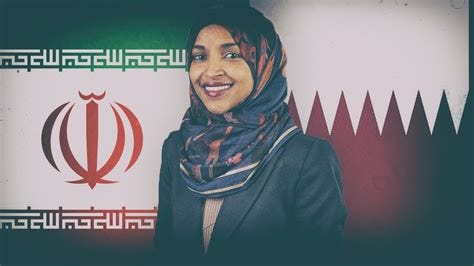
In late 2019, several foreign and independent media outlets — Al Arabiya, The Jerusalem Post, i24News, Iran International, and Fox13 Tampa — reported a stunning claim: U.S. Representative Ilhan Omar (D-MN) had allegedly been recruited and funded by the Qatari government, a regime accused of sponsoring Islamist networks across the West.
The allegation surfaced through sworn testimony given by Alan Bender, a Kuwaiti-born Canadian businessman, during a Florida lawsuit involving Sheikh Khalid bin Hamad al-Thani, the brother of Qatar’s former emir. Bender testified that Qatari intelligence officials had told him Omar was one of their key assets, used to funnel “sensitive U.S. information” through to Iran — a statement that, if true, would constitute one of the most severe cases of political infiltration in American history.
Predictably, the corporate media buried the story or framed it as Saudi disinformation. Yet the deposition exists. The lawsuit was real. And Omar herself has never been subjected to a formal congressional inquiry over the matter. Six years later, questions linger — not simply about her, but about the broader failure of congressional oversight and transparency when foreign intelligence operations intersect with domestic politics.
Background
To understand the origins of this controversy, we need to examine the 2019 Florida lawsuit:
Plaintiffs: Matthew Pittard and Matthew Allende, both American bodyguards employed by Sheikh Khalid bin Hamad al-Thani.
Allegations: wrongful imprisonment, solicitation to commit murder, and unpaid wages.
Venue: U.S. District Court, Middle District of Florida.
Outcome: voluntarily dismissed without prejudice in January 2020.
Bender was deposed in this case via video link from Canada. His testimony, later obtained by Al Arabiya English and verified as part of the official case file by the plaintiffs’ attorney, alleged extensive attempts by Qatari intelligence to recruit American politicians and journalists.
According to Bender: “If it wasn’t for our cash, Ilhan Omar would be just another black Somali refugee in America collecting welfare and serving tables on weekends.”
The statement, while explosive and racially vulgar, aligns disturbingly with Qatar’s documented efforts to finance Western political influence, from think tanks in Washington D.C. to universities like Georgetown and Brookings.
Key details from the deposition (summarized across sources):
Omar was allegedly “recruited from even before she thought about becoming a government official.”
She allegedly met with Turkey’s President Erdoğan in 2017 and swore allegiance to him (which Omar’s office denies).
Qatar’s officials supposedly referred to her as the “jewel of the crown.”
Sensitive congressional information was allegedly relayed through Qatar “and then to Iran.”
Bender named other alleged Qatari assets, including activist Linda Sarsour and political advisor Jared Kushner, further muddying the geopolitical picture.
These claims drew instant fire. Corporate media Lead Stories, Snopes, and Washington Examiner framed them as “Saudi propaganda,” noting Bender’s past association with anti-Qatari figures. Yet none of those outlets disproved the existence or content of the sworn deposition — they dismissed its credibility, not its authenticity.
Evidence
1. Court Record Validity
The lawsuit did exist (Case No. 8:19-cv-01861, M.D. Fla.).
The deposition was admitted into discovery.
The case’s voluntary dismissal means its evidence was never adjudicated, not disproven.
Media outlets such as Fox13 Tampa and The Jerusalem Post confirmed receiving and verifying the transcript through the plaintiffs’ legal team.
2. Bender’s Background
Alan Bender has business links with Gulf royals, including Saudi contacts.
His claim to have been approached by Qatar to recruit politicians for “influence operations” aligns with what intelligence analysts have documented since 2014: Qatar’s extensive funding of soft-power influence networks, especially in the U.S. and U.K.
3. Qatar’s Strategic Motive
Qatar has long balanced ties between Iran, the U.S., and Islamist movements such as the Muslim Brotherhood.
Controlling sympathetic figures in Congress would serve multiple ends: influence U.S. policy on sanctions, arms sales, and the geopolitics of the Gulf.
4. Ilhan Omar’s Documented Ethical Issues
Separate from the Qatar claims, Rep. Omar has:
Been fined for campaign finance violations (Minnesota Campaign Finance Board, 2019).
Directed hundreds of thousands in campaign payments to a consulting firm tied to her romantic partner (now husband) Tim Mynett.
Shown consistent alignment with Qatari and Turkish foreign policy positions, including opposition to sanctions and leniency toward Muslim Brotherhood affiliates.
5. 2026 Development: New Financial Questions
According to a January 2026 ABC News 4 (WCIV) report, Omar’s disclosed assets jumped from under $250,000 in 2023 to as much as $30 million in 2024, primarily through vague holdings in a “winery and venture capital firm.”
Even under loose congressional reporting brackets, this represents a wealth spike of over 100x in a single year — coinciding suspiciously with renewed Gulf investments in American venture capital pipelines.
Qatari Political‑Influence Structure in the West:
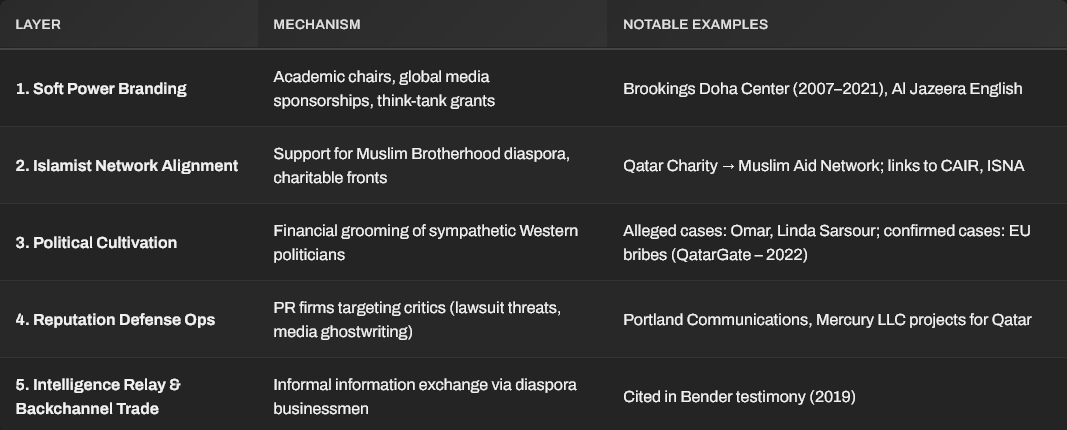
This network operates like a three‑tiered funnel: cash flows → ideological alignment → policy leverage.
Analysis
Let’s separate fact from probability:
Confirmed Facts:
A deposition under oath named Ilhan Omar as a Qatari affiliate.
The deposition was entered into a real U.S. court case.
Qatar has historically used soft-power and financial infiltration to leverage Western elites.
Omar’s wealth, political connections, and foreign policy voting patterns raise legitimate transparency issues.
Strong Indicators:
Qatar’s liaison mentioned by Bender (Mohammed Al-Masnad, Secretary to the Emir for Security Affairs) is a real official known to run “security diplomacy” across the Gulf.
Similar influence operations have been documented — e.g., lobbying by Nick Muzin, a U.S. consultant later revealed to have received $3 million from Qatar to influence GOP policy.
Omar’s staunch opposition to listing the Muslim Brotherhood as a terrorist organization — a position shared by Doha and Ankara — follows Qatar’s strategic priorities.
Speculative Elements:
Alleged direct payments or “sensitive intel transfers” have not been corroborated by financial or intelligence records accessible to the public.
The degree of communication between Omar, Qatari intermediaries, and Iran remains unproven.
Still, the pattern of financial opacity and foreign alignment cannot be ignored. Congress’s ethics regime allows members to report assets in enormous ranges (e.g., $5–25 million), making concrete tracing of wealth origins impossible. This loophole effectively launders influence through disclosure compliance.
Counterarguments
Pro-Omar and mainstream rebuttals (2020–present):
“Saudi propaganda” angle: outlets such as Lead Stories claimed the story was part of Riyadh-Doha disinformation warfare. However, this avoids addressing whether the deposition reflects genuine intelligence operations. Disinformation campaigns can contain real information.
No official charges: absence of investigation does not equal innocence — particularly when political self-preservation shields members of Congress from scrutiny.
Credibility of Bender: critics point to his ties to Saudi Arabia, but his account was corroborated in parts by Kuwaiti activist Dr. Abdullah al-Saleh, who publicly asserted that Bender’s claims matched his own experiences with Qatari operations.
These counterpoints matter — yet none fully dismantle the possibility of partial truth embedded in the allegations.
Conclusion
The Ilhan Omar–Qatar case remains an open wound in American transparency, emblematic of Congress’s inability — or unwillingness — to police itself. Whether or not Omar personally acted as a “Qatari asset,” her trajectory illustrates how foreign influence easily coexists within the U.S. political infrastructure:
Lobbyists register as “consultants.”
Donations wash through PACs and LLCs.
Financial disclosures obscure more than they reveal.
In the absence of independent audits or forensic tracing of congressional wealth, the public can never know with certainty whether lawmakers act on behalf of their constituents or their “international benefactors.”
Rep. Omar’s unexplained explosion of personal wealth, coupled with longstanding claims of foreign grooming, demands an independent investigation — not by partisan committees, but by a special counsel operating outside legislative control.
Until Congress enacts mandatory conflict-of-interest audits and precise wealth declarations, America’s political system will remain vulnerable to state-sponsored subversion — whether by Qatar, Saudi Arabia, or domestic interests hiding behind the same curtain of secrecy.
The Omar affair, dismissed as rumor in 2019, may one day be remembered as the first visible crack in the façade of congressional financial integrity.
Are these the reasons why Ilhan Omar seems untouchable?