

When companies can injure the public with impunity, “health policy” is no longer science — it’s indemnity engineering.
“Every time the state expands corporate immunity, it contracts public trust.”
— Independent legal scholar, 2025
The Forgotten Beginning: When Vaccine Makers Were Accountable
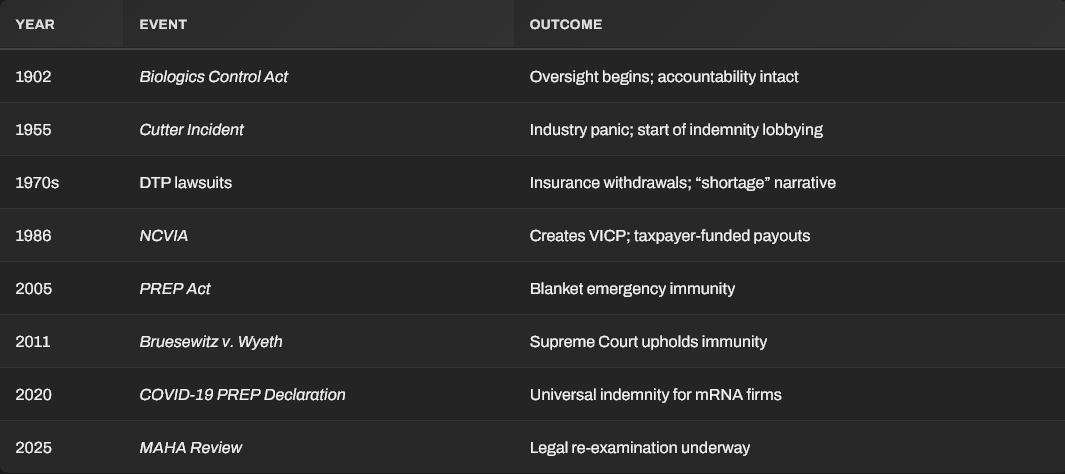
At the turn of the 20th century, vaccine manufacturers stood on equal footing with every other product maker: if their serum injured or killed someone, they faced a jury of citizens. After a contaminated smallpox vaccine in 1901 killed thirteen children in St. Louis, Congress passed the Biologics Control Act of 1902, emphasizing purity and oversight—but stopping far short of indemnity. For decades, accountability remained possible. When the Cutter Incident of 1955 left 200,000 children paralyzed or infected with live poliovirus, Cutter Laboratories was successfully sued. The precedent was clear: negligence had consequences.
But as vaccination became widespread and legally mandated, liability expanded too. Through the 1970s, a flood of lawsuits over DTP-induced seizures and encephalopathy rattled the industry. Insurers withdrew, manufacturers quit the market, and officials warned of “vaccine shortages.” In reality, the shortage narrative became a political cudgel — a way to demand that Washington, not juries, control the future of vaccine adjudication.
1986: The Birth of the Untouchables
The pressure campaign culminated with the National Childhood Vaccine Injury Act (NCVIA) of 1986. Sold as a balance between innovation and safety, it replaced civil lawsuits with a specialized tribunal — the Vaccine Injury Compensation Program — funded not by companies, but by taxpayers. Vaccine makers were granted near-total immunity from design-defect claims. Over time, the Department of Justice, acting as the program’s counsel, began fighting claimants rather than supporting them. The result was a soft coup: injury responsibility shifted from producers to the public itself.
Then came the PREP Act of 2005, the second shield, wrapped in the language of counterterrorism. Under this statute, any medical countermeasure deployed during a “public health emergency” — whether a vaccine, mRNA shot, or experimental therapy — carried blanket immunity. Once a Secretary of Health declaration was filed, no citizen could sue a manufacturer, distributor, or administrator except in near-impossible cases of “willful misconduct.” Since then, this emergency switch has become the standard business model for the biotech era.
2020–2025: The Apex — and the Backlash
When COVID-19 struck, the PREP Act automatically activated. Every manufacturer involved in mRNA vaccine production became untouchable. The Countermeasures Injury Compensation Program (CICP)—a bureaucratic cousin of the 1986 system—processed a trickle of claims, denying almost every one. Yet the same pandemic that obliterated small businesses delivered $100+ billion in vaccine profits to Pfizer and Moderna.
Now, under the Make America Healthy Again (MAHA) initiative, President Trump and HHS Secretary Robert F. Kennedy Jr. are examining whether America’s indemnity structure is unconstitutional. Congressional hearings have reopened archived safety data and questioned whether blanket immunity suppresses genuine innovation. It is the first serious attempt since Reagan’s second term to re-link risk with responsibility. The answer will decide whether “public health” returns to meaning public safety — or remains an accounting term for privatized immunity.
Sidebar: The Liability Timeline, Condensed
“Accountability and safety rise and fall together — remove one, and the other becomes theater.”
The Reckoning Ahead
A civilization’s health law mirrors its values. For 120 years, America’s vaccine liability framework evolved from private accountability to systemic immunity — a transformation achieved not by medical discovery but by legislative alchemy. The debate in 2025 is therefore not about being “pro” or “anti” vaccine; it’s about whether any corporation should ever operate beyond the reach of law. If the current review succeeds, it could restore scientific transparency, rebuild trust, and remind the world that responsibility is not a barrier to progress — it is the foundation of it.