

Franklin Delano Roosevelt remains one of the most consequential figures in American history. The standard narrative portrays him as democracy’s savior, the steady hand who guided America through the Great Depression and World War II. This assessment requires serious revision.
When examined through the lens of actual outcomes—the bankruptcy of Britain, the empowerment of Soviet communism, the fundamental transformation of American governance, and the documented infiltration of his administration by foreign agents—a different picture emerges. The ledger shows tens of millions dead under communist regimes that American policy enabled. That’s not hyperbole. That’s documented history.
Franklin Delano Roosevelt’s family ties are well known: The nation’s 26th president, Theodore Roosevelt, was his fifth cousin, and he married his fifth cousin once removed, Eleanor Roosevelt. But FDR was related to 10 other presidents, five by blood and six by marriage: John Adams, James Madison, John Quincy Adams, Martin Van Buren, William Henry Harrison, Zachary Taylor, Andrew Johnson, Ulysses S. Grant, Benjamin Harrison, and William Howard Taft.
The Transformation of American Governance
Before World War II demanded attention, Roosevelt had already fundamentally altered the American system of government. His New Deal programs represented more than economic recovery efforts. They constituted a deliberate restructuring of the relationship between citizens and the federal government.
Roosevelt understood a principle that crisis managers throughout history have recognized: emergencies create opportunities for systemic change that would be impossible under normal circumstances. While American families lost farms and stood in bread lines, the Roosevelt administration was engineering a new model of federal power.
Documentary evidence and contemporary accounts indicate that New Deal funds were distributed according to political calculations. Jurisdictions and localities that opposed Roosevelt’s agenda found themselves receiving reduced allocations. Communities that maintained traditional American principles of self-reliance and limited government experienced delays and obstacles in accessing federal relief programs.
This pattern was not random. Counties that supported FDR received infrastructure projects, employment programs, and direct assistance. Counties that voted against him watched neighboring regions prosper while their own populations struggled. Federal patronage, once limited to political appointments, expanded into a continental system of ideological reward and punishment.
The funds flowed primarily to individuals and organizations that embraced New Deal philosophy. Those who promoted expanded federal authority and centralized economic planning received support. Those who resisted found themselves marginalized. This created a self-reinforcing cycle that gradually shifted American political culture toward acceptance of federal intervention.
The confrontation with the Supreme Court in 1937 demonstrates Roosevelt’s approach to institutional resistance. The court-packing scheme—his proposal to add additional justices for every sitting justice over seventy—is often characterized as a political failure. This interpretation misses the strategic outcome.
Roosevelt did not need to pack the Court. The threat proved sufficient. The “switch in time that saved nine,” when Justice Owen Roberts changed his position on New Deal legislation, was not coincidental. The Supreme Court, designed as a check on legislative and executive overreach, learned that sustained resistance to executive power carried institutional consequences. This lesson shaped judicial behavior for generations.
The cumulative effect of New Deal policies was the replacement of the previous American system—characterized by limited federal authority, local autonomy, and individual self-reliance—with the administrative state that exists today. Federal agencies multiplied, regulatory authority expanded, taxation increased, and Americans increasingly looked to Washington rather than their communities for solutions to social and economic problems.
The alphabet agencies created during this period did more than administer programs. They established dependencies. Functions previously performed by churches, mutual aid societies, extended families, and local communities were absorbed by federal bureaucracies. The transformation was structural and permanent.
Soviet Penetration of the Roosevelt Administration
The presence of Soviet agents and sympathizers within the Roosevelt administration has moved from controversial allegation to documented fact. Soviet archives opened after the Cold War, the Venona project’s decryption of Soviet communications, and testimony from defectors have confirmed infiltration that exceeded contemporary estimates.
Harry Hopkins occupied a unique position in American government. He lived in the White House, served as Roosevelt’s closest advisor, directed major New Deal programs, and later managed American wartime relations with both Britain and the Soviet Union. Multiple intelligence sources, including Soviet defector Oleg Gordievsky, identified Hopkins as Agent 19 of Soviet intelligence.
The implications are substantial. The individual most responsible for implementing domestic policy and managing Allied relations was, according to intelligence assessments, providing information to Moscow. His access to Roosevelt was unlimited. His influence on policy was extensive.
Whittaker Chambers, himself a former Soviet operative, exposed networks of Soviet agents throughout the federal bureaucracy in his book “Witness” and in Congressional testimony. Chambers provided names, evidence, and documentation. The establishment he had penetrated attacked his credibility and character.
Subsequent evidence vindicated Chambers. The Venona decryptions confirmed that Soviet infiltration was more extensive than his testimony indicated. The intelligence community had known for years what the public was only beginning to understand.
Alger Hiss represents the most consequential case. A State Department official who advised Roosevelt at the Yalta Conference and helped draft the United Nations charter, Hiss was present for decisions that shaped the postwar world. He was also, as evidence eventually demonstrated, working for Soviet intelligence.
Understanding Hiss’s role clarifies otherwise inexplicable decisions. When you recognize that Soviet agents were advising American leadership during negotiations over Europe’s future, the outcomes at Yalta become comprehensible. American concessions that appeared naive or foolish reflected the influence of advisors whose primary loyalty was to a foreign power.
The networks to which Hiss belonged extended throughout the State Department, Treasury Department, and the Office of Strategic Services, the predecessor to the CIA. These networks shaped policy at multiple levels, ensuring that Soviet interests received favorable consideration in American decision-making.
The Economic Destruction of Britain
The conventional narrative credits Roosevelt with saving Britain from Nazi Germany. Examination of the actual terms under which assistance was provided tells a different story.
Before Lend-Lease legislation in 1941, Britain had to pay cash for all American supplies. When cash reserves were exhausted, Britain liquidated overseas investments. British companies were forced to sell American holdings at distressed prices. Gold reserves were shipped across the Atlantic. The British government went so far as to require citizens to surrender gold and foreign currency holdings.
The Destroyers-for-Bases agreement of 1940 illustrates the dynamic. Britain, fighting alone and desperate for naval vessels to combat German submarines, received fifty obsolete American destroyers. Many were barely operational. In exchange, Britain granted the United States ninety-nine-year leases on military bases across the Atlantic and Caribbean. The strategic value transferred to America far exceeded the military utility of aging ships the U.S. Navy had already deemed expendable.
The economic foundations of the British Empire were systematically transferred to the United States as payment for assistance against a common enemy. This was not generosity. It was the extraction of maximum value from a desperate ally.
Roosevelt’s naval policies in the Atlantic further complicate the neutrality narrative. American destroyers conducted operations that were anything but neutral. They tracked German submarines and transmitted position information to the Royal Navy. They engaged in actions that, under international law, constituted acts of war.
The incidents involving USS Greer, USS Kearny, and USS Reuben James were not unprovoked German attacks on innocent neutral vessels. They resulted from American warships actively participating in anti-submarine warfare while officially maintaining neutral status. Roosevelt sought an incident that would shift American public opinion toward intervention. His policies created the conditions for such incidents.
Unconditional Aid to the Soviet Union
The contrast between American treatment of Britain and the Soviet Union is stark. While Britain paid for everything and was stripped of its economic foundations, the Soviet Union received comprehensive assistance without payment or conditions.
The scale of American aid to the Soviets is documented in official records. Over 400,000 trucks, 14,000 aircraft, and 13,000 tanks were shipped. Millions of tons of food, steel, aluminum, and other raw materials followed. Complete factories were disassembled, shipped across the Pacific, and reassembled in the Soviet Union.
The Soviets received not merely weapons but the industrial capacity to produce them. Blueprints, manufacturing processes, and technical knowledge that American industry had developed over decades were transferred. This was not emergency war assistance. It was the systematic industrialization of a foreign power.
The espionage dimension is equally documented. Soviet agents were permitted access to facilities and information that security protocols should have protected. When security personnel raised concerns, they were overruled by higher authorities. The Manhattan Project, America’s most closely guarded secret, was penetrated so thoroughly that Stalin learned of the atomic bomb before Vice President Truman.
Diana West’s “American Betrayal” and Sean McMeekin’s “Stalin’s War” document these patterns in detail. The evidence indicates that Soviet theft of American secrets was not merely tolerated but facilitated as a matter of policy. The cost to American industry and national security was subordinated to maintenance of the Soviet relationship.
The continuation of aid after Germany’s defeat was inevitable further demonstrates the pattern. Equipment that could have supported Pacific operations or postwar reconstruction continued flowing to the Soviet Union. Much of this material subsequently equipped communist forces in China, Korea, and elsewhere, contributing to conflicts that would cost American lives for decades.
American Servicemen Abandoned
The treatment of American personnel who encountered Soviet forces reveals priorities within the Roosevelt administration. Sailors who braved German submarines to deliver supplies to Soviet ports reported hostile reception and poor treatment. American airmen who landed in Soviet territory were frequently imprisoned rather than repatriated.
At the war’s conclusion, an estimated 15,000 American servicemen remained in Soviet custody. They were held in labor camps alongside other prisoners. The American government knew of their situation. No meaningful action was taken to secure their release.
Not a single shipment was delayed. No conditions were attached to continuing aid. The lives of American citizens held in Soviet captivity were worth less, in policy terms, than maintaining relations with Stalin’s government. American servicemen died in Soviet labor camps while their government shipped supplies to their captors.
Operation Keelhaul compounded this betrayal. Millions of people were forcibly repatriated to Soviet control despite certain knowledge of what awaited them. Cossacks who had fought against Soviet forces, White Russians who had fled the Revolution, Eastern Europeans who had resisted Soviet occupation—all were handed over at gunpoint to Soviet authorities.
Many committed suicide rather than face what they knew was coming. American and British personnel who carried out these operations understood they were delivering human beings to imprisonment and death. The operations continued regardless.
Strategic Decisions That Extended Soviet Power
The policy of unconditional surrender eliminated diplomatic options that might have shortened the war and limited Soviet expansion. Every German peace overture was rejected. German resistance figures who sought to negotiate Hitler’s removal and a separate peace were rebuffed.
The war that might have concluded in 1943 or 1944 continued until 1945. Each additional month allowed Soviet forces to advance further into Central Europe. Millions of additional casualties, military and civilian, resulted from policies that precluded any negotiated resolution.
The Morgenthau Plan represented the logical extension of this approach. Treasury Secretary Henry Morgenthau proposed the complete deindustrialization of Germany. Factories would be dismantled. Mines would be destroyed. Germany would be reduced to agricultural subsistence.
Implementation would have caused mass starvation and eliminated the only significant power capable of checking Soviet expansion in Central Europe. Roosevelt seriously considered this proposal. Only after his death did policy shift toward German reconstruction as a bulwark against Soviet ambitions.
Strategic alternatives that would have limited Soviet gains were consistently rejected. Churchill advocated a Mediterranean approach that would have placed Allied forces in Central Europe before Soviet armies arrived. American planners, some influenced by Soviet-sympathizing advisors, insisted on the direct approach through France.
The result was predictable. While American forces fought westward from Normandy, Soviet armies occupied territories they would control for half a century. Alternative strategies that might have preserved Eastern European nations from communist domination were dismissed.
The Tehran Conference
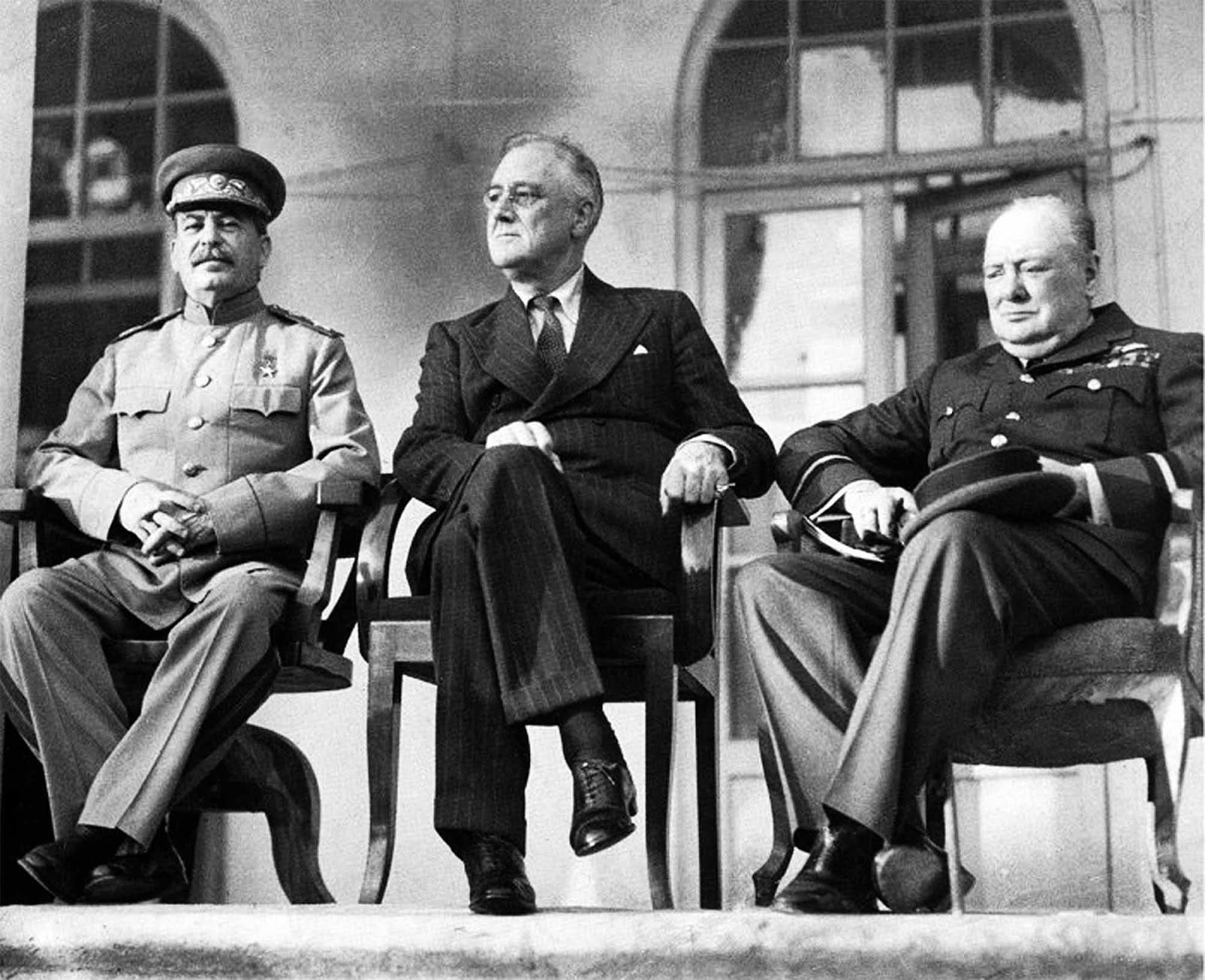
The Tehran Conference in 1943 provides insight into the relationships among Allied leaders. During discussions, Stalin proposed that 100,000 German officers should be executed after the war to permanently break Prussian military tradition.
Roosevelt’s response was to suggest that perhaps 49,000 would be sufficient. His son Elliott and other American officials present laughed at the exchange. Only Churchill recognized the obscenity of joking about mass murder and left the room in protest. Stalin then claimed he had been joking.
This was not dark humor among leaders facing difficult decisions. This was the American president participating in casual discussion of mass execution with a dictator who had already killed millions of his own citizens. The incident reveals attitudes that shaped subsequent policy.
After the war, German military personnel were transferred to Soviet custody in large numbers. They were worked to death in labor camps, producing casualties that ultimately exceeded Stalin’s Tehran suggestion. The policies that enabled this outcome were established during Roosevelt’s presidency and continued under his successor.
The Resulting Order
Assessment of Roosevelt’s presidency requires examination of outcomes rather than intentions. The results include:
The comprehensive transfer of Eastern Europe to Soviet control, with attendant atrocities including mass rape, murder, and deportation affecting millions.
The transformation of the Soviet Union from a backward nation into an industrial and military power, armed and equipped with American technology and materials.
The bankruptcy of the British Empire and the transfer of its strategic assets to American control, achieved through economic pressure on an ally fighting a common enemy.
The replacement of limited federal government with an expansive administrative state, staffed significantly by individuals whose loyalties were divided or compromised.
The creation of dependencies—institutional, economic, and psychological—that fundamentally altered the relationship between American citizens and their government.
For those who view these outcomes favorably, Roosevelt merits the reverence he receives. For those who recognize the human cost of Soviet power, who value the American constitutional order that preceded the New Deal, who understand what was lost when Eastern Europe fell under communist domination, the assessment must be different.
The Cold War that followed World War II was presented as genuine conflict between opposing systems. Yet the networks that facilitated Soviet penetration of the Roosevelt administration continued to influence American policy. The question is not whether the Cold War was real—it was. The question is whether the terms of that conflict were shaped by relationships established in the 1930s and 1940s.
The monuments remain standing. The textbooks maintain their narrative. But the documentary record exists for those willing to examine it. Soviet archives, Venona decryptions, defector testimony, and contemporary accounts provide evidence that contradicts the standard interpretation.
History ultimately judges leaders by consequences, not by the mythology constructed around them. By that standard, the Roosevelt record warrants fundamental reassessment.