


Recent findings reveal that the FBI’s claim that only 3.7 percent of active shooters are stopped by law-abiding gun owners is entirely false.
The FBI failed to properly record instances where law-abiding citizens stopped violent shooters, leading to false reports that “good guys with guns” have no effect on stopping violent criminals, according to the Crime Prevention Research Center.
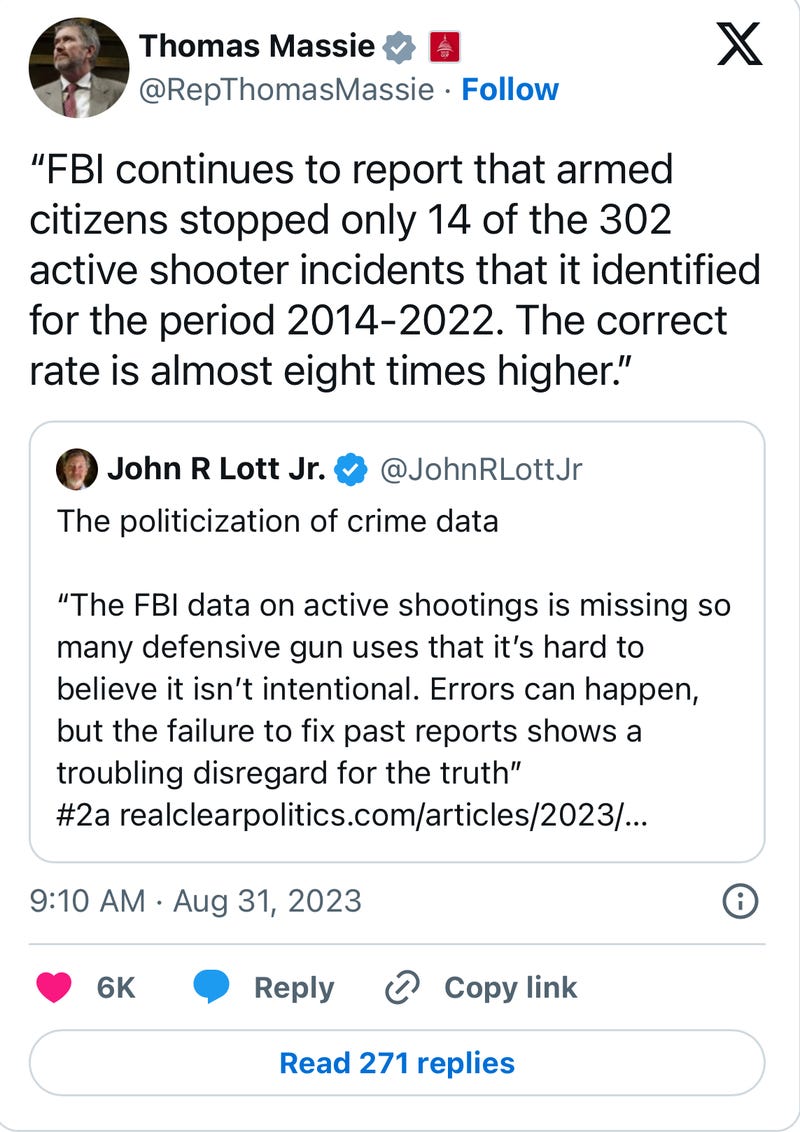
The FBI’s data, which claimed that only 14 of 374 active shooters were stopped by armed citizens between 2014 and 2024, under counted shootings by a staggering 561 incidents. When those excluded cases are applied to the dataset, it reveals more than 202 instances where law-abiding gun owners stopped an active shooter.
This updated dataset takes the FBI’s original statistic which claims only 3.7 percent of active shooters were stopped by armed citizens and raises the real number to 36 percent. If “gun-free zones,” a misguided policy that assumes criminals will obey a metal sign, are excluded from the data, over 52 percent of active shooters are stopped by law-abiding gun owners.
“Of course, law-abiding citizens stopping these attacks are not rare. What is rare is not citizens stopping these attacks—it’s the national news covering it,” said Crime Prevention Research Center President John Lott.
Institutional Data Manipulation: How the Numbers Get Buried
The disparity between recorded incidents and actual events exposes a systematic problem within federal data collection. The FBI’s methodology excludes entire categories of defensive gun use, creating artificial scarcity in the data. These omissions aren’t random errors—they follow patterns that consistently minimize civilian defensive actions.
The 561 missing incidents weren’t lost to clerical oversight. They were systematically excluded through narrow classification criteria that favor institutional narratives over ground truth. When citizens successfully defend themselves and others, the FBI’s reporting structure dilutes these events through reclassification, geographic exclusions, and timing technicalities.
Consider the mechanics of how these exclusions operate: If an armed citizen confronts a shooter who then flees without firing additional rounds, the FBI doesn’t count it as a defensive gun use. If the incident occurs in a jurisdiction with complex reporting protocols, it may never reach federal databases. If the citizen holds any form of security license—even volunteer church security—the event gets reclassified as professional intervention rather than civilian defense.
These methodological choices aren’t neutral. They construct a reality where armed citizens appear ineffective while institutional responses appear essential. The data becomes a tool of narrative control rather than empirical measurement.
Cooking the Books or Just Plain Old Incompetence?
The large disparity between the Crime Prevention Research Center’s data and the FBI’s statistics raises major concerns, as accurate information is essential for shaping policy and providing a true picture of gun ownership in America.
After all, gun control remains a central issue in many political races, and the policies implemented directly affect the Second Amendment rights of everyday Americans.
“The cascading effect is incredibly deleterious,” said former U.S. Justice Department official Theo Wold. “When the Bureau gets it so systematically wrong, it shapes the entire national debate.”
So why is there such a large disparity?
Alongside the 561 omitted incidents and the inclusion of “gun free” zones, the report found the FBI mislabeled numerous events, and in many cases, simply listed civilians as “security guards.”
For example, the FBI had classified the 2019 church shooting in White Settlement, Texas where a parishioner shot and killed the gunman as an incident where the shooter was apprehended by a security guard.
The Crime Prevention Research Center further noted that the FBI excluded some cases it labels “domestic disputes” or “retaliation murders” from its data about civilians stopping active shooters. The group also found that armed bystanders who thwarted attacks were not counted if the suspect fled the scene.
The Reclassification Game: Turning Heroes Into Guards
The White Settlement case reveals the FBI’s reclassification strategy in stark detail. Jack Wilson, the church parishioner who ended the attack, was a volunteer security team member. No paycheck. No federal training. No institutional authority. Yet the FBI recorded his actions as professional security intervention rather than civilian defense.
This pattern repeats across hundreds of cases. Citizens with concealed carry permits who happen to work part-time security get reclassified. Off-duty police officers acting as private citizens become official responders. Retired military personnel defending their communities become professional interventions.
Each reclassification removes another data point from civilian defensive statistics. The cumulative effect transforms a landscape where armed citizens regularly defend themselves into a statistical desert where only professionals matter.
The exclusion criteria extend beyond security classifications. Geographic boundaries matter: shootings stopped in parking lots don’t count if they’re not technically “on premises.” Time limits matter: if the attack lasts too long before civilian intervention, it gets reclassified as a prolonged incident rather than immediate defense. Weapon types matter: citizens using non-firearm defensive tools get excluded from gun defense statistics entirely.
These technical exclusions create a maze of criteria that virtually guarantees undercounting civilian defense while preserving every instance of institutional response.
Shaping the Narrative with Bad Data
A simple Google search about active shooters being stopped by law-abiding gun owners brings up numerous studies claiming to “debunk” the idea that honest citizens can play a role in protecting society—but the real data shows they are completely wrong.
These studies, funded by “progressive” donors and promoted by gun control groups, also ignore evidence showing that gun control has little to no effect on criminals. Instead, it creates an environment that restricts responsible citizens while giving violent criminals an easier playing field.
In recent years, the Left has weaponized fear about firearms to mobilize concerned voters. Regardless of the real data, it is imperative that they control the narrative while they push towards total disarmament—or as they tell everyone “gun violence” prevention.
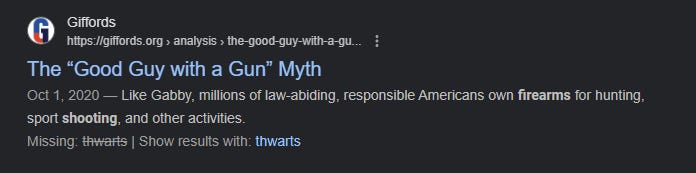
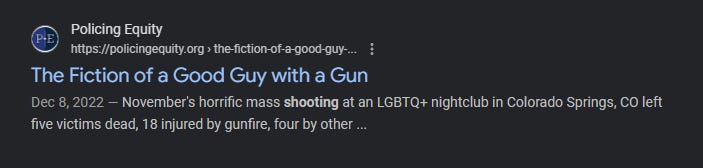
Alongside “progressive” studies, mainstream media outlets continue to label the “good guy” as an uncommon occurrence.
Headlines show this framing:
“Rare in US for an active shooter to be stopped by bystander” (Associated Press);
“Rampage in Indiana a rare instance of armed civilian ending mass shooting” (Washington Post);
and “After Indiana mall shooting, one hero but no lasting solution to gun violence” (New York Times).
The Academic-Media Echo Chamber: Manufacturing Consensus
The false narrative perpetuates through academic institutions that depend on federal funding and media outlets that treat FBI statistics as gospel. University researchers build entire studies on compromised datasets, then publish findings that reinforce institutional bias. These studies get cited by journalists who lack the expertise or incentive to examine underlying methodology.
Bloomberg-funded research centers produce reports claiming minimal civilian defensive effectiveness. These reports cite FBI data without acknowledging its systematic exclusions. The reports get covered by major news outlets as authoritative research. The coverage influences public opinion and policy discussions. The cycle completes itself through confirmation bias rather than empirical verification.
Anti-gun organizations amplify this manufactured consensus through coordinated messaging campaigns. Press releases timing with mass shooting events. Op-eds placed in major newspapers. Social media campaigns featuring selective statistics. Expert testimony before legislative committees. Each touchpoint reinforces the narrative while avoiding deeper methodological questions.
The result is a consensus built on compromised foundations—but consensus nonetheless. Once established, this false consensus becomes self-reinforcing. Challenging it requires not just better data but active resistance to institutional pressure and media gatekeeping.
Only You Can Prevent Active Shooters
Policies such as “gun-free zones” assign blame to the firearm itself rather than the individual responsible for pulling the trigger. These policies create defenseless environments, allowing large groups of citizens to gather without any means of protection—and voters know this.
According to a 2022 Trafalgar Group poll, 42 percent of voters said that armed citizens were the best defense against mass shootings, while only 25 percent said it was local police.
The Crime Prevention Research Center study confirms that such areas are prime targets for active shooters. Recall that excluding “gun-free zones” from the data raises successful defensive action by gun owners from 36 percent to 52 percent.
Other forms of gun control such as purchasing restrictions, background checks, and magazine capacity limits also place a heavier burden on law-abiding gun owners, as the FBI’s own data confirms that criminals do not obtain firearms legally. It’s also all unconstitutional.
A 2019 FBI study showed that only seven percent of crimes committed with a firearm involved legally purchased guns. Half of all offenders had stolen the firearm, while 43 percent had purchased it from underground or black-market vendors.
The results of gun control leave law-abiding citizens open to senseless violence, but they also turn our schools into major targets. Allowing teachers to carry firearms adds a layer of rapid protection that children deserve.
The FBI reports that most active threat events—including mass shootings—are over within five minutes. Yet it takes law enforcement between five and 10 minutes (at best) to respond to a shooting.
The situation is even more dire for rural schools that could be left stranded for over 20 minutes waiting for police response.
Honorable, well-trained, law-abiding teachers can effectively fill that gap and save countless lives—but it’s important that Americans know the true statistics if protective policies are going to be implemented.
Response Time Reality: The Fatal Gap Between Theory and Practice
The five-minute window reveals the fundamental flaw in institutional protection models. Most active shooter events conclude before professional responders arrive on scene. During those critical minutes, the only defense available comes from people already present—potential victims who become defenders.
Rural communities face particularly stark realities. Sheriff’s deputies covering hundreds of square miles cannot provide immediate response. State police operating from regional headquarters face even longer delays. For schools, businesses, and churches in remote areas, self-defense isn’t a philosophical choice—it’s a survival necessity.
The institutional response model assumes urban response times and suburban resource availability. These assumptions collapse in vast stretches of American territory where population density makes professional response impractical. Yet federal policies ignore geographic reality in favor of uniform restrictions that disarm citizens where they’re most vulnerable.
Even in urban areas with rapid response capabilities, the initial minutes belong to potential victims. Professional responders must assess the situation, establish perimeters, coordinate entry protocols, and locate the threat. These necessary procedures consume precious time while violence continues unchecked.
Armed citizens already on-scene bypass these delays entirely. Their response time approaches zero. Their familiarity with the environment provides tactical advantage. Their immediate presence offers the only realistic chance of limiting casualties during those crucial opening minutes.
Holding the FBI Accountable
The FBI should be a trusted source of information, but time and time again the data it presents to the public fails to reflect the reality of what is truly happening in the United States.
In 2024, Restoration News conducted a deep dive into crime across the country and found that the FBI had severely under reported the surging crime wave even making it appear as though crime was trending downward. States like California, Georgia, North Carolina, Wisconsin, Pennsylvania, and Virginia saw major increases in murder, violent assault, and human trafficking between 2019 and 2023—but the FBI said all was well.
As “gun violence” prevention and gun control rhetoric continue to dominate American politics, it is essential that the public knows the truth. Despite studies that claim to “debunk” defensive carry and numerous gun control groups that push for full disarmament, the evidence is clear.
The pattern extends beyond active shooter statistics into broader crime reporting failures. The FBI’s Uniform Crime Reporting system suffers from participation gaps, methodology changes, and classification inconsistencies that obscure national crime trends. When local agencies don’t participate or submit incomplete data, the FBI fills gaps through statistical modeling rather than acknowledging uncertainty.
This institutional failure compounds across multiple data categories. Violent crime statistics get adjusted downward through technical reclassifications. Property crime reporting varies wildly between jurisdictions using different threshold criteria. Drug enforcement statistics shift based on changing federal priorities rather than actual trafficking patterns.
The cumulative effect creates a statistical landscape that serves institutional interests rather than public understanding. Citizens making personal safety decisions, legislators crafting policy responses, and communities allocating resources all operate from compromised information. The FBI’s credibility failure reverberates through every level of American governance where accurate crime data matters.
Constitutional restoration requires institutional accountability. The American people deserve federal agencies that prioritize truth over narrative control, empirical accuracy over political convenience, and public service over bureaucratic self-interest. Until that accountability emerges, citizens must seek alternative sources and maintain healthy skepticism toward official statistics—especially when constitutional rights hang in the balance.