


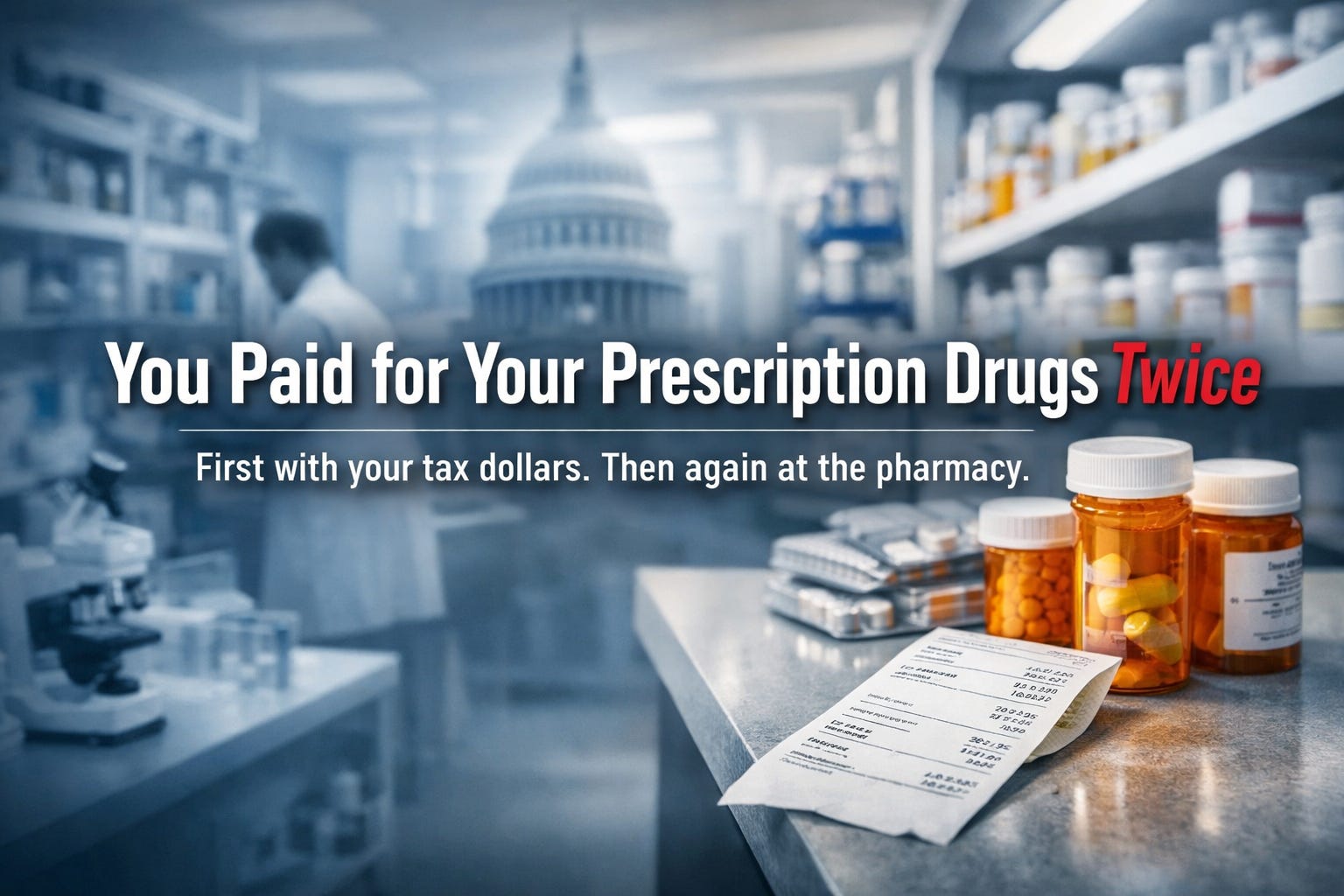
The relationship between public funding and pharmaceutical innovation represents one of the most significant yet underexamined aspects of American healthcare policy. Recent comprehensive analyses have established a clear empirical fact: every single new drug approved by the FDA between 2010 and 2019 received substantial support from taxpayer dollars, primarily through the National Institutes of Health (NIH). This finding fundamentally challenges conventional narratives about drug development and pricing in the United States.
The Financial Architecture of Drug Development
Multiple peer-reviewed studies have converged on remarkably consistent findings regarding public investment in pharmaceutical innovation. Research published in the Proceedings of the National Academy of Sciences (2018), JAMA Health Forum (2023), and analyses from Bentley University’s Center for Integration of Science and Industry demonstrate that NIH funding contributed to the development of 354 out of 356 drugs approved during the 2010-2019 period—approximately 99.4% of all new medications.
The scale of public investment proves substantial. NIH expenditures linked to these drug approvals totaled approximately $187 billion over the decade. This funding primarily supported basic research costing between $1.4 and $1.7 billion, depending on accounting methodologies employed.
These figures become particularly significant when compared to industry investments. After normalizing for capital costs and risk adjustments, government spending often matched or exceeded private sector contributions per drug approval. This parity in investment levels raises fundamental questions about drug pricing policies, particularly given that Americans consistently pay the highest pharmaceutical prices globally.
Understanding the Division of Labor
The pharmaceutical development ecosystem operates through a distinct division of responsibilities between public and private sectors. NIH and other public agencies primarily fund foundational, long-horizon research—the identification of biological targets, disease mechanisms, and molecular pathways. This work, while essential for drug development, typically spans decades and offers little immediate commercial potential.
Private pharmaceutical companies generally enter the process during later stages, focusing on clinical development phases including expensive randomized trials, regulatory navigation, and eventual marketing. This “handover” model creates what economists term a moral hazard: public institutions bear early-stage risks while private companies capture late-stage profits.
Bentley University’s 2023 analysis quantified this asymmetry, calculating that NIH funding provides pharmaceutical companies an effective $3 billion cost advantage per approved drug through risk reduction and target validation. These savings, however, are not returned to the public through reduced prices or profit-sharing mechanisms. Instead, they translate directly into enhanced shareholder returns and corporate profits.
The Regulatory Framework and Its Consequences
The current system’s structure stems largely from the Bayh-Dole Act of 1980, legislation that permits universities and other institutions to patent discoveries resulting from federally funded research. While originally intended to accelerate the translation of academic discoveries into practical applications, this framework has evolved into a mechanism for privatizing publicly funded knowledge.
University technology transfer offices now function as intermediaries, negotiating licensing agreements with pharmaceutical companies. These offices typically measure success by revenue generation rather than public benefit metrics. The incentive structure favors exclusive licenses to the highest bidder rather than open-access arrangements that might accelerate broader innovation.
Once private companies acquire these patents, they can market the resulting drugs back to the healthcare system—and the taxpayers who funded the original research—at monopoly prices. The NIH receives no proportional royalty stream despite its foundational investment. This arrangement allows pharmaceutical companies to cite “R&D costs” as justification for high prices, even when the majority of intellectual groundwork was publicly funded.
Economic and Policy Implications
The documented reality of public funding for pharmaceutical innovation carries several significant implications for healthcare policy. First, it effectively undermines the standard industry justification for high drug prices—that such prices are necessary to fund future innovation. If taxpayers already fund the foundational research, this argument loses its logical foundation.
Second, the absence of structured mechanisms for public return on investment represents a significant policy failure. Despite substantial taxpayer financing, no comprehensive royalty or equity model exists to return profits to the NIH or U.S. Treasury. This one-directional flow of value—from public investment to private profit—constitutes what economists might term “institutional parasitism.”
Third, current lobbying efforts often target NIH funding as “wasteful government spending,” despite evidence that public research institutions produce the fundamental knowledge sustaining the entire biopharmaceutical industry. The Congressional Budget Office estimated industry R&D spending at $83 billion in 2019, representing a ten fold increase from early 1980s levels. However, NIH spent $83 billion in 2019, representing a ten fold increase from early 1980s levels. However, NIH spent $40-50 billion annually during the same period, almost entirely on precompetitive research that industry depends upon but would not fund independently.
The Role of Charitable Organizations
Charitable organizations and academic centers add another layer to this complex funding ecosystem. Entities such as the Wellcome Trust and the Alzheimer’s Drug Discovery Foundation frequently support translational research—projects that show scientific promise but lack immediate commercial appeal. This “middle ground” funding often targets orphan diseases and neglected conditions that large pharmaceutical companies systematically avoid.
Importantly, charitable contributions to medical research are typically tax-deductible, representing another form of public subsidy. The result is a system where government agencies and public charities bear both moral and financial risks, while pharmaceutical companies profit from innovations they neither initiated nor substantially funded during crucial early stages.
Transparency and Accountability Challenges
The current system actively obscures the origins of pharmaceutical innovation through various mechanisms. NIH-funded research manifests primarily as scientific papers rather than commercial products, making the connection between public investment and private profit difficult to trace. Pharmaceutical companies acquire or license findings after targets are validated, then present the resulting products as fruits of their own “innovation,” though their actual contribution often amounts to development and commercialization rather than discovery.
This opacity appears deliberate. Pharmaceutical companies have strong incentives to downplay the public origins of their products, as acknowledgment would undermine pricing justifications and invite political scrutiny. Academic institutions contribute to this concealment through confidential licensing agreements and the absence of requirements to track how publicly funded discoveries are eventually commercialized.
Constitutional Considerations
The current pharmaceutical development model raises fundamental questions about constitutional principles. The Constitution grants Congress power to promote scientific progress by securing exclusive rights to inventors, but this power was intended to serve public interests rather than create permanent extraction mechanisms for entities that did not actually invent the underlying technologies.
When the patent system is used to monopolize publicly funded knowledge, it arguably violates the constitutional grant’s original intent. The Founders envisioned temporary monopolies as incentives for invention, not as tools for privatizing public research to justify perpetual extraction from taxpayers who funded the original work.
Pathways to Reform
Addressing these systemic issues would require comprehensive policy reforms. Potential measures include implementing open-access requirements for all patents derived from publicly funded research, establishing profit-sharing mechanisms that provide returns to NIH proportional to its investment levels, and requiring transparent disclosure of funding sources in all FDA drug approvals.
Additional reforms might include prohibiting the practice of “evergreening”—making trivial modifications to extend patent protection—for any compound with substantial public research origins. Price controls tied to public investment levels could ensure that drugs developed primarily with taxpayer funds remain accessible to the public that funded them.
Conclusion
The empirical evidence conclusively demonstrates that American taxpayers function as the primary venture capitalists of modern medicine. Through NIH and related agencies, public funds support virtually every significant pharmaceutical discovery, while the corporate sector capitalizes on these investments during later development stages.
This system of socialized risk and privatized reward represents a fundamental distortion of market principles. It creates a dynamic where the American public funds pharmaceutical innovation twice—first through taxes supporting basic research, then through high drug prices when accessing medications their taxes helped create.
The studies documenting this reality are peer-reviewed and publicly available. The financial data is clear and consistent across multiple analyses. What remains absent is political will to acknowledge these facts plainly and implement reforms that ensure public investment in pharmaceutical research generates appropriate public returns.
Until such reforms occur, the United States will continue operating a system where taxpayers bear the risks of pharmaceutical innovation while private companies capture the rewards—a arrangement that serves neither public health interests nor basic principles of economic fairness. The current model does not represent a functioning market system but rather a sophisticated mechanism for transferring public resources into private profits, supported by regulatory frameworks that prioritize commercial interests over public benefit.