


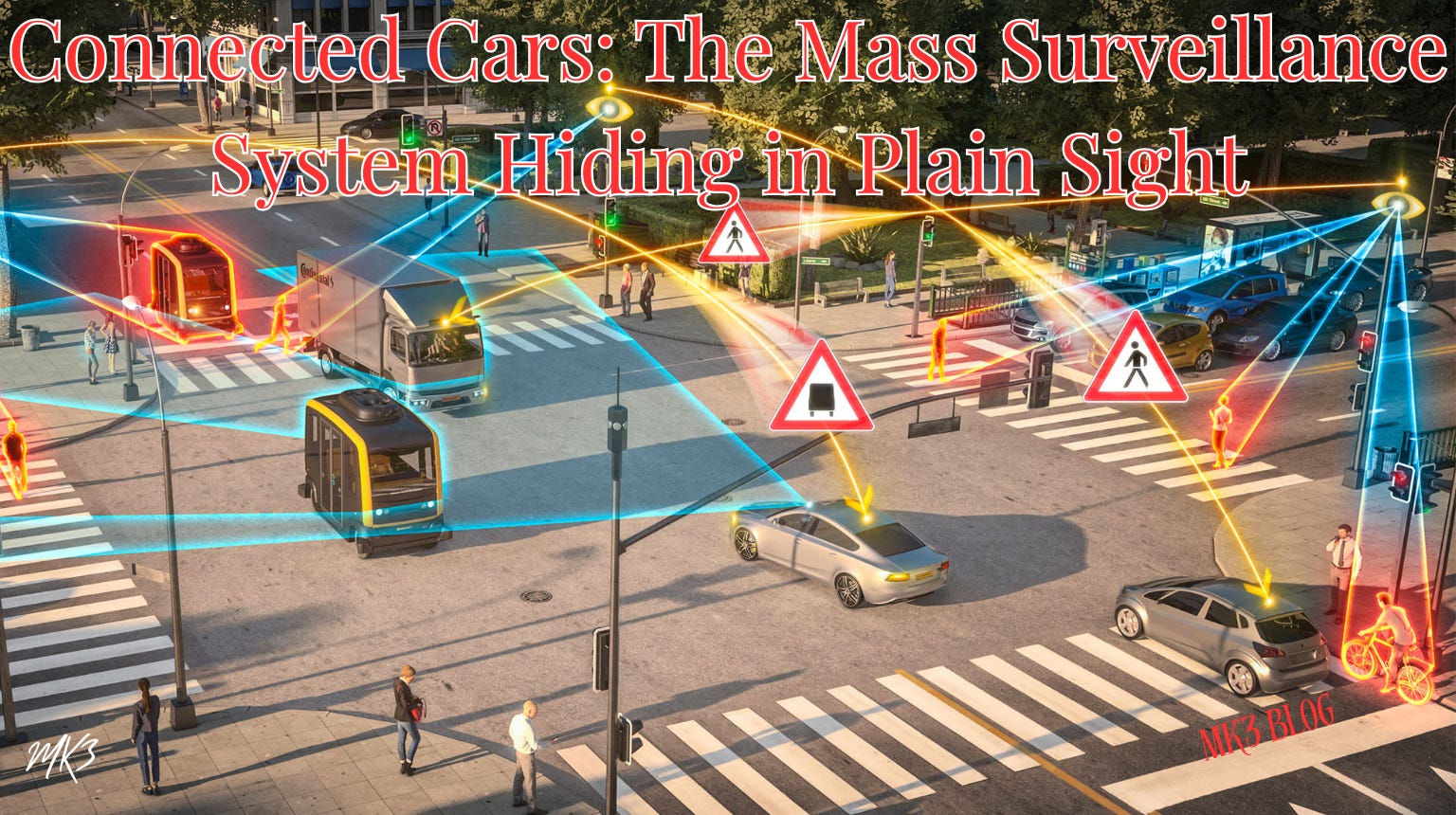
The automotive industry calls it “smart mobility.” Marketing departments push phrases like “seamless connectivity” and “enhanced driving experience.” What they don’t advertise is the reality: connected vehicles represent one of the most comprehensive data-extraction systems ever deployed at scale. Every modern car rolling off the assembly line functions as a mobile surveillance platform, collecting intimate details about drivers and passengers while transmitting that information to corporate databases, data brokers, and third-party buyers.
This isn’t speculation. It’s documented fact, confirmed by federal regulators, independent researchers, and the automakers’ own legal filings.
The Architecture of Automotive Surveillance
Every connected vehicle manufactured today comes equipped with an array of sensors that would have seemed like science fiction two decades ago. GPS receivers track location continuously. Embedded modems maintain constant cellular connections to manufacturer cloud systems. Accelerometers measure every start, stop, and turn. Cameras monitor cabin occupants. Microphones listen. Bluetooth systems interface with paired devices. The vehicle itself becomes a data collection node operating around the clock.
According to S&P Global Mobility, the average connected car generates more than 100 data points per minute. Translated into raw information, that amounts to 20-25 gigabytes per hour of driving. This data flows whether the driver has explicitly opted in or not. Manufacturers embed collection mechanisms within “performance telemetry” systems and companion applications, making data extraction a default condition of vehicle operation.
The stated purpose is safety and service improvement. The actual application extends far beyond those boundaries into behavioral analytics, insurance risk scoring, and commercial profiling operations.
The Depth of Data Collection
Multiple investigations have documented the scope of information modern vehicles extract from their occupants. The Mozilla Foundation, Federal Trade Commission, and independent security researchers have mapped collection practices that exceed what most consumers imagine possible.
Geolocation data forms the foundation. Connected vehicles track every destination, every route, every stop. They record travel speeds, arrival times, and duration of stays. The system knows where you live, where you work, where you worship, who you visit, and how often.
Biometric information adds another layer. Vehicles equipped with driver monitoring systems capture facial scans and analyze expressions. Voice recognition systems create voiceprints. Seat pressure sensors can identify individual occupants by weight distribution patterns.
Personal identifiers flow through vehicle systems when drivers pair their smartphones. Contact lists, call logs, text message content, and application data synchronize to the car’s infotainment system—and from there to manufacturer servers. The vehicle becomes a conduit for extracting information from devices owners believed were private.
Behavioral data captures driving style in granular detail. Acceleration patterns, braking habits, cornering speed, following distance—every dynamic input creates a profile. Some manufacturers have deployed systems that claim to detect driver “emotion” through cabin cameras, adding psychological assessment to the data stream.
Algorithmic inferences transform raw data into classifications. Predictive models categorize drivers by risk profile, personality type, and estimated income level. The information collected becomes the raw material for conclusions the driver never consented to.
Mozilla’s 2023 privacy review examined 25 major automotive brands. Every single one failed basic privacy standards. The organization rated connected vehicles as the worst product category for privacy ever recorded. Several manufacturers’ terms of service claimed rights to collect information about users’ “sex life” and “genetic information.”
The Data Economy: Vehicles as Revenue Generators
The automotive industry has embraced a fundamental shift in business model. As S&P Global noted in industry analysis, manufacturers now view data as “the new oil.” The vehicle sale represents only the initial transaction. The continuous data stream represents ongoing revenue.
The flow operates through distinct tiers. Automobile manufacturers—Tesla, General Motors, Toyota, Ford, and others—collect telematics directly from vehicles through embedded connectivity. This raw data feeds into manufacturer systems for initial processing.
Data aggregators and brokers form the second tier. Companies like LexisNexis and Verisk purchase or receive vehicle data through partnership agreements. They process this information into products useful for insurance companies, financial institutions, and marketing operations.
The third tier encompasses end buyers: advertisers seeking behavioral profiles, analytics firms building predictive models, and law enforcement agencies accessing location and movement records.
In 2024, multiple lawsuits revealed that General Motors had transmitted individual driving behaviors—including speeding incidents, hard braking events, and acceleration patterns—directly to insurance companies through LexisNexis. Drivers discovered their insurance premiums had increased without explanation. The cause was data they never knew was being collected, shared through channels they never authorized, used to make financial decisions that directly harmed them.
This represents the embryonic form of a digital credit scoring system applied to mobility itself.
The Transformation of American Freedom
The automobile occupied a unique position in American culture. It represented personal freedom, the ability to go anywhere without permission or supervision. The open road symbolized possibility. The car provided a private space, an extension of the home, where conversations happened and thoughts remained unmonitored.
Connected vehicles have inverted this relationship. The car is no longer a tool of freedom but a mobile sensor array reporting continuously to corporate databases. The transformation happened through a specific mechanism: freedom repackaged as convenience.
Manufacturers told consumers that cloud-connected diagnostics would protect them. Navigation systems would guide them. Safety features would watch over them. The language of protection obscured the reality of surveillance. Every data stream feeding “safety improvements” simultaneously builds behavioral dossiers on the humans inside the vehicle.
Academic analysis of this phenomenon draws uncomfortable historical parallels. Research published in ScienceDirect noted that “the enclosed nature of the car’s cabin is reminiscent of Foucault’s panopticon”—the theoretical prison where inmates modify behavior because they might always be watched.
The critical element is that drivers cannot easily opt out. Automobiles have become required infrastructure for participation in modern economic life. They are not optional tools but necessities for employment, family obligations, and basic commerce. The “consent” extracted through terms of service is fundamentally coerced. As CBT News documented, disconnecting from data collection often disables navigation, safety features, or even core vehicle functions.
Legal Frameworks and Regulatory Response
Several regulatory bodies have begun addressing automotive surveillance, though enforcement consistently lags behind technological deployment.
The Federal Trade Commission warned automakers in 2024 that misuse of geolocation and biometric data violates consumer protection laws. The agency’s January 2025 action against General Motors specifically cited failure to obtain proper consent and material harm to drivers through data sales affecting insurance eligibility. GM agreed to a five-year prohibition on sharing driving data with consumer reporting agencies—a penalty that amounts to a temporary pause rather than structural reform.
European regulators have applied the General Data Protection Regulation to connected vehicles, with upcoming frameworks including the Data Act and AI Act imposing requirements for data minimization. These rules mandate that companies collect only information necessary for stated purposes and provide clear disclosure of data practices.
China’s Personal Information Protection Law requires data localization, keeping information generated within Chinese borders on domestic servers. The irony is apparent: Chinese-manufactured smart vehicles may simply redirect surveillance from Western corporations to Beijing rather than eliminating it.
New frameworks taking effect in 2025 and 2026 address national security dimensions. The U.S. “Connected Vehicle Rule” and EU “Cyber Resilience Act” target vulnerabilities created by foreign-made sensors and AI modules, recognizing that automotive data collection creates intelligence exposure at scale.
These regulatory efforts sound comprehensive. The fundamental limitation is that data regulation operates reactively rather than preventatively. Once information is collected, it enters circulation. Legal frameworks establish penalties for misuse but cannot recall data already harvested.
Security Vulnerabilities: Every Connection Creates Risk
The same connectivity enabling surveillance creates attack surfaces for malicious actors. Every data pathway into a vehicle is also a potential pathway for intrusion.
The 2015 Jeep Cherokee remote hijack demonstrated that hackers could take control of vehicle systems—including steering and brakes—through cellular connections. Security researchers accessed the vehicle’s network remotely and demonstrated the ability to crash a moving car.
Tesla experienced a 2023 data breach exposing more than 100 gigabytes of sensitive information, including customer personal data and internal company communications. Mercedes-Benz suffered a 2022 breach affecting 1.6 million records through third-party vendor exposure.
Cybercriminals now target vehicle networks with the same intensity they applied to social media platforms a decade ago. The ecosystem has grown valuable enough to attract sophisticated attacks. The convergence of personal privacy vulnerability and potential physical safety compromise creates a threat category that blurs traditional boundaries between cybercrime and physical security.
Practical Countermeasures for Individual Drivers
While systematic privacy protection remains nearly impossible within current connected vehicle architecture, drivers can implement limited defensive measures.
Disabling unnecessary data sharing requires navigating deep into infotainment settings. Manufacturers do not make these options prominent, but persistence can reduce some collection.
Avoiding direct device linking prevents the most invasive data synchronization. Not connecting personal phones or email accounts to vehicle infotainment systems stops that particular extraction channel.
Creating burner accounts for cloud-linked manufacturer applications provides some separation between vehicle data and primary personal identity.
Manually clearing vehicle data before selling or servicing prevents transfer of personal information to subsequent owners or service personnel. The FTC provides specific guidance on this process.
Demanding transparency through formal requests under GDPR, CCPA, or state-level consumer protection laws can force automakers to disclose what data they hold and how they use it.
Selecting vehicles with minimal connectivity—older models or brands allowing operation without constant online connection—reduces exposure at the cost of some modern features.
These individual actions provide marginal protection. The real solution isn’t personal—it’s structural. Society requires legally enforceable ownership of personal data and mandatory separation between critical vehicle systems and data collection networks.
The Question of Legal Right and Corporate Entitlement
The fundamental question remains: what gave automobile manufacturers the impression they could sell data generated by vehicles their customers purchased?
The mechanism operates through contractual manipulation, regulatory capture, and systematic information asymmetry. Terms buried in End User License Agreements for infotainment systems, mobile companion apps, and onboarding prompts extract “consent” through documents written to be incomprehensible and presented on a take-it-or-leave-it basis.
Manufacturers frame these as service agreements. They are written so opaquely that consumers surrender telemetry rights without understanding what they’ve conceded. The agreements are non-negotiable—accepting is required to access core vehicle features including navigation, emergency services, and connectivity functions.
The automaker then claims: “You consented to data collection and use in accordance with our Privacy Policy.”
This consent was neither informed nor freely given. It was extracted under functional coercion—emergency features stop working if you opt out, navigation systems require acceptance, the vehicle degrades into partial functionality without agreement.
Three mental models underpin corporate data claims. The “software-as-a-service” logic treats the car as a platform rather than a product, asserting manufacturer ownership of the experience data stream. The “right to diagnose” excuse uses safety and performance monitoring as pretext for full data extraction, though less than ten percent of collected information relates to diagnostics. Regulatory silence in the United States—the absence of automotive-specific privacy law equivalent to GDPR—creates conditions where everything becomes permitted until specifically prohibited.
The burden of education belongs with manufacturers. They designed these systems. They wrote the terms. They benefit from the data extraction. The deliberate obscurity of their practices represents strategic choice, not oversight.
The Trajectory Without Intervention
Unchecked, current trends lead toward algorithmic governance of mobility itself. A “driving credit score” becomes possible—a system where insurers and regulators use data-derived assessments to determine who can drive and at what cost. Manufacturer-controlled access enables remote revocation of features or disabling of functions. The subscription model extends from entertainment to transportation infrastructure.
The FTC settlement with General Motors represents minor friction against massive industry momentum toward normalized vehicle surveillance.
The path forward requires ownership reform. Vehicle data must be legally classified as property of the vehicle owner, not the manufacturer. Anything less constitutes expropriation with legal cover.
-MK3, MK3Blog
The twentieth century’s great automotive innovations delivered mobility and personal freedom. The twenty-first century risks converting that freedom into digital servitude packaged as convenience. A “smart car” that monitors everything isn’t intelligent—it’s a surveillance platform on wheels, and the people inside are the product being sold.