


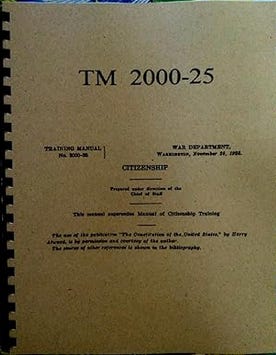
In 1928, the War Department published a document that would never survive today’s political climate.
Not because it was secret.
Not because it was radical.
But because it told the truth—plainly, unapologetically, and without concern for feelings.
Training Manual No. 2000-25: Citizenship was issued to young American men preparing for military service. Its purpose was not merely to teach drill or discipline, but to answer a far more dangerous question:
What kind of citizen must exist for the Republic to survive?
That question has been carefully avoided for decades. We talk endlessly about rights, obsess over identity, and inflate entitlements, while quietly abandoning the concept that made all of them possible in the first place:
Citizenship as responsibility.
This manual did not treat citizenship as a vibe, a label, or a lifestyle accessory. It treated it as a burden voluntarily assumed, a moral obligation, and a condition precedent to liberty itself.
And that is precisely why it matters now.
The Forgotten Premise: Liberty Is Not Self-Sustaining
One of the most dangerous modern myths is the idea that freedom is automatic—that once achieved, it simply continues.
The authors of this manual knew better.
They wrote explicitly that national defense does not begin with weapons, but with citizenship training—because a nation defended by arms but hollowed out by ignorance collapses from within.
Liberty, they argued, depends on:
An educated population
Moral character
Individual initiative
Respect for law
Loyalty to constitutional principles
Remove any one of these, and the structure weakens. Remove several, and the structure falls.
Today, we invest billions in hardware and almost nothing in civic formation. We have outsourced citizenship education to slogans, social media, and grievance narratives.
The result?
A population that knows how to protest but not how to govern.
Individual Initiative: The Engine the Modern World Is Actively Destroying
The manual places extraordinary emphasis on individual initiative, tracing it back through Anglo-Saxon self-government, the English common law tradition, and ultimately to the American colonial experience.
This is critical, because individual initiative is not merely economic—it is political.
A citizen who cannot govern himself will inevitably demand to be governed by others.
The American experiment succeeded because:
People worked before they demanded
They governed locally before appealing nationally
They solved problems personally before outsourcing them to authority
Modern collectivist ideology—regardless of which flag it flies—reverses this equation. It teaches dependency first, grievance second, entitlement third, and responsibility never.
The manual warns explicitly against this mindset, framing individualism vs. collectivism as the defining political struggle of the future.
They were not wrong.
They were prophetic.
Citizenship Has a Social Cost—and a Social Standard
One of the most controversial sections today would be the manual’s treatment of assimilation.
It does not apologize for the claim that self-government requires a shared civic understanding. It does not pretend that cultural fragmentation is harmless. And it does not confuse tolerance with surrender.
The authors openly acknowledge that mass immigration from societies without traditions of self-rule presents a real risk to republican government unless deliberate citizenship education occurs.
This is not racism.
It is political realism.
Self-government is not intuitive. It is learned. And if it is not taught, it is replaced—by hierarchy, factionalism, or authoritarian control.
The manual’s solution was not exclusion, but education, assimilation, and loyalty to constitutional principles above all other allegiances.
Which brings us to a phrase modern America refuses to say out loud.
“No Divided Allegiance” Was Not a Suggestion
The manual states plainly:
There can be no divided allegiance here.
That statement would be called “extreme” today. In 1928, it was considered obvious.
Citizenship, by definition, requires exclusive political loyalty. Not cultural erasure. Not personal conformity. Political allegiance.
You cannot serve two sovereigns.
You cannot obey two constitutions.
You cannot claim protection from a government you refuse to defend.
The manual ties suffrage, office-holding, and full participation directly to oaths, loyalty, and demonstrated attachment to constitutional principles.
Voting was not treated as a personal expression. It was treated as a duty owed.
Ask yourself honestly:
Do we still believe that?
Economic Citizenship: Work, Thrift, and Reality
Another section modern readers will find uncomfortable is the manual’s treatment of economics.
It rejects the fantasy that prosperity is automatic or guaranteed. It emphasizes:
Thrift
Skill
Education
Capital formation
Cooperation between labor and management
The manual explicitly warns against class conflict, material envy, and economic ignorance—arguing that they destroy both productivity and social trust.
This is not “corporate propaganda.” It is economic literacy.
A nation of specialists cannot survive if every group believes it is being exploited and none believe they are responsible for sustaining the system.
The manual understood something we have forgotten:
Economic warfare inside a republic is still warfare.
Character: The Asset That Cannot Be Printed, Stimulated, or Legislated
The single most important claim in the manual is also the simplest:
Character is the greatest asset of America.
Not GDP.
Not military spending.
Not technological dominance.
Character.
The authors dismantle the idea that institutions, wealth, or infrastructure sustain a nation. Those are products. Character is the source.
They trace American character to:
Religious discipline
Family structure
Local self-government
Education
Moral restraint
They openly state that there is no collective morality—only the summed moral quality of individuals.
This directly contradicts modern political thinking, which assumes systems can replace virtue.
They cannot.
A corrupt population produces corrupt systems every time.
Self-Government Was Earned—Not Declared
One of the most humbling sections describes experimental self-government.
The Founders did not wake up enlightened. They failed repeatedly. They governed locally. They learned painfully. They corrected mistakes. They argued. They compromised. They studied history.
Self-government took 150 years of preparation before independence was even attempted.
Contrast that with today’s demand for instant outcomes, zero tradeoffs, and permanent revolution.
The manual makes clear:
Freedom without preparation produces chaos.
Chaos produces tyranny.
Patriotism Is Not Emotional—It Is Behavioral
The manual’s definition of patriotism has nothing to do with aesthetics, slogans, or symbolism alone.
Patriotism is expressed through:
Obeying the law
Paying taxes
Voting responsibly
Serving when required
Placing country above self
“I am an American,” the manual concludes, is not a boast—it is a challenge.
A challenge to live up to something larger than comfort.
Why This Manual Terrifies the Modern System
This document is dangerous—not because it promotes authoritarianism, but because it exposes dependency.
It assumes citizens are capable of discipline.
It assumes liberty has conditions.
It assumes ignorance is not a right.
It assumes loyalty matters.
Most of all, it assumes the Republic can fail.
And it will—if citizenship continues to be treated as an entitlement rather than a responsibility.
Final Thought: The Republic Is Not Lost—But It Is Untrained
The men who wrote this manual had lived through:
World War I
Mass industrialization
Rapid immigration
Political extremism abroad
They understood fragility.
They understood that no constitution enforces itself.
And they left us a warning we chose to ignore.
The question is no longer whether the principles still apply.
The question is whether there are enough citizens left who are willing to carry them.