


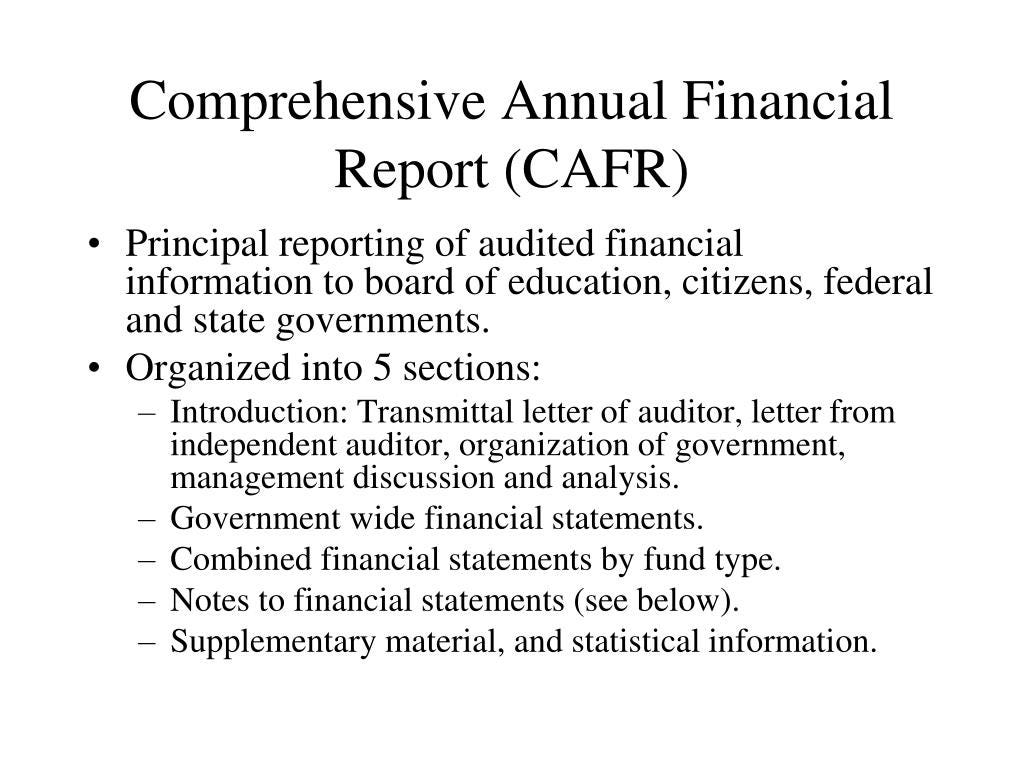
Introduction to CAFR reporting
A CAFR stands for Comprehensive Annual Financial Report. This is what states, counties, cities and other governmental entities issue each year. It allows you to determine how a government took in and spent money as well as handled debt throughout the previous year. These reports follow guidelines laid out by the GASB (Governmental Accounting Standards Board). Which tell the governmental entities what financial statements to report and how they can be compared from year to year.
Purpose of CAFR
As stated before the CAFR will give you a snapshot of a governments financial condition. Just like a company would release their annual report so shareholders and banks can evaluate its condition. A government would release a CAFR so you the bond holder and regulators can evaluate its condition. Much like a grade card. You can tell if it had more income then expenses. If their reserves increased or decreased and how much long term debt they accrued.
Local and state governments will release a CAFR once they have completed their audit. This will ensure their financial statements are in accordance with the GASB and back up the numbers. You should read these reports yourself as well. While you know that the audit is saying the financial statements are fairly represented based on certain rules. You don't know if those decisions were smart or not. That is what you and your elected officials are for.
Many cities and counties issue bonds to help them grow and develop new roads and facilities. Bond holders want to know that a city can pay back their loans. You want to know this as well even if you don't purchase a bond. Bond payments will play into your cost for those projects. If bond holders can't get this information they will probably charge higher interest. Which will cause you to pay more in the future.
CAFR exists to provide transparency to the public. When you elect an official to represent you and handle your money they should be able to show you what they did with it. You can look at all the different funds in your area. General Fund, Special Revenue Funds and Debt Service to name a few. You can even see what transfers occurred and if they used one time funds to pay for recurring expenses.
Standardization of CAFR
The Scale of the Problem
As mentioned before there are over 90,000 governments in our country. According to analysts our country's local and state government spend around 11% of our GDP. As of Q1 2018 there was $3.8 Trillion in municipal securities. Having these amounts of money being spent and borrowed you want the reports to be similar so we can compare. Which can save money when we borrow for these projects.
There are many states and local governments that will publish their audited CAFR every year. Most of which publish their CAFR in PDF format. While this is nice to have it doesn't allow the numbers to be easily accessed. If you want to pull debt figures from your local county for the past 10 years you will have to go through each year. Enter those figures into a spreadsheet and hope you got it right. Multiply that by the 50 counties you want to pull numbers from. You can imagine how error prone this process becomes.
This process won't be automated any time soon either. You can write a program to find keywords in a PDF but not easily tag information. Say you want to pull a number for Total Long Term Debt from each of those 50 counties. And compare it to a rule you made up. That would take an extensive amount of time to pull and enter by hand. So analysts and government will continue to lose time.
What is XBRL?
There is a standardized way to pull numbers from corporate reports in the U.S. It's called XBRL. Which stands for eXtensible Business Reporting Language. It allows you to tag each number and describe what that number is. By doing this you can use software to compare and contrast those numbers to one another.
A Taxonomy is used when you create these XBRL documents. It will define each of these tags and what they relate to. When creating an XBRL report for a company they will input all these numbers and their description. Then a program can look at those numbers and make sure they fit within that Taxonomy. Which can help eliminate errors that would go unnoticed if it was a PDF.
Let me give you an example. If you have a PDF and it says 4,200,000. Next to the words Net Position. You will have to figure out what Net Position is to that company. If you had an XBRL document that would state what Net Position is already and you could use your time to see if it changed from the previous year.
Companies that sell stock are required to file their financial statements using XBRL. This has been going on for about 10 years as we look at this article in 2018. Since companies that sell stock are publicly traded on a exchange they have to follow these rules by the SEC. We don't have these rules in place for our states and local governments.
Early Attempts at Standardization
While the SEC was deciding to require XBRL for publicly traded companies. There were discussions about implementing this for our government as well. The Association of Government Accountants created an article in 2008 about XBRL and Public Sector Financial Reporting. They went into depth on how they could convert the State of Oregons CAFR to an XBRL instance document.
The Municipal Securities Rule Making Board also wanted to implement XBRL into their EMMA system. This is where you can find most of your municipal bonds and disclosure information. Having this data in a standardized way would help you as the investor.
The GASB has created an Electronic Financial Reporting project. They have been trying to see what improvements can be made to electronically deliver information. Since they create the accounting rules they aren't a regulatory body. They can't require all local and state governments to file in this way.
Why Standardization Has Been Elusive
It seems like it will be a while before this can happen. We had the recession last decade which caused many local and state budgets to suffer. So implementing a new way to report would seem unnecessary to many.
There is no one that can require all local and state governments to publish in one format. The SEC can require companies that are publicly traded to report using XBRL. But since municipal, state and federal securities are excluded from the Securities Act of 1933. They aren't required to report through the SEC. Which is why we have the MSRB and continuing disclosure in place for our municipal bonds.
There are some countries that have started to report their financial statements this way. If all of our states and local governments started to report in this manner we would be one of the only countries to do so.
Florida Leads the Way
On March 23 2018 Florida became the first state to require its local governments to file their financial statements using XBRL. Governor Rick Scott signed the bill into law and will have the states CFO create an XBRL Taxonomy. While this doesn't solve all of our problems. It will allow us to see what tags can be used for local governments.
Will County in Illinois was the first local government to publish financial information in a standardized format. Using the CAFR demonstration Taxonomy. This allowed Will County to create an XBRL document.
The XBRL US State and Local Government Disclosure Modernization Working Group created this Taxonomy. IRIS is a member of this working group. By having a demonstration Taxonomy we can continue to find improvements that can be made to the final Taxonomy.
Impediments to standardization of CAFR
One of the reasons government reporting is difficult to tag is because there is no stock being sold. Our municipal bonds are bought and sold but not as frequently as companies that are publicly traded. Which causes the market to not want to implement this. But that shouldn't deter you from wanting better reporting.
Another reason governments will delay this is because of lack of personnel. Many local governments have part time employees that know the ropes. But may not have taken many classes on governmental accounting. Having them learn a new process can seem daunting. Which will cause them to put it off and spend more time doing it the old way.
Yes there are costs associated with creating XBRL documents. But many of these programs can pull information from a financial statement and tag it for you. IRIS CARBON is one program that has helped our clients create XBRL documents. Once your local or state government figures out what tags to use they can use a program like CARBON. Which will help scale the effort they put into this.
Can Standardization help local governments?
Having all of these governments file in the same manner will allow you to hold them accountable. You can see what information they have reported and what information they may have left out. Your officials can explain what happened in words but you can back it up with numbers. Which will create trust in the government you live in.
Since many municipalities use bonds to finance projects you will want to know if they can pay them back. You will look at credit ratings and disclosure information when deciding to purchase a bond. If you have more information about their financial position you can help decrease the interest rate they will pay. Which can allow your local or state government to spend that money on other things.
Of course there are other factors that can increase a bond rate. But if you have less unknown information about that municipality you will have lower interest rates. Which can help your local government save money on big projects.
Not only will this allow you to get information quicker but it will also help your government. They can spend less time inputting numbers into spreadsheets and analyzing their data. Other counties that have similar Taxonomies can help each other out. Allowing them to share costs on consultants and software.
My two cents
Any governments entity’s foremost responsibility is their duty towards its citizens. Publishing of government financial information in a standardized, machine-readable format, would not only help bring accolades and operational transparency but also enhance citizens confidence in their elected representatives. Municipal bonds are a large source of funds for roads, parks, schools, and other infrastructure developments. Muni-bonds are also a large investment market, where investors seek the credit rating of the issuer before buying. It would help reduce government expenditure in large bond-funded projects, such as road and park construction if the investors easily understood the fiscal health of the local governments through the readily available structured data. Making the financial information of local governments available to investors can help lower the risk and thus, the cost of bond-funded projects.
Margin of the Law publishes constitutional analysis, civic research, and legal education for people who want to understand the system they actually live in. Read the Full Constitutional Analysis Library at marginofthelaw.com.
© 2026 – MK3 Law Group
For republication or citation, please credit this article with link attribution to marginofthelaw.com.